







Question: Please answer 17.8 & 17.11 L01 LO 2 L01 LO 1 L01 General Motors had $32 billion, and Toyota had about $42 billion. Why woulu
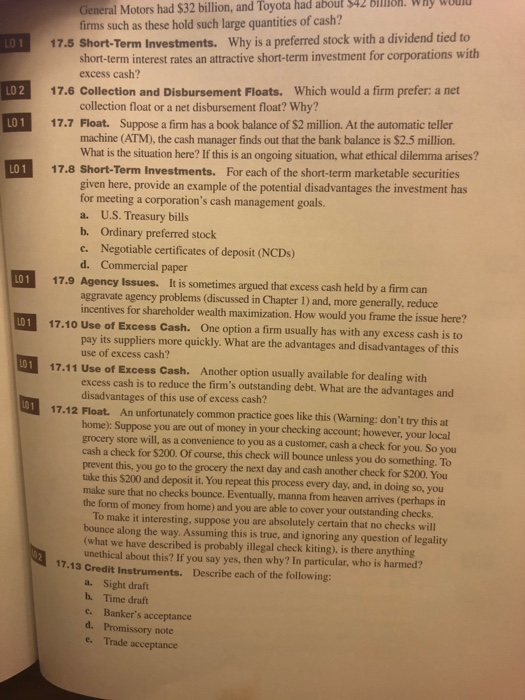
L01 LO 2 L01 LO 1 L01 General Motors had $32 billion, and Toyota had about $42 billion. Why woulu firms such as these hold such large quantities of cash? 17.5 Short-Term Investments. Why is a preferred stock with a dividend tied to short-term interest rates an attractive short-term investment for corporations with excess cash? 17.6 Collection and Disbursement Floats. Which would a firm prefer: a net collection float or a net disbursement float? Why? 17.7 Float. Suppose a firm has a book balance of $2 million. At the automatic teller machine (ATM), the cash manager finds out that the bank balance is $2.5 million. What is the situation here? If this is an ongoing situation, what ethical dilemma arises? 17.8 Short-Term Investments. For each of the short-term marketable securities given here, provide an example of the potential disadvantages the investment has for meeting a corporation's cash management goals. a. U.S. Treasury bills b. Ordinary preferred stock c. Negotiable certificates of deposit (NCDs) d. Commercial paper 17.9 Agency issues. It is sometimes argued that excess cash held by a firm can aggravate agency problems (discussed in Chapter 1) and, more generally, reduce incentives for shareholder wealth maximization. How would you frame the issue here? 17.10 Use of Excess Cash. One option a firm usually has with any excess cash is to pay its suppliers more quickly. What are the advantages and disadvantages of this use of excess cash? 17.11 Use of Excess Cash. Another option usually available for dealing with excess cash is to reduce the firm's outstanding debt. What are the advantages and disadvantages of this use of excess cash? 17.12 Float. An unfortunately common practice goes like this (Warning: don't try this at home): Suppose you are out of money in your checking account; however, your local grocery store will, as a convenience to you as a customer, cash a check for you. So you cash a check for $200. Of course, this check will bounce unless you do somethine. To prevent this, you go to the grocery the next day and cash another check for $200. You take this $200 and deposit it. You repeat this process every day, and, in doing so, you make sure that no checks bounce. Eventually, manna from heaven arrives (perhaps in the form of money from home) and you are able to cover your outstanding checks. To make it interesting, suppose you are absolutely certain that no checks will bounce along the way. Assuming this is true, and ignoring any question of legality (what we have described is probably illegal check kiting), is there anything unethical about this? If you say yes, then why? In particular, who is harmed? 13 Credit Instruments. Describe each of the following: a. Sight draft b. Time draft c. Banker's acceptance d. Promissory note e. Trade acceptance
Step by Step Solution
There are 3 Steps involved in it

Get step-by-step solutions from verified subject matter experts
 Study Help