







Question: Please answer 5-41 a thru l PREHENSIVE/SPREADSHEET PROBLEM 41 TIME VALUE OF MONEY Answer the following questions b. What is the investment's FV at rates
Please answer 5-41 a thru l
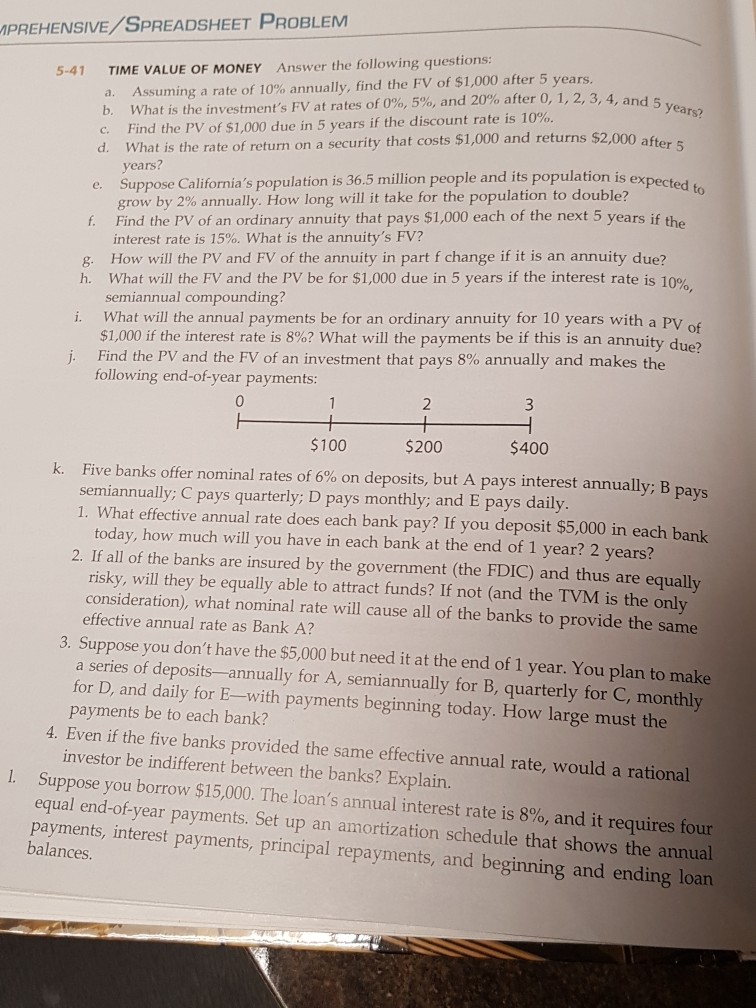
PREHENSIVE/SPREADSHEET PROBLEM 41 TIME VALUE OF MONEY Answer the following questions b. What is the investment's FV at rates of 0%, 5%, and 20% after 0, 1, 2, 3, 4 c. Find the PV of $1,000 due in 5 years if the discount rate is 10% d. What is the rate of return on a security that costs $1,000 and returns $2,000a Assuming a rate of 10% annually, find the FV of $1,000 after 5 years and 5 years? after 5 rs e. Suppose California's population is 36.5 million people and its population is expected grow by 2% annually. How long will it take for the population to double? f. Find the PV of an ordinary annuity that pays $1,000 each of the next 5 years if the interest rate is 15%. What is the annuity's FV? g. How will the PV and FV of the annuity in part f change if it is an annuity due? h. What will the FV and the PV be for $1,000 due in 5 years if the interest rate is 10 semiannual compounding What will the annual payments be for an ordinary annuity for 10 years with a Py of $1,000 if the interest rate is 8%? What will the payments be if this is an annuity d Find the PV and the FV of an investment that pays 8% annually and makes the following end-of-year payments i. ue? J. 0 2 3 $100 $200 $400 Five banks offer nominal rates of 6% on deposits, but A pays interest annually; B pays semiannually; C pays quarterly; D pays monthly; and E pays daily 1. What effective annual rate does each bank pay? If you deposit $5,000 in each bank k. today, how much will you have in each bank at the end of 1 year? 2 years? 2. If all of the banks are insured by the government (the FDIC) and thus are equally risky, will they be equally able to attract funds? If not (and the TVM is the only consideration), what nominal rate will cause all of the banks to provide the same effective annual rate as Bank A? 3. Suppose you don't have the $5,000 but need it at the end of 1 year. You plan to make a series of deposits annually for A, semiannually for B, quarterly for C, monthly for D, and daily for E-with payments beginning today. How large must the payments be to each bank? 4. Even if the five banks provided the same effective annual rate, would a rational vestor be indifferent between the banks? Explain I. Suppose you borrow $15,000. The loan's annual interest rate is 8%, and it requires four equal end-of-year payments. Set up an amortization schedule that shows the annual payments, interest payments, principal repayments, and beginning and ending loar balances
Step by Step Solution
There are 3 Steps involved in it

Get step-by-step solutions from verified subject matter experts
 Study Help