







Question: Please answer 9.11, 9.12, 9.13 and 9.14 case application Working together anywhere, anytime that they need. It also makes project work easier because project teams
Please answer 9.11, 9.12, 9.13 and 9.14
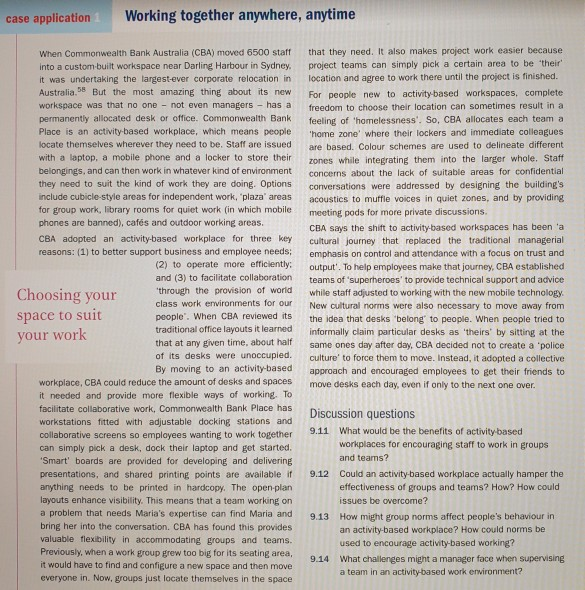
case application Working together anywhere, anytime that they need. It also makes project work easier because project teams can simply pick a certain area to be their location and agree to work there until the project is finished. For people new to activity based workspaces, complete freedom to choose their location can sometimes result in a feeling of 'homelessness'. So, CBA allocates each team a 'home zone' where their lockers and immediate colleagues are based. Colour schemes are used to delineate different zones while integrating them into the larger whole. Staff concerns about the lack of suitable areas for confidential conversations were addressed by designing the building's acoustics to muffie voices in quiet zones, and by providing meeting pods for more private discussions CBA says the shift to activity based workspaces has been 'a cultural journey that replaced the traditional managerial emphasis on control and attendance with a focus on trust and output'. To help employees make that journey, CBA established teams of "superheroes' to provide technical support and advice while staff adjusted to working with the new mobile technology New cultural norms were also necessary to move away from the idea that desks belong to people. When people tried to informally claim particular desks as 'theirs' by sitting at the same ones day after day. CBA decided not to create a police culture' to force them to move. Instead, it adopted a collective approach and encouraged employees to get their friends to move desks each day, even if only to the next one over. Choosing your When Commonwealth Bank Australia (CBA) moved 6500 staff into a custom built workspace near Darling Harbour in Sydney it was undertaking the largest-ever corporate relocation in Australia.58 But the most amazing thing about its new workspace was that no one - not even managers - has a permanently allocated desk or office. Commonwealth Bank Place is an activity based workplace, which means people locate themselves wherever they need to be. Staff are issued with a laptop, a mobile phone and a locker to store their belongings, and can then work in whatever kind of environment they need to suit the kind of work they are doing. Options include cubicle-style areas for independent work, 'plaza' areas for group work, library rooms for quiet work (in which mobile phones are banned), cafs and outdoor working areas. CBA adopted an activity-based workplace for three key reasons: (1) to better support business and employee needs: (2) to operate more efficiently and (3) to facilitate collaboration through the provision of world class work environments for our people'. When CBA reviewed its traditional office layouts it learned that at any given time, about half of its desks were unoccupied. By moving to an activity based workplace, CBA could reduce the amount of desks and spaces it needed and provide more flexible ways of working. To facilitate collaborative work, Commonwealth Bank Place has workstations fitted with adjustable docking stations and collaborative screens so employees wanting to work together can simply pick a desk, dock their laptop and get started. 'Smart' boards are provided for developing and delivering presentations, and shared printing points are available if anything needs to be printed in hardcopy. The open-plan layouts enhance visibility. This means that a team working on a problem that needs Maria's expertise can find Maria and bring her into the conversation. CBA has found this provides valuable flexibility in accommodating groups and teams. Previously, when a work group grew too big for its seating area, it would have to find and configure a new space and then move everyone in. Now, groups just locate themselves in the space space to suit your work Discussion questions 9.11 What would be the benefits of activity based workplaces for encouraging staff to work in groups and teams? 9.12 Could an activity-based workplace actually hamper the effectiveness of groups and teams? How? How could issues be overcome? 9.13 How might group norms affect people's behaviour in an activity based workplace? How could norms be used to encourage activity based working? 9.14 What challenges might a manager face when supervising a team in an activity based work environment
Step by Step Solution
There are 3 Steps involved in it
1 Expert Approved Answer
Step: 1 Unlock

Question Has Been Solved by an Expert!
Get step-by-step solutions from verified subject matter experts
Step: 2 Unlock
Step: 3 Unlock
 Study Help