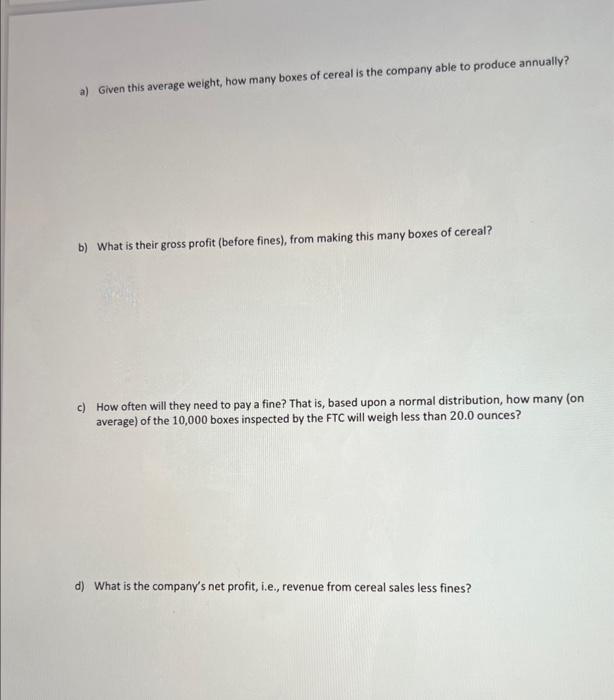
please answer a, b, c and d
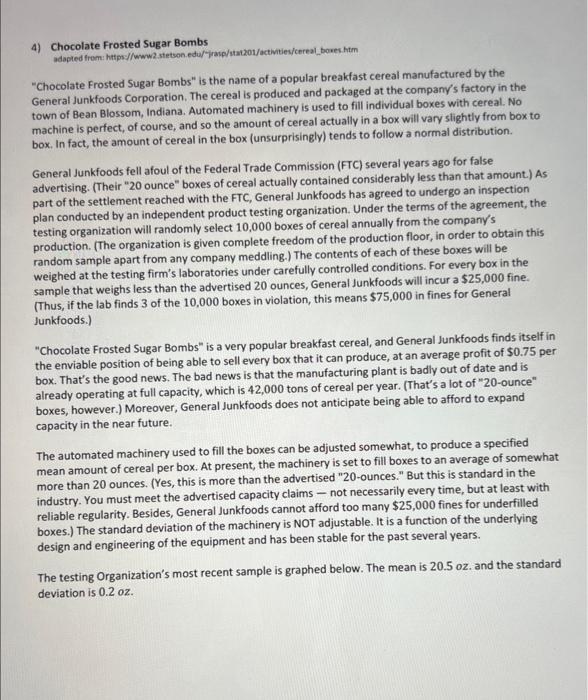
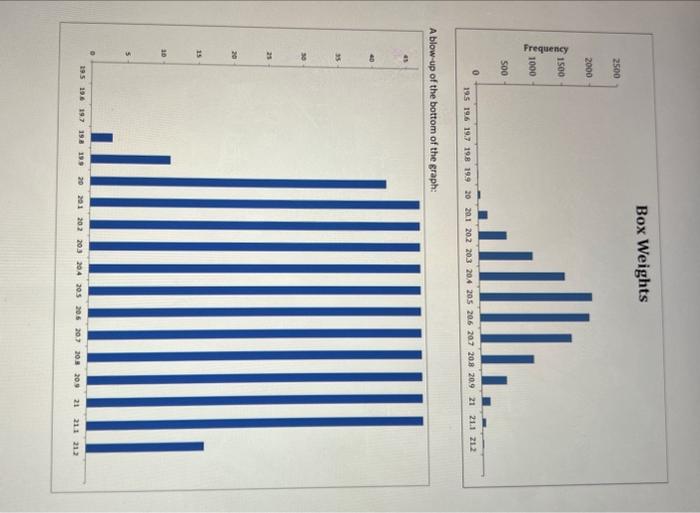
4) Chocolate Frosted Sugar Bombs "Chocolate Frosted Sugar Bombs" is the name of a popular breakfast cereal manufactured by the General Junkfoods Corporation. The cereal is produced and packaged at the company's factory in the town of Bean Blossom, Indiana. Automated machinery is used to fill individual boxes with cereal. No machine is perfect, of course, and so the amount of cereal actually in a box will vary slightly from box to box. In fact, the amount of cereal in the box (unsurprisingly) tends to follow a normal distribution. General Junkfoods fell afoul of the Federal Trade Commission (FTC) several years ago for false advertising. (Their "20 ounce" boxes of cereal actually contained considerably less than that amount.) As part of the settlement reached with the FTC, General Junkfoods has agreed to undergo an inspection plan conducted by an independent product testing organization. Under the terms of the agreement, the testing organization will randomly select 10,000 boxes of cereal annually from the company's production. (The organization is given complete freedom of the production floor, in order to obtain this random sample apart from any company meddling.) The contents of each of these boxes will be weighed at the testing firm's laboratories under carefully controlled conditions. For every box in the sample that weighs less than the advertised 20 ounces, General Junkfoods will incur a $25,000 fine. (Thus, if the lab finds 3 of the 10,000 boxes in violation, this means $75,000 in fines for General Junkfoods.) "Chocolate Frosted Sugar Bombs" is a very popular breakfast cereal, and General Junkfoods finds itself in the enviable position of being able to sell every box that it can produce, at an average profit of $0.75 per box. That's the good news. The bad news is that the manufacturing plant is badly out of date and is already operating at full capacity, which is 42,000 tons of cereal per year. (That's a lot of "20-ounce" boxes, however.) Moreover, General Junkfoods does not anticipate being able to afford to expand capacity in the near future. The automated machinery used to fill the boxes can be adjusted somewhat, to produce a specified mean amount of cereal per box. At present, the machinery is set to fill boxes to an average of somewhat more than 20 ounces. (Yes, this is more than the advertised "20-ounces." But this is standard in the industry. You must meet the advertised capacity claims - not necessarily every time, but at least with reliable regularity. Besides, General Junkfoods cannot afford too many $25,000 fines for underfilled boxes.) The standard deviation of the machinery is NOT adjustable. It is a function of the underlying design and engineering of the equipment and has been stable for the past several years. The testing Organization's most recent sample is graphed below. The mean is 20.5 oz. and the standard deviation is 0.2oz. A blow-up of the bottom of the graph: a) Given this average weight, how many boxes of cereal is the company able to produce annually? b) What is their gross profit (before fines), from making this many boxes of cereal? c) How often will they need to pay a fine? That is, based upon a normal distribution, how many (on average) of the 10,000 boxes inspected by the FTC will weigh less than 20.0 ounces? d) What is the company's net profit, i.e., revenue from cereal sales less fines