







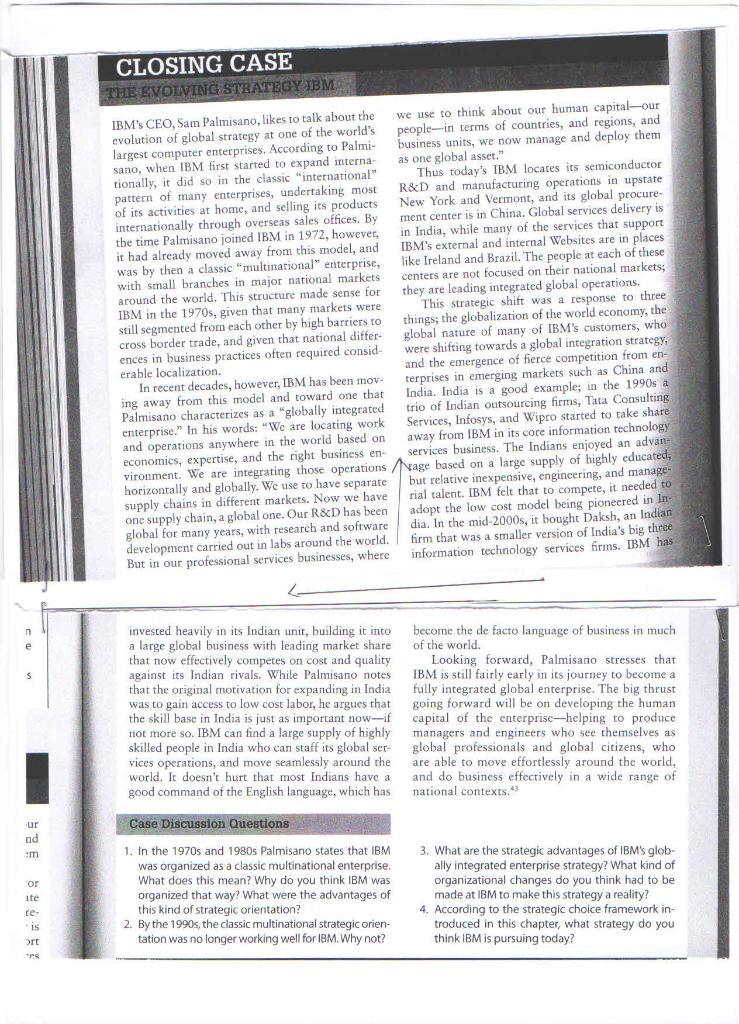
Question: please answer above quesetions by typing ,thx CLOSING CASE THE EVOLVING STRATEGY IBM IBM's CEO, Sam Palmisano, likes to talk about the we use to
please answer above quesetions by typing ,thx
CLOSING CASE THE EVOLVING STRATEGY IBM IBM's CEO, Sam Palmisano, likes to talk about the we use to think about our human capital-our evolution of global strategy at one of the world's people-in terms of countries, and regions, and largest computer enterprises. According to Palmi- business units, we now manage and deploy them sano, when IBM first started to expand interna as one global asset." tionally, it did so in the classic "international Thus today's IBM locares its semiconductor pattern of many enterprises, undertaking most R&D and manufacturing operations in upstate of its activities at home, and selling its products New York and Vermont, and its global procure- internationally through overseas sales offices. By ment center is in China. Global services delivery is the time Palmisano joined IBM in 1972, however, in India, while many of the services that support it had already moved away from this model, and IBM's external and internal Websites are in places was by then a classic "multinational" enterprise, like Ireland and Brazil. The people at each of these with small branches in major national markets centers are not focused on their national markets; around the world. This structure made sense for they are leading integrated global operations, IBM in the 1970s, given that many markets were This strategic shift was a response to three still segmented from each other by high barriers to things; the globalization of the world economy, the cross border trade, and given that national differ- global nature of many of IBM's customers, who ences in business practices often required consid- were shifting towards a global integration strategy, erable localization. and the emergence of fierce competition from en- In recent decades, however, IBM has been mov- terprises in emerging markets such as China and ing away from this model and toward one that India India is a good example; in the 1990s a Palmisano characterizes as a "globally integrated trio of Indian outsourcing firms, Tata Consulting enterprise." In his words: "We are locating work Services, Infosys, and Wipro started to take share and operations anywhere in the world based on away from IBM in its core information technology nomics, expertise, and the right business en- services business. The Indians enjoyed an advan- vironment. We are integrating those operations age based on a large supply of highly educated, horizontally and globally. We use to have separate but relative inexpensive, engineering, and manage supply chains in different markets. Now we have rial talent. IBM felt that to compete, it needed to one supply chain, a global one. Our R&D has been adopt the low cost model being pioneered in In- global for many years, with research and software dia. In the mid-2000s, it bought Daksh, an Indian development carried out in labs around the world. firm that was a smaller version of India's big three But in our professional services businesses, where information technology services firms. IBM has n s invested heavily in its Indian unit, building it into a large global business with leading market share that tow effectively competes on cost and quality against its Indian rivals. While Palmisano notes that the original motivation for expanding in India was to gain access to low cost labor, he argues that the skill base in India is just as important now-if not more so. IBM can find a large supply of highly skilled people in India who can staff its global ser- vices operations, and move seamlessly around the world. It doesn't hurt that most Indians have a good command of the English language, which has become the de facto language of business in much of the world. Looking forward, Palmisano stresses that IBM is still fairly early in its journey to become a fully integrated global enterprise. The big thrust going forward will be on developing the human capital of the enterprise-helping to produce managers and engineers who see themselves as global professionals and global citizens, who are able to move effortlessly around the world, and do business effectively in a wide range of national contexts. Case Discussion Questions ur nd m tor ite re- is Ort PS 1. In the 1970s and 1980s Palmisano states that IBM was organized as a classic multinational enterprise. What does this mean? Why do you think IBM was organized that way? What were the advantages of this kind of strategic orientation? 2. By the 1990s, the classic multinational strategic orien- tation was no longer working well for IBM. Why not? 3. What are the strategic advantages of IBM's glob- ally integrated enterprise strategy? What kind of organizational changes do you think had to be made at IBM to make this strategy a reality? 4. According to the strategic choice framework in- troduced in this chapter, what strategy do you think IBM is pursuing todayStep by Step Solution
There are 3 Steps involved in it
1 Expert Approved Answer
Step: 1 Unlock

Question Has Been Solved by an Expert!
Get step-by-step solutions from verified subject matter experts
Step: 2 Unlock
Step: 3 Unlock
 Study Help