Question: Please answer a-i MandelaAgeGuesses version age_guesses A 98 A 89 A 90 A 90 A 74 A 36 A 36 A 75 A 86 A
Please answer a-i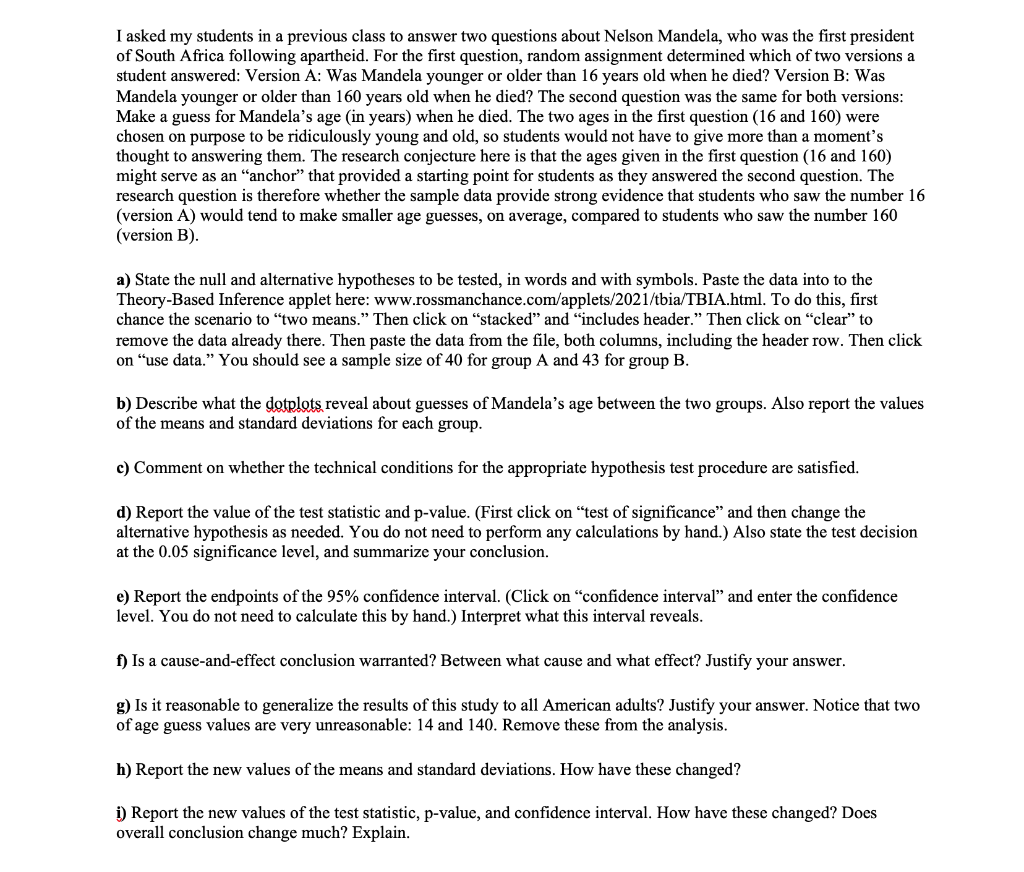
"MandelaAgeGuesses"
| version | age_guesses |
| A | 98 |
| A | 89 |
| A | 90 |
| A | 90 |
| A | 74 |
| A | 36 |
| A | 36 |
| A | 75 |
| A | 86 |
| A | 78 |
| A | 30 |
| A | 95 |
| A | 78 |
| A | 81 |
| A | 90 |
| A | 92 |
| A | 76 |
| A | 54 |
| A | 14 |
| A | 86 |
| A | 94 |
| A | 36 |
| A | 48 |
| A | 63 |
| A | 87 |
| A | 41 |
| A | 95 |
| A | 90 |
| A | 75 |
| A | 76 |
| A | 49 |
| A | 32 |
| A | 44 |
| A | 65 |
| A | 87 |
| A | 70 |
| A | 32 |
| A | 85 |
| A | 60 |
| A | 75 |
| B | 89 |
| B | 102 |
| B | 80 |
| B | 140 |
| B | 65 |
| B | 89 |
| B | 100 |
| B | 94 |
| B | 80 |
| B | 88 |
| B | 104 |
| B | 76 |
| B | 66 |
| B | 93 |
| B | 95 |
| B | 91 |
| B | 70 |
| B | 101 |
| B | 84 |
| B | 63 |
| B | 68 |
| B | 78 |
| B | 87 |
| B | 98 |
| B | 52 |
| B | 109 |
| B | 100 |
| B | 95 |
| B | 67 |
| B | 90 |
| B | 98 |
| B | 103 |
| B | 81 |
| B | 82 |
| B | 65 |
| B | 87 |
| B | 93 |
| B | 86 |
| B | 84 |
| B | 94 |
| B | 79 |
| B | 84 |
| B | 85 |
I asked my students in a previous class to answer two questions about Nelson Mandela, who was the first president of South Africa following apartheid. For the first question, random assignment determined which of two versions a student answered: Version A: Was Mandela younger or older than 16 years old when he died? Version B: Was Mandela younger or older than 160 years old when he died? The second question was the same for both versions: Make a guess for Mandela's age (in years) when he died. The two ages in the first question (16 and 160) were chosen on purpose to be ridiculously young and old, so students would not have to give more than a moment's thought to answering them. The research conjecture here is that the ages given in the first question (16 and 160) might serve as an anchor that provided a starting point for students as they answered the second question. The research question is therefore whether the sample data provide strong evidence that students who saw the number 16 (version A) would tend to make smaller age guesses, on average, compared to students who saw the number 160 (version B). a) State the null and alternative hypotheses to be tested, in words and with symbols. Paste the data into to the Theory-Based Inference applet here: www.rossmanchance.com/applets/2021/tbia/TBIA.html. To do this, first chance the scenario to "two means." Then click on "stacked" and "includes header." Then click on "clear" to remove the data already there. Then paste the data from the file, both columns, including the header row. Then click on use data." You should see a sample size of 40 for group A and 43 for group B. b) Describe what the dotplots reveal about guesses of Mandela's age between the two groups. Also report the values of the means and standard deviations for each group. c) Comment on whether the technical conditions for the appropriate hypothesis test procedure are satisfied. d) Report the value of the test statistic and p-value. (First click on "test of significance" and then change the alternative hypothesis as needed. You do not need to perform any calculations by hand.) Also state the test decision at the 0.05 significance level, and summarize your conclusion. e) Report the endpoints of the 95% confidence interval. (Click on "confidence interval" and enter the confidence level. You do not need to calculate this by hand.) Interpret what this interval reveals. f) Is a cause-and-effect conclusion warranted? Between what cause and what effect? Justify your answer. g) Is it reasonable to generalize the results of this study to all American adults? Justify your answer. Notice that two of age guess values are very unreasonable: 14 and 140. Remove these from the analysis. h) Report the new values of the means and standard deviations. How have these changed? i) Report the new values of the test statistic, p-value, and confidence interval. How have these changed? Does overall conclusion change much? Explain. I asked my students in a previous class to answer two questions about Nelson Mandela, who was the first president of South Africa following apartheid. For the first question, random assignment determined which of two versions a student answered: Version A: Was Mandela younger or older than 16 years old when he died? Version B: Was Mandela younger or older than 160 years old when he died? The second question was the same for both versions: Make a guess for Mandela's age (in years) when he died. The two ages in the first question (16 and 160) were chosen on purpose to be ridiculously young and old, so students would not have to give more than a moment's thought to answering them. The research conjecture here is that the ages given in the first question (16 and 160) might serve as an anchor that provided a starting point for students as they answered the second question. The research question is therefore whether the sample data provide strong evidence that students who saw the number 16 (version A) would tend to make smaller age guesses, on average, compared to students who saw the number 160 (version B). a) State the null and alternative hypotheses to be tested, in words and with symbols. Paste the data into to the Theory-Based Inference applet here: www.rossmanchance.com/applets/2021/tbia/TBIA.html. To do this, first chance the scenario to "two means." Then click on "stacked" and "includes header." Then click on "clear" to remove the data already there. Then paste the data from the file, both columns, including the header row. Then click on use data." You should see a sample size of 40 for group A and 43 for group B. b) Describe what the dotplots reveal about guesses of Mandela's age between the two groups. Also report the values of the means and standard deviations for each group. c) Comment on whether the technical conditions for the appropriate hypothesis test procedure are satisfied. d) Report the value of the test statistic and p-value. (First click on "test of significance" and then change the alternative hypothesis as needed. You do not need to perform any calculations by hand.) Also state the test decision at the 0.05 significance level, and summarize your conclusion. e) Report the endpoints of the 95% confidence interval. (Click on "confidence interval" and enter the confidence level. You do not need to calculate this by hand.) Interpret what this interval reveals. f) Is a cause-and-effect conclusion warranted? Between what cause and what effect? Justify your answer. g) Is it reasonable to generalize the results of this study to all American adults? Justify your answer. Notice that two of age guess values are very unreasonable: 14 and 140. Remove these from the analysis. h) Report the new values of the means and standard deviations. How have these changed? i) Report the new values of the test statistic, p-value, and confidence interval. How have these changed? Does overall conclusion change much? Explain









 Study Help