







Question: Please answer all 4 and I WILL THUMBS UP! A balanced scorecard that includes both strategic and financial performance targets requires managers to set an
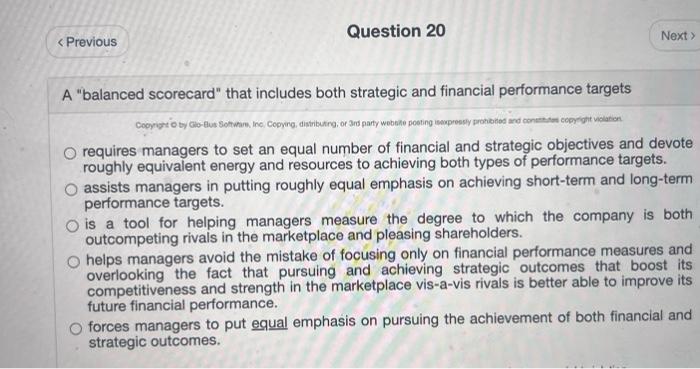
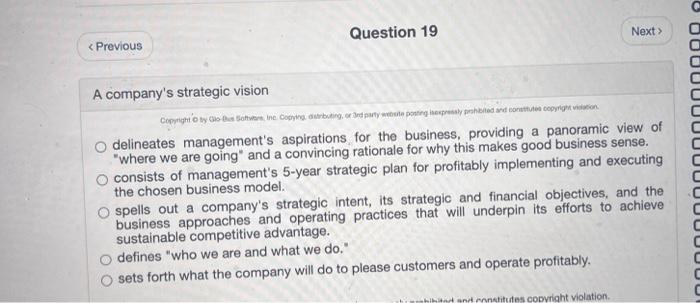
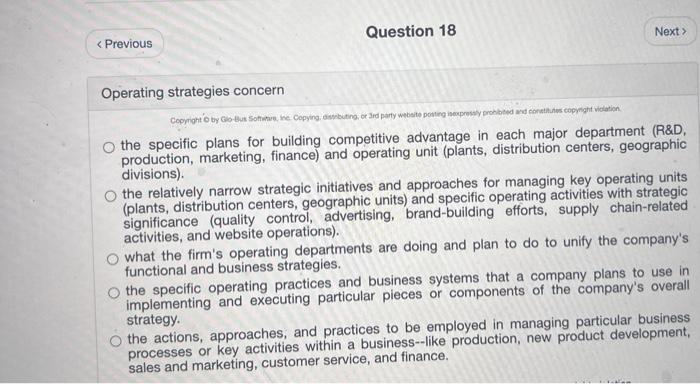
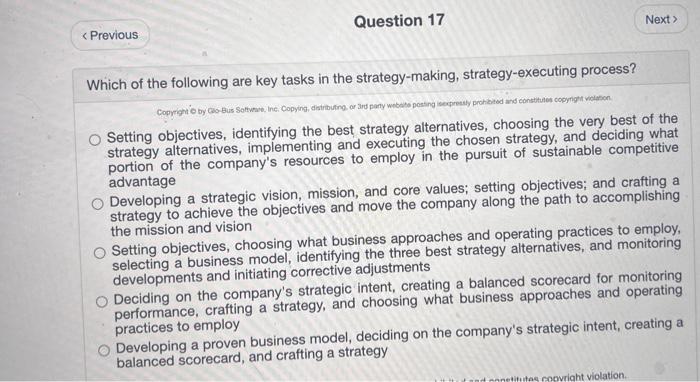
A "balanced scorecard" that includes both strategic and financial performance targets requires managers to set an equal number of financial and strategic objectives and devote roughly equivalent energy and resources to achieving both types of performance targets. assists managers in putting roughly equal emphasis on achieving short-term and long-term performance targets. is a tool for helping managers measure the degree to which the company is both outcompeting rivals in the marketplace and pleasing shareholders. helps managers avoid the mistake of focusing only on financial performance measures and overlooking the fact that pursuing and achieving strategic outcomes that boost its competitiveness and strength in the marketplace vis-a-vis rivals is better able to improve its future financial performance. forces managers to put equal emphasis on pursuing the achievement of both financial and strategic outcomes. A company's strategic vision delineates management's aspirations for the business, providing a panoramic view of "where we are going" and a convincing rationale for why this makes good business sense. consists of management's 5-year strategic plan for profitably implementing and executing the chosen business model. spells out a company's strategic intent, its strategic and financial objectives, and the business approaches and operating practices that will underpin its efforts to achieve sustainable competitive advantage. defines "who we are and what we do." sets forth what the company will do to please customers and operate profitably. Operating strategies concern the specific plans for building competitive advantage in each major department (R\&D, production, marketing, finance) and operating unit (plants, distribution centers, geographic divisions). the relatively narrow strategic initiatives and approaches for managing key operating units (plants, distribution centers, geographic units) and specific operating activities with strategic significance (quality control, advertising, brand-building efforts, supply chain-related activities, and website operations). what the firm's operating departments are doing and plan to do to unify the company's functional and business strategies. the specific operating practices and business systems that a company plans to use in implementing and executing particular pieces or components of the company's overall strategy. the actions, approaches, and practices to be employed in managing particular business processes or key activities within a business-like production, new product development, sales and marketing, customer service, and finance. Which of the following are key tasks in the strategy-making, strategy-executing process? Setting objectives, identifying the best strategy alternatives, choosing the very best of the strategy alternatives, implementing and executing the chosen strategy, and deciding what portion of the company's resources to employ in the pursuit of sustainable competitive advantage Developing a strategic vision, mission, and core values; setting objectives; and crafting a strategy to achieve the objectives and move the company along the path to accomplishing the mission and vision Setting objectives, choosing what business approaches and operating practices to employ, selecting a business model, identifying the three best strategy alternatives, and monitoring developments and initiating corrective adjustments Deciding on the company's strategic intent, creating a balanced scorecard for monitoring performance, crafting a strategy, and choosing what business approaches and operating practices to employ Developing a proven business model, deciding on the company's strategic intent, creating a balanced scorecard, and crafting a strategy
Step by Step Solution
There are 3 Steps involved in it

Get step-by-step solutions from verified subject matter experts
 Study Help