







Question: Please answer all A variable of two populations has a mean of 40 and a standard deviation of 30 for one of the populations and
Please answer all
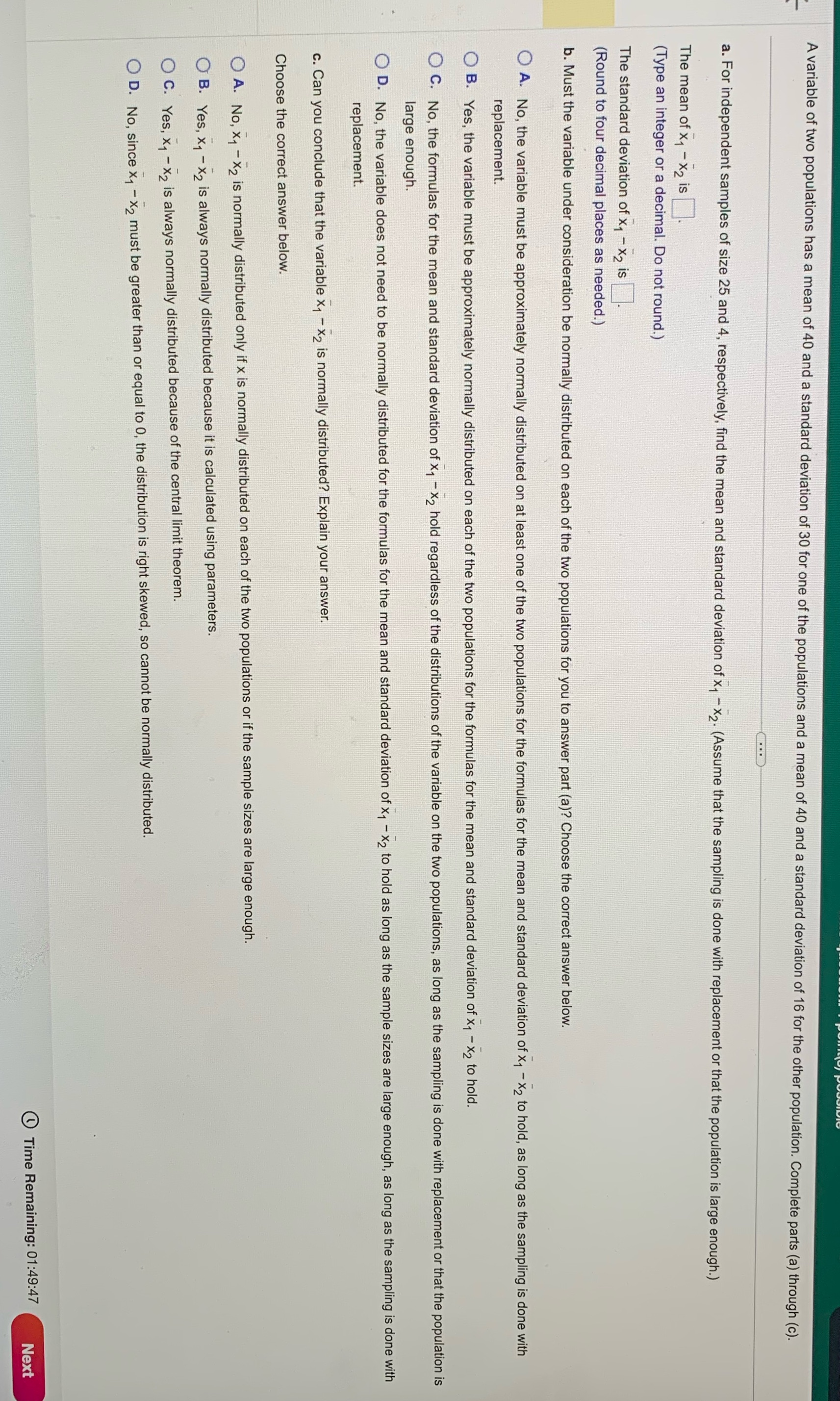
A variable of two populations has a mean of 40 and a standard deviation of 30 for one of the populations and a mean of 40 and a standard deviation of 16 for the other population. Complete parts (a) through (c). a. For independent samples of size 25 and 4, respectively, find the mean and standard deviation of X, - X2. (Assume that the sampling is done with replacement or that the population is large enough.) The mean of X, -x2 is . (Type an integer or a decimal. Do not round.) The standard deviation of x1 - x2 is. (Round to four decimal places as needed.) b. Must the variable under consideration be normally distributed on each of the two populations for you to answer part (a)? Choose the correct answer below. O A. No, the variable must be approximately normally distributed on at least one of the two populations for the formulas for the mean and standard deviation of X1 - X2 to hold, as long as the sampling is done with replacement. O B. Yes, the variable must be approximately normally distributed on each of the two populations for the formulas for the mean and standard deviation of X1 - X2 to hold. O C. No, the formulas for the mean and standard deviation of X, - X2 hold regardless of the distributions of the variable on the two populations, as long as the sampling is done with replacement or that the population is large enough. O D. No, the variable does not need to be normally distributed for the formulas for the mean and standard deviation of X1 - X2 to hold as long as the sample sizes are large enough, as long as the sampling is done with replacement. c. Can you conclude that the variable x1 - X2 is normally distributed? Explain your answer. Choose the correct answer below. O A. No, X1 - X2 is normally distributed only if x is normally distributed on each of the two populations or if the sample sizes are large enough. O B. Yes, X1 - X2 is always normally distributed because it is calculated using parameters. O C. Yes, X1 - X2 is always normally distributed because of the central limit theorem. O D. No, since X1 - X2 must be greater than or equal to 0, the distribution is right skewed, so cannot be normally distributed. Time Remaining: 01:49:47 Next
Step by Step Solution
There are 3 Steps involved in it

Get step-by-step solutions from verified subject matter experts
 Study Help