







Question: please answer all as they are all connected When 1-bromobutane reacts with t-butoxide in acetone, it does so via an E2 mechanism due to the
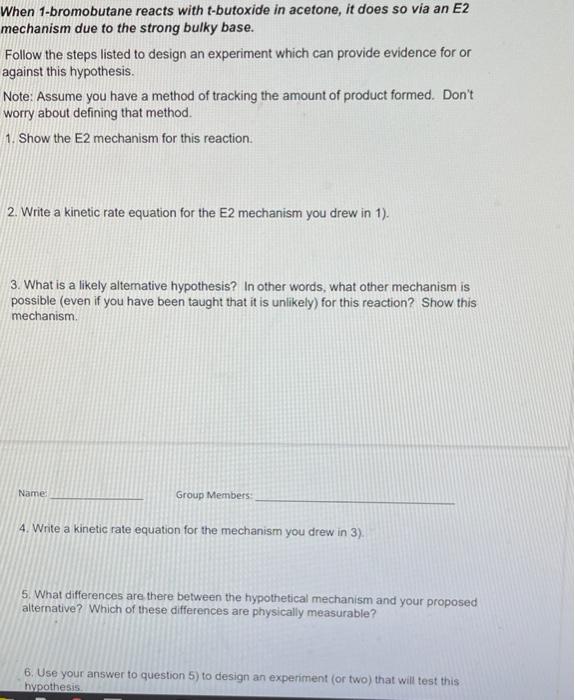
When 1-bromobutane reacts with t-butoxide in acetone, it does so via an E2 mechanism due to the strong bulky base. Follow the steps listed to design an experiment which can provide evidence for or against this hypothesis. Note: Assume you have a method of tracking the amount of product formed. Don't worry about defining that method. 1. Show the E2 mechanism for this reaction. 2. Write a kinetic rate equation for the E2 mechanism you drew in 1). 3. What is a likely alternative hypothesis? In other words, what other mechanism is possible (even if you have been taught that it is unlikely) for this reaction? Show this mechanism Name Group Members 4. Write a kinetic rate equation for the mechanism you drew in 3). 5. What differences are there between the hypothetical mechanism and your proposed alternative? Which of these differences are physically measurable? 6. Use your answer to question 5) to design an experiment (or two) that will test this hypothesis
Step by Step Solution
There are 3 Steps involved in it

Get step-by-step solutions from verified subject matter experts
 Study Help