







Question: PLEASE ANSWER ALL CORRECTLY AND COMPLETELY 1-3. : THIS IS THE FORMAT YOU SHOULD FOLLOW: PLEASE FOLLOW THE FORMAT BEFORE ANSWERING THANK YOU. I'LL GIVE
PLEASE ANSWER ALL CORRECTLY AND COMPLETELY 1-3. :
THIS IS THE FORMAT YOU SHOULD FOLLOW:
PLEASE FOLLOW THE FORMAT BEFORE ANSWERING THANK YOU. I'LL GIVE THUMBS UP TO WHO WILL ANSWER COMPLETELY.
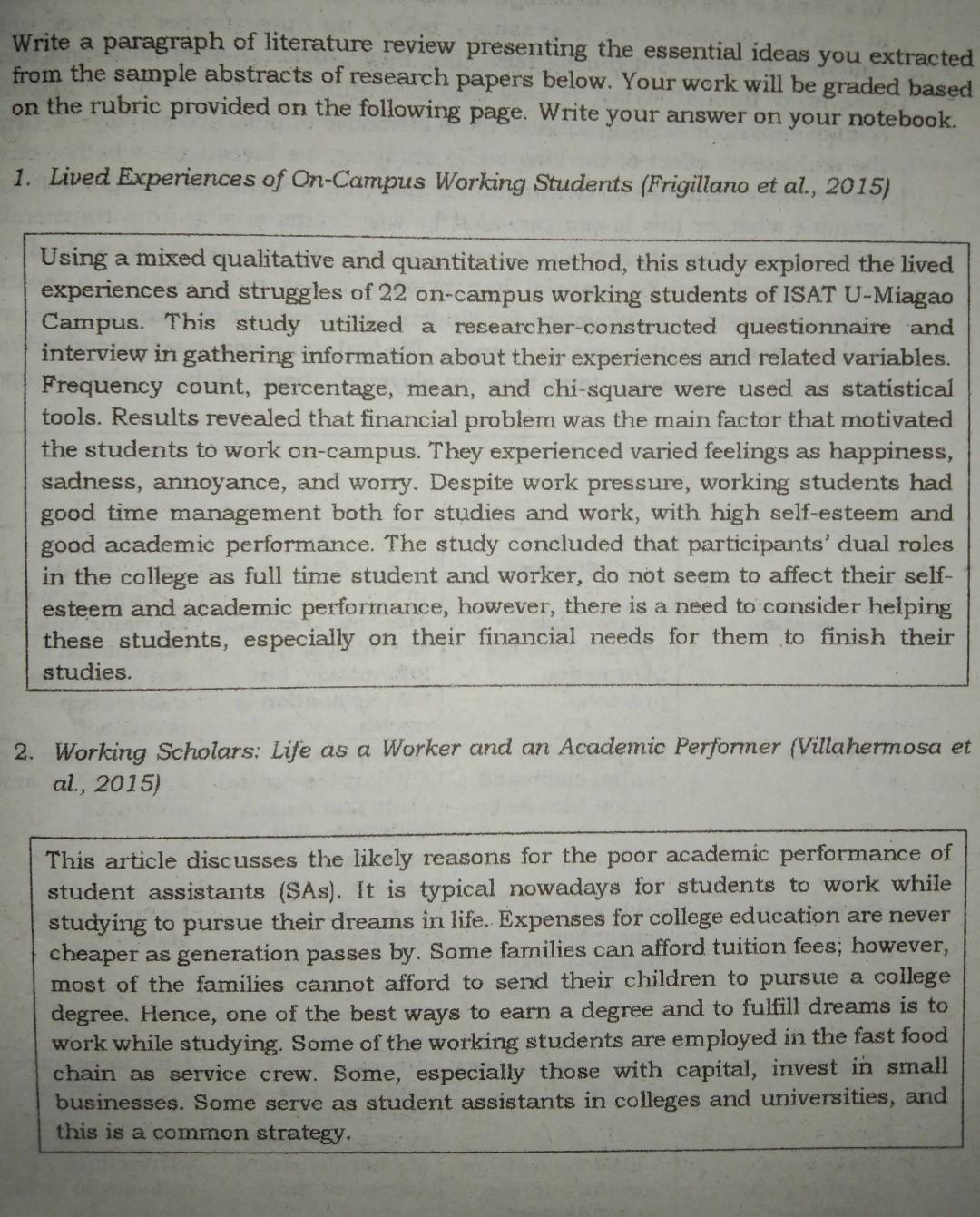
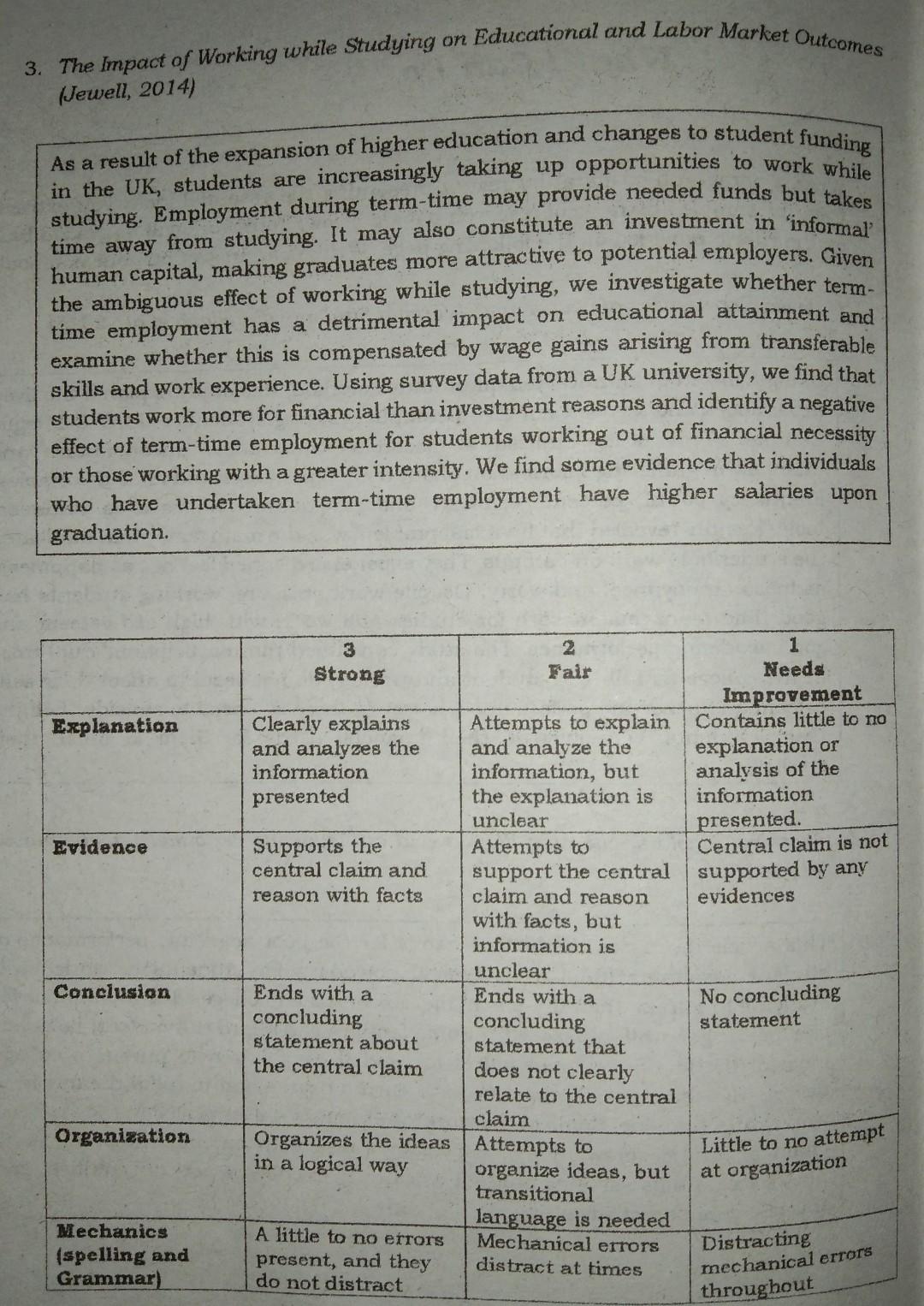
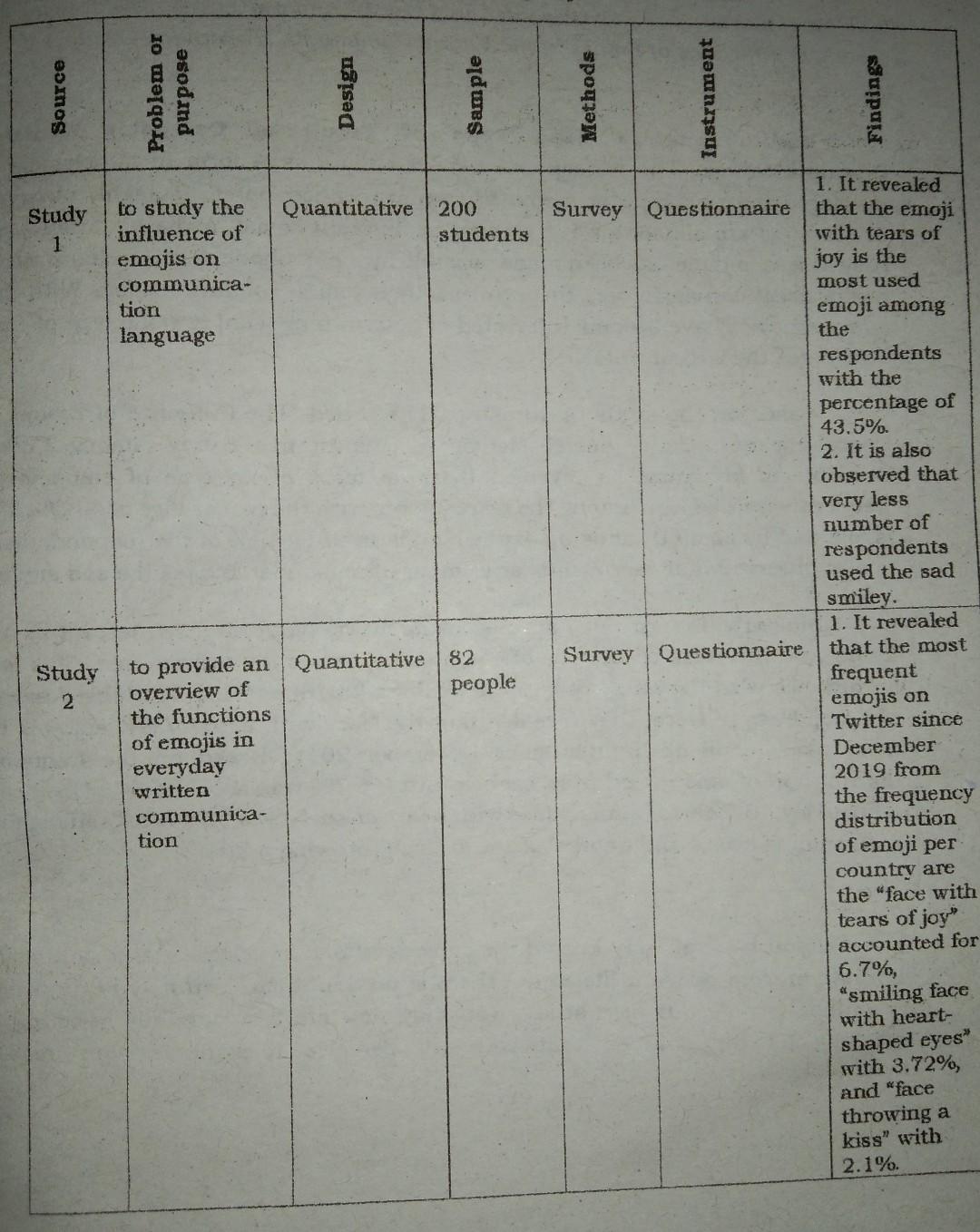
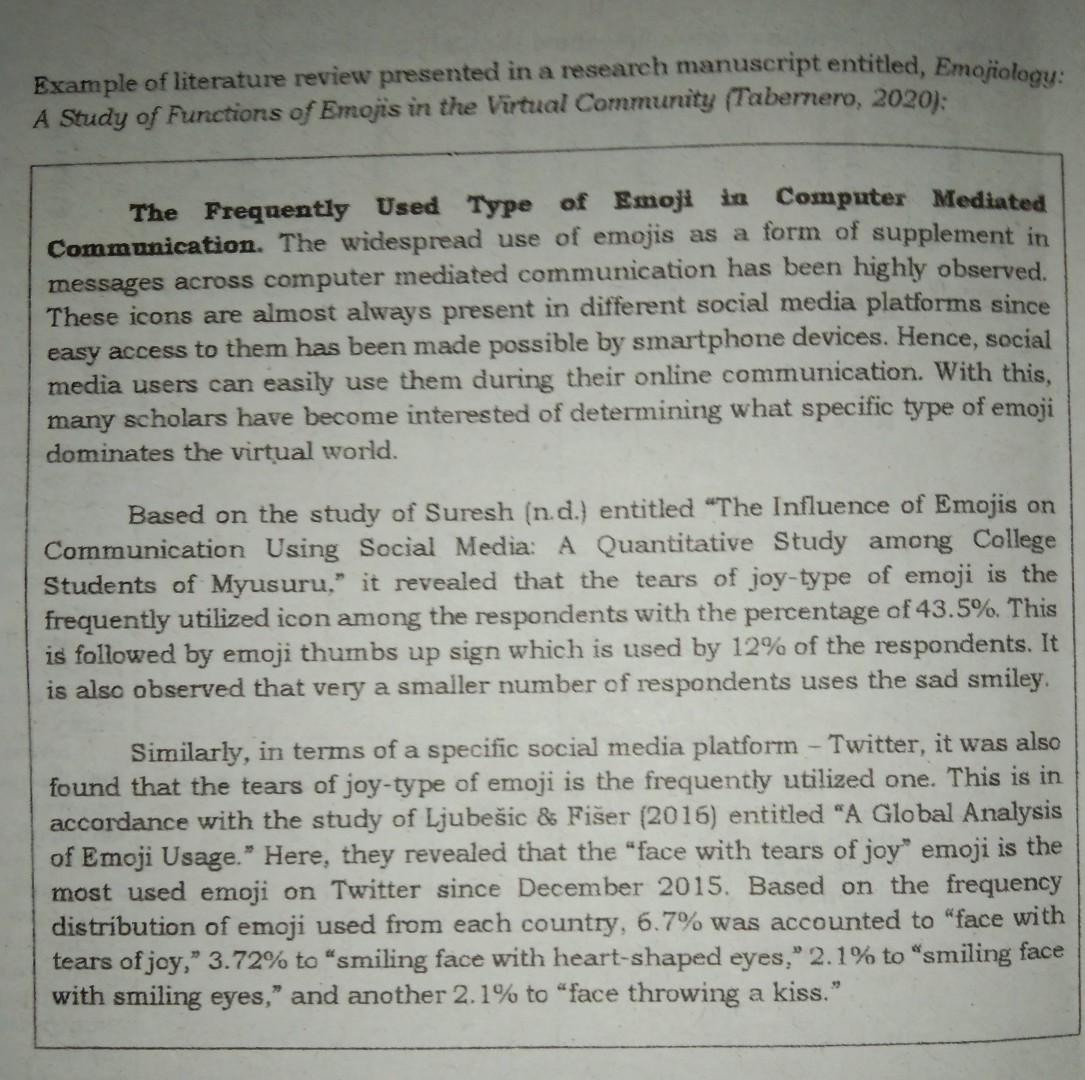
Write a paragraph of literature review presenting the essential ideas you extracted from the sample abstracts of research papers below. Your work will be graded based on the rubric provided on the following page. Write your answer on your notebook. 1. Lived Experiences of On-Campus Working Students (Frigillano et al., 2015) Using a mixed qualitative and quantitative method, this study explored the lived experiences and struggles of 22 on-campus working students of ISAT U-Miagao Campus. This study utilized a researcher-constructed questionnaire and interview in gathering information about their experiences and related variables. Frequency count, percentage, mean, and chi-square were used as statistical tools. Results revealed that financial problem was the main factor that motivated the students to work on-campus. They experienced varied feelings as happiness, sadness, annoyance, and worry. Despite work pressure, working students had good time management both for studies and work, with high self-esteem and good academic performance. The study concluded that participants' dual roles in the college as full time student and worker, do not seem to affect their self- esteem and academic performance, however, there is a need to consider helping these students, especially on their financial needs for them to finish their studies. 2. Working Scholars: Life as a Worker and an Academic Performer (Villahermosa et al., 2015) This article discusses the likely reasons for the poor academic performance of student assistants (SAs). It is typical nowadays for students to work while studying to pursue their dreams in life. Expenses for college education are never cheaper as generation passes by. Some families can afford tuition fees; however, most of the families cannot afford to send their children to pursue a college degree. Hence, one of the best ways to earn a degree and to fulfill dreams is to work while studying. Some of the working students are employed in the fast food chain as service crew. Some, especially those with capital, invest in small businesses. Some serve as student assistants in colleges and universities, and this is a common strategy. 3. The Impact of Working while Studying on Educational and Labor Market Outcomes (Jewell, 2014) As a result of the expansion of higher education and changes to student funding in the UK, students are increasingly taking up opportunities to work while studying. Employment during term-time may provide needed funds but takes time away from studying. It may also constitute an investment in 'informal human capital , making graduates more attractive to potential employers. Given the ambiguous effect of working while studying, we investigate whether term- time employment has a detrimental impact on educational attainment and examine whether this is compensated by wage gains arising from transferable skills and work experience. Using survey data from a UK university, we find that students work more for financial than investment reasons and identify a negative effect of term-time employment for students working out of financial necessity or those working with a greater intensity. We find some evidence that individuals who have undertaken term-time employment have higher salaries upon graduation Explanation Evidence 3 2 1 Strong Fair Needs Improvement Clearly explains Attempts to explain Contains little to no and analyzes the and analyze the explanation or information information, but analysis of the presented the explanation is information unclear presented. Supports the Attempts to Central claim is not central claim and support the central supported by any reason with facts claim and reason evidences with facts, but information is unclear Ends with a Ends with a No concluding concluding concluding statement statement about statement that the central claim does not clearly relate to the central claim Organizes the ideas Attempts to in a logical way organize ideas, but transitional language is needed A little to no errors Mechanical errors Distracting present, and they distract at times do not distract Conclusion Organization Little to no attempt at organization Mechanics (spelling and Grammar) mechanical errors throughout Source Methods Instrument Findings Quantitative Study 1 200 students Survey Questionnaire to study the influence of emojis on communica- tion language 1. It revealed that the emoji with tears of joy is the most used emoji among the respondents with the percentage of 43.5% 2. It is also observed that very less Survey Questionnaire Study 2 Quantitative 82 people to provide an overview of the functions of emojis in everyday written communica- tion number of respondents used the sad smiley. 1. It revealed that the most frequent emojis on Twitter since December 2019 from the frequency distribution of emoji per country are the "face with tears of joy" accounted for 6.7%, "smiling face with heart- shaped eyes" with 3.72% and "face throwing a kiss" with 2.1%. Example of literature review presented in a research manuscript entitled, Emojiologu: A Study of Functions of Emojis in the Virtual Community (Tabernero, 2020): The Frequently Used Type of Emoji in Computer Mediated Communication. The widespread use of emojis as a form of supplement in messages across computer mediated communication has been highly observed. These icons are almost always present in different social media platforms since easy access to them has been made possible by smartphone devices. Hence, social media users can easily use them during their online communication. With this, many scholars have become interested of determining what specific type of emoji dominates the virtual world. Based on the study of Suresh (n.d.) entitled "The Influence of Emojis on Communication Using Social Media: A Quantitative Study among College Students of Myusuru," it revealed that the tears of joy-type of emoji is the frequently utilized icon among the respondents with the percentage of 43.5%. This is followed by emoji thumbs up sign which is used by 12% of the respondents. It is also observed that very a smaller number of respondents uses the sad smiley Similarly, in terms of a specific social media platformn - Twitter, it was also found that the tears of joy-type of emoji is the frequently utilized one. This is in accordance with the study of Ljubeic & Fier (2016) entitled "A Global Analysis of Emoji Usage. Here, they revealed that the "face with tears of joy emoji is the most used emoji on Twitter since December 2015. Based on the frequency distribution of emoji used from each country, 6.7% was accounted to "face with tears of joy," 3.72% to "smiling face with heart-shaped eyes," 2.1% to "smiling face with smiling eyes," and another 2.1% to "face throwing a kissStep by Step Solution
There are 3 Steps involved in it
1 Expert Approved Answer
Step: 1 Unlock

Question Has Been Solved by an Expert!
Get step-by-step solutions from verified subject matter experts
Step: 2 Unlock
Step: 3 Unlock
 Study Help