







Question: please answer all, i will give a high rate. this is the link for the reference: https://sg.docs.wps.com/l/sIDTNstgyz_OikAY please answer thank you so much, show your
please answer all, i will give a high rate. this is the link for the reference: https://sg.docs.wps.com/l/sIDTNstgyz_OikAY
please answer thank you so much, show your solutions for exercise 1.3
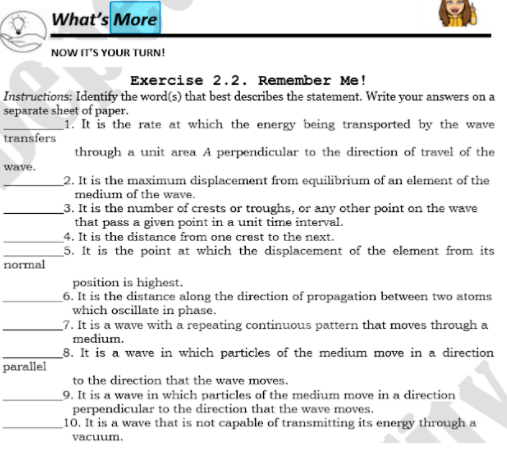
What's More LV NOW IT'S YOUR TURN! Exercise 1.2 Remember Me! Instructions: Identify the word(s) that best describes the statement. Write your answers on the separate sheet of paper. 1. It is the force that acts on the object to impede the oscillation. 2. It is equal to the square root of the force constant divided by the mass. 3. It is any system that behaves where an object oscillates in the presence of a retarding force. 4. It is a harmonic oscillator that decays to the equilibrium position without oscillations. 5. It is a harmonic oscillator that oscillates with a frequency smaller than in the non-damped case and an amplitude decreasing with time. Exercise 1.3 Think Before you Write! Instructions: Answer the following questions concisely. Write your answers on a separate sheet of paper. 1. Will damped oscillations occur for any values of b and k? Explain. 2. Is it possible to have damped oscillations when a system is at resonance? Why? 3. What makes a critically damped system?What's More NOW IT'S YOUR TURN! Exercise 2.2. Remember Me! Instructions: Identify the word(s) that best describes the statement. Write your answers on a separate sheet of paper. 1. It is the rate at which the energy being transported by the wave transfers through a unit area A perpendicular to the direction of travel of the wave. 2. It is the maximum displacement from equilibrium of an element of the medium of the wave. 3. It is the number of crests or troughs, or any other point on the wave that pass a given point in a unit time interval. 4. It is the distance from one crest to the next. 5. It is the point at which the displacement of the element from its normal position is highest. 6. It is the distance along the direction of propagation between two atoms which oscillate in phase. 7. It is a wave with a repeating continuous pattern that moves through a medium. 8. It is a wave in which particles of the medium move in a direction parallel to the direction that the wave moves. 9. It is a wave in which particles of the medium move in a direction perpendicular to the direction that the wave moves. 10. It is a wave that is not capable of transmitting its energy through a vacuum
Step by Step Solution
There are 3 Steps involved in it

Get step-by-step solutions from verified subject matter experts
 Study Help