







Question: please answer all, i will rate! G=G+RTln( products) / reactants); at 25C,RT=592cal/molK; at 37C,RT= 616cal/molK G=()R RInK eq R=1.987cal/molK;T (Kelvin) =C+273 When the polymer XXX...
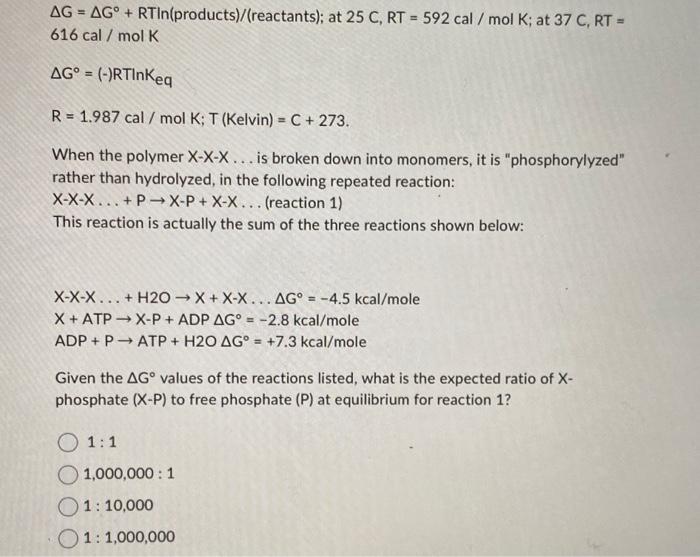
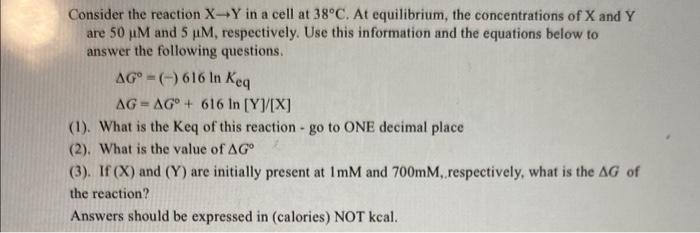
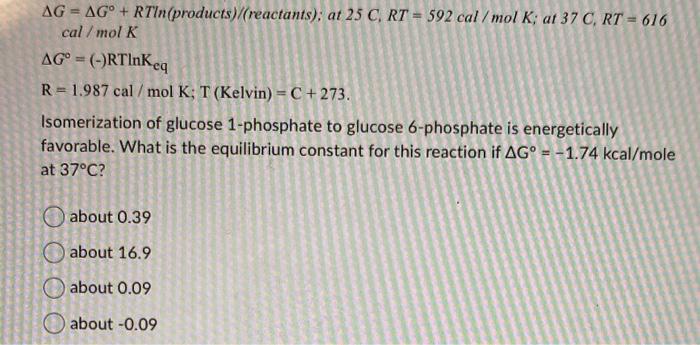
G=G+RTln( products) / reactants); at 25C,RT=592cal/molK; at 37C,RT= 616cal/molK G=()R RInK eq R=1.987cal/molK;T (Kelvin) =C+273 When the polymer XXX... is broken down into monomers, it is "phosphorylyzed" rather than hydrolyzed, in the following repeated reaction: XXX+PXP+XX (reaction 1 ) This reaction is actually the sum of the three reactions shown below: XXX+H2OX+XXG=4.5kcal/moleX+ATPXP+ADPG=2.8kcal/moleADP+PATP+H2OG=+7.3kcal/mole Given the G values of the reactions listed, what is the expected ratio of X phosphate (XP) to free phosphate (P) at equilibrium for reaction 1 ? 1:11,000,000:11:10,0001:1,000,000 Consider the reaction XY in a cell at 38C. At equilibrium, the concentrations of X and Y are 50M and 5M, respectively. Use this information and the equations below to answer the following questions. G=()616lnKeqG=G+616ln[Y]/[X] (1). What is the Keq of this reaction - go to ONE decimal place (2). What is the value of G (3). If (X) and (Y) are initially present at 1mM and 700mM, respectively, what is the G of the reaction? Answers should be expressed in (calories) NOT kcal. G=G+RTln( products )/( reactants ); at 25C,RT=592cal/molK; at 37C,RT=616 cal/molK G=()RTlnKeqR=1.987cal/molK;T(Kelvin)=C+273. Isomerization of glucose 1-phosphate to glucose 6-phosphate is energetically favorable. What is the equilibrium constant for this reaction if G=1.74kcal/mole at 37C? about 0.39 about 16.9 about 0.09 about 0.09
Step by Step Solution
There are 3 Steps involved in it

Get step-by-step solutions from verified subject matter experts
 Study Help