







Question: PLEASE ANSWER ALL LETTERED QUESTIONS ABOUT PROBLEM a . Assuming that investments A and B are equally risky and using the 4% discount rate, apply
PLEASE ANSWER ALL LETTERED QUESTIONS ABOUT PROBLEM 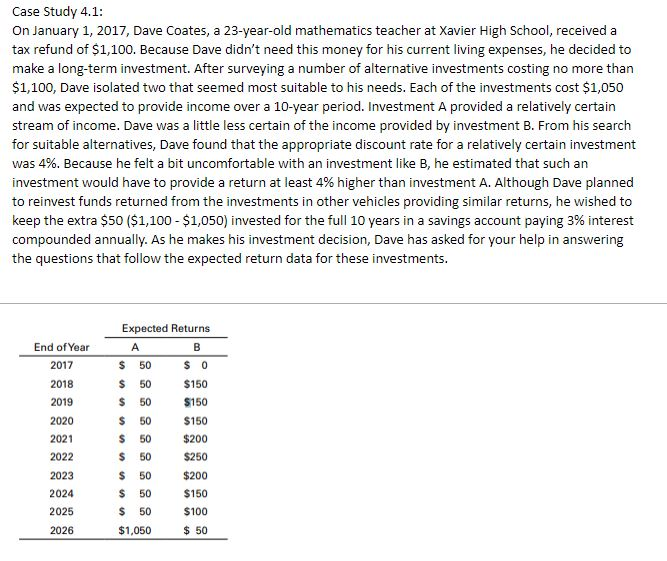
a. Assuming that investments A and B are equally risky and using the 4% discount rate, apply the present value technique to assess the acceptability of each investment and to determine the preferred investment. Explain your findings.
b. Recognizing that investment B is more risky than investment A, reassess the two alternatives, adding the 4% risk premium to the 4% discount rate for investment A and therefore applying a 8% discount rate to investment B. Compare your findings relative to acceptability and preference to those found for question a.
c. From your findings in questions a and b, indicate whether the IRR for investment A is above or below 4% and whether that for investment B is above or below 8%. Explain.
d. Use the present value technique to estimate the IRR on each investment. Compare your findings and contrast them with your response to question c.
e. Which, if either, of the two investments would you recommend that Dave make? Explain
f. Indicate to Dave how much money the extra $50 will have grown to by the end of 2026, assuming he makes no withdrawals from the savings account.
Case Study 4.1: On January 1, 2017, Dave Coates, a 23-year-old mathematics teacher at Xavier High School, received a tax refund of $1,100. Because Dave didn't need this money for his current living expenses, he decided to make a long-term investment. After surveying a number of alternative investments costing no more than $1,100, Dave isolated two that seemed most suitable to his needs. Each of the investments cost $1,050 and was expected to provide income over a 10-year period. Investment A provided a relatively certain stream of income. Dave was a little less certain of the income provided by investment B. From his search for suitable alternatives, Dave found that the appropriate discount rate for a relatively certain investment was 4%. Because he felt a bit uncomfortable with an investment like B, he estimated that such an investment would have to provide a return at least 4% higher than investment A. Although Dave planned to reinvest funds returned from the investments in other vehicles providing similar returns, he wished to keep the extra $50 ($1,100-$1,050) invested for the full 10 years in a savings account paying 3% interest compounded annually. As he makes his investment decision, Dave has asked for your help in answering the questions that follow the expected return data for these investments Expected Returns End of Year 2017 2018 2019 2020 2021 2022 2023 2024 2025 2026 S 50 S 50 $ 50 S 50 S 50 S 50 S 50 S 50 S 50 $1,050 $150 $150 $150 $200 $250 $200 $150 $100 50
Step by Step Solution
There are 3 Steps involved in it

Get step-by-step solutions from verified subject matter experts
 Study Help