


Question: Please Answer all MCQs correctly. Please 5. The available-to-promise (ATP) quantity for any period t which has an MPs quantity, other thanfirst period, is equal

Please Answer all MCQs correctly. PleasePlease Answer all MCQs correctly. Please 5. The
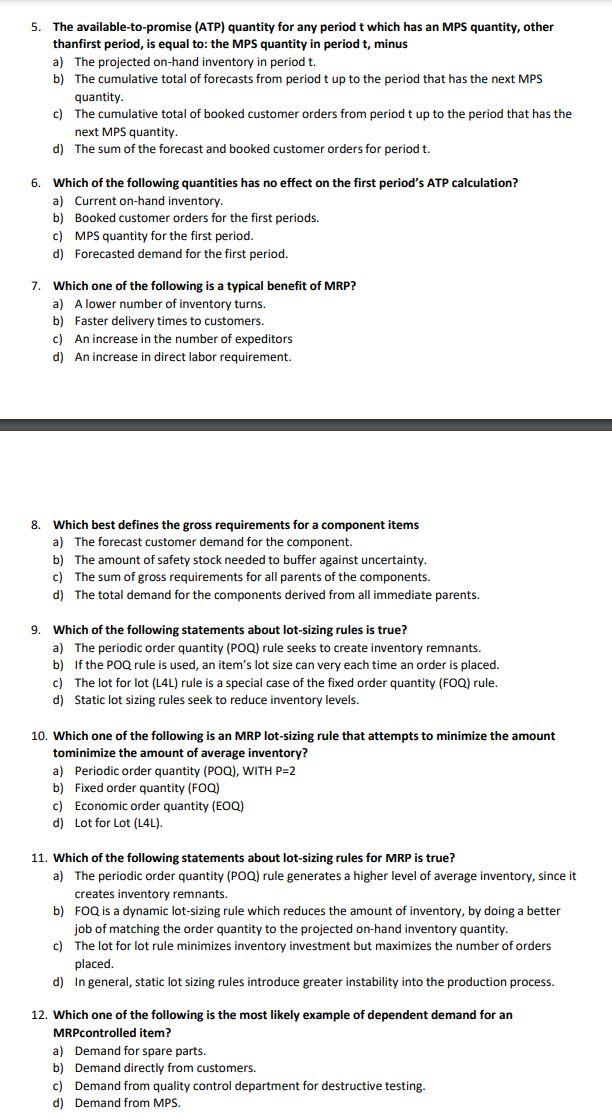
5. The available-to-promise (ATP) quantity for any period t which has an MPs quantity, other thanfirst period, is equal to: the MPS quantity in period t, minus a) The projected on-hand inventory in period t. b) The cumulative total of forecasts from period t up to the period that has the next MPS quantity. c) The cumulative total of booked customer orders from period t up to the period that has the next MPS quantity. d) The sum of the forecast and booked customer orders for period t. 6. Which of the following quantities has no effect on the first period's ATP calculation? a) Current on-hand inventory. b) Booked customer orders for the first periods. c) MPS quantity for the first period. d) Forecasted demand for the first period. 7 Which one of the following is a typical benefit of MRP? a) A lower number of inventory turns. b) Faster delivery times to customers. c) An increase in the number of expeditors d) An increase in direct labor requirement. 8 Which best defines the gross requirements for a component items a) The forecast customer demand for the component. b) The amount of safety stock needed to buffer against uncertainty. c) The sum of gross requirements for all parents of the components. d) The total demand for the components derived from all immediate parents. 9. Which of the following statements about lot-sizing rules is true? a) The periodic order quantity (POQ) rule seeks to create inventory remnants. b) If the POQ rule is used, an item's lot size can very each time an order is placed. c) The lot for lot (L4L) rule is a special case of the fixed order quantity (FOQ) rule. d) Static lot sizing rules seek to reduce inventory levels. 10. Which one of the following is an MRP Iot-sizing rule that attempts to minimize the amount tominimize the amount of average inventory? a) Periodic order quantity (POQ), WITH P=2 b) Fixed order quantity (FOQ) c) Economic order quantity (EOQ) d) Lot for Lot (L4L). 11. Which of the following statements about lot-sizing rules for MRP is true? a) The periodic order quantity (POQ) rule generates a higher level of average inventory, since it creates inventory remnants. b) FOQ is a dynamic lot-sizing rule which reduces the amount of inventory, by doing a better job of matching the order quantity to the projected on-hand inventory quantity. c) The lot for lot rule minimizes inventory investment but maximizes the number of orders placed. d) In general, static lot sizing rules introduce greater instability into the production process. 12. Which one of the following is the most likely example of dependent demand for an MRPcontrolled item? a) Demand for spare parts. b) Demand directly from customers. c) Demand from quality control department for destructive testing. d) Demand from MPS

Step by Step Solution

There are 3 Steps involved in it

1 Expert Approved Answer
Step: 1 Unlock blur-text-image

Question Has Been Solved by an Expert!

Get step-by-step solutions from verified subject matter experts

Step: 2 Unlock
Step: 3 Unlock

Students Have Also Explored These Related General Management Questions!