







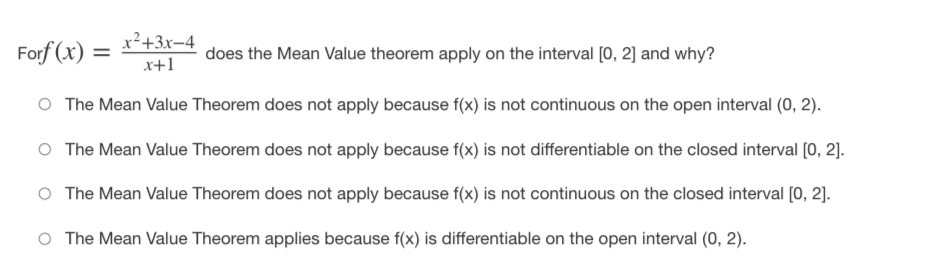
Question: PLEASE ANSWER ALL QUESTIONS AND MAKE WRITING CLEAR 3 _ ForfOC) = % does the Mean Value theorem apply on the interval [0, 2] and
![2] and why? 0 The Mean Value Theorem does not apply because](https://s3.amazonaws.com/si.experts.images/answers/2024/06/666639392398f_3536666393909202.jpg)
![the closed interval [0, 2]. O The Mean Value Theorem does not](https://s3.amazonaws.com/si.experts.images/answers/2024/06/6666393a205ea_3546666393a0a6ae.jpg)
![apply because x) is not continuous on the closed interval [0, 2].](https://s3.amazonaws.com/si.experts.images/answers/2024/06/6666393a5de25_3546666393a4ec0f.jpg)
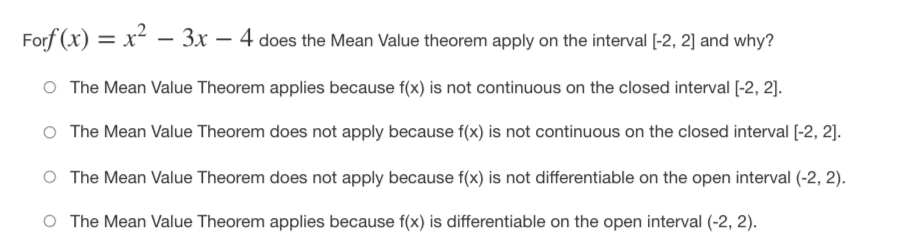
![Value theorem apply on the interval [-2, 2] and why? 0 The](https://s3.amazonaws.com/si.experts.images/answers/2024/06/6666393b4ec7e_3556666393b28af4.jpg)
PLEASE ANSWER ALL QUESTIONS AND MAKE WRITING CLEAR
![interval [-2. 2]. O The Mean Value Theorem does not apply because](https://s3.amazonaws.com/si.experts.images/answers/2024/06/6666393bd0f96_3556666393bba8d6.jpg)
![x} is not continuous on the closed interval [-2. 2]. O The](https://s3.amazonaws.com/si.experts.images/answers/2024/06/6666393c20c65_3566666393c0ead4.jpg)
![interval [1, 2] that satisfy the Mean Value Theorem. o c= -V2](https://s3.amazonaws.com/si.experts.images/answers/2024/06/6666393ddff4c_3576666393dbeecd.jpg)
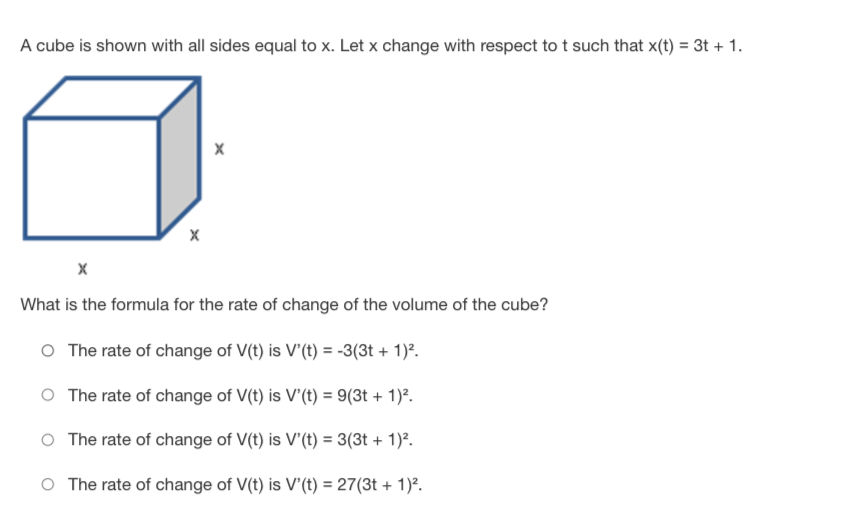
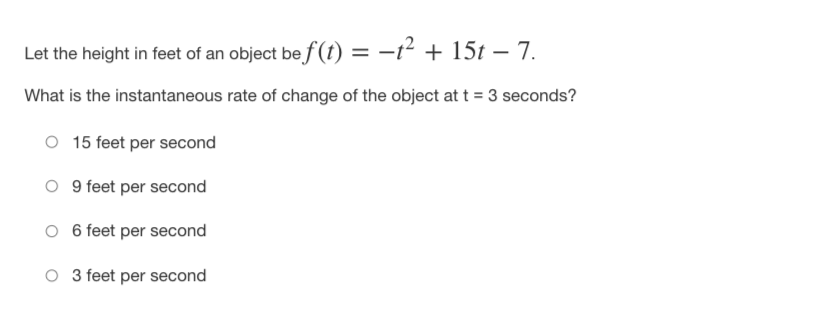
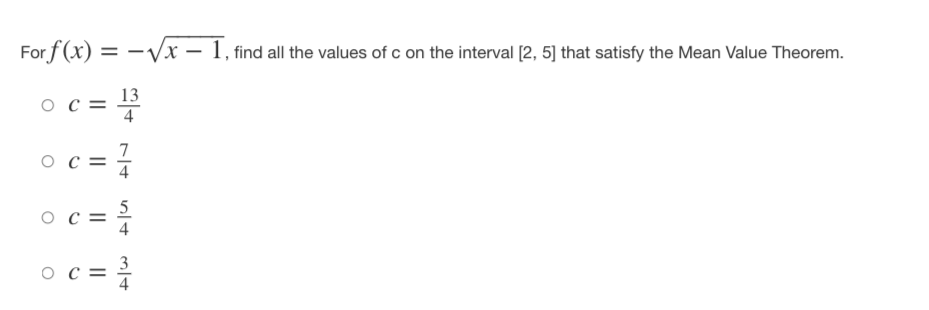
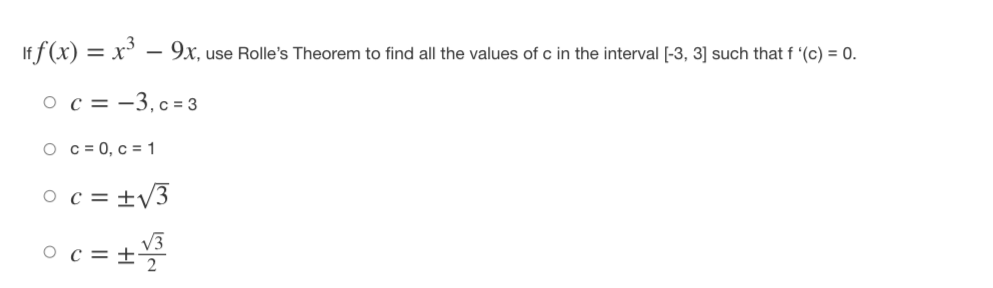
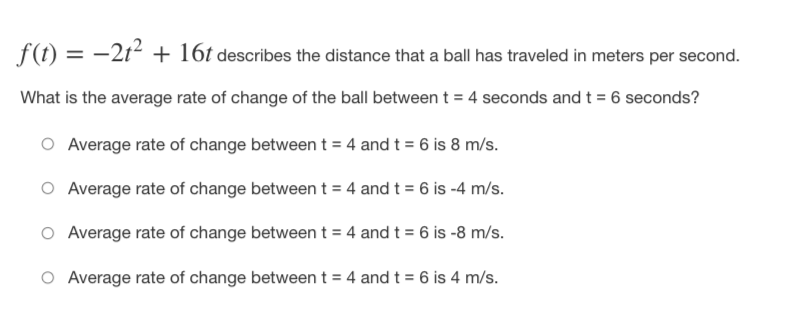
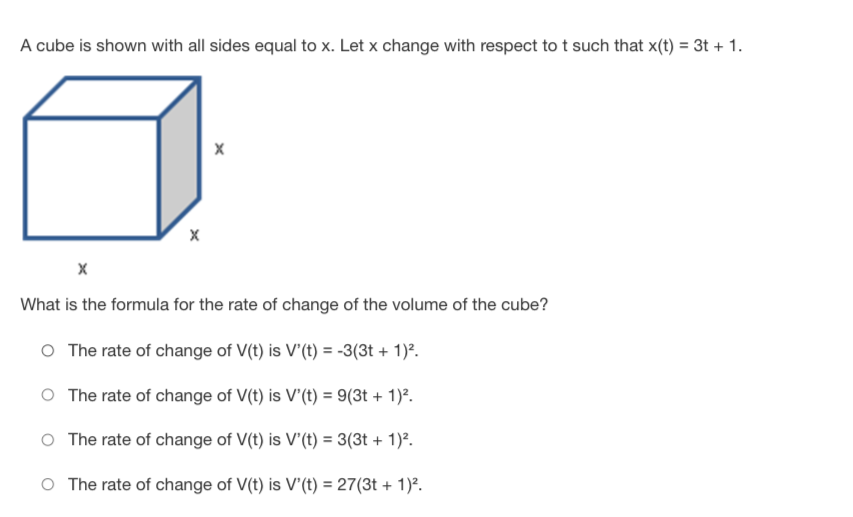
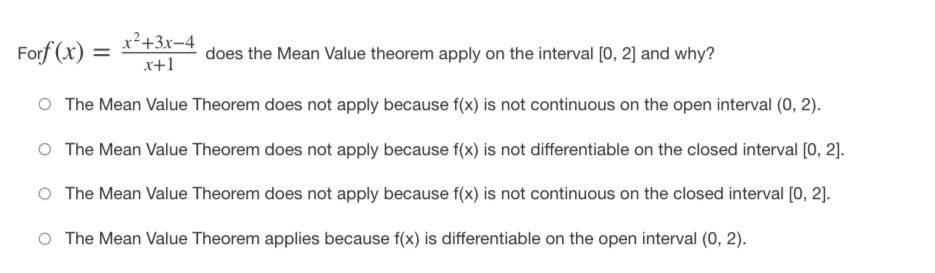
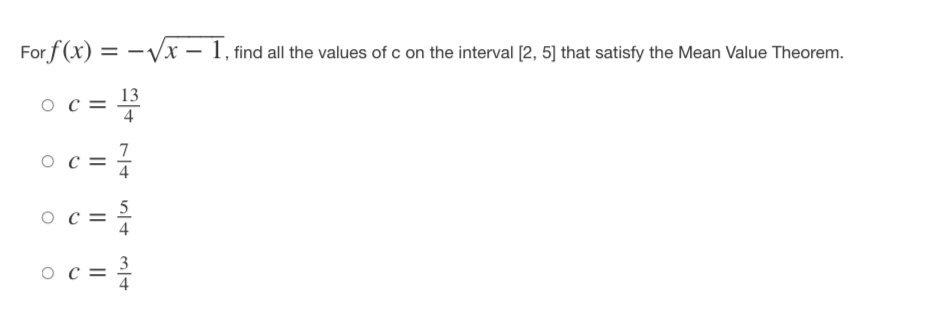
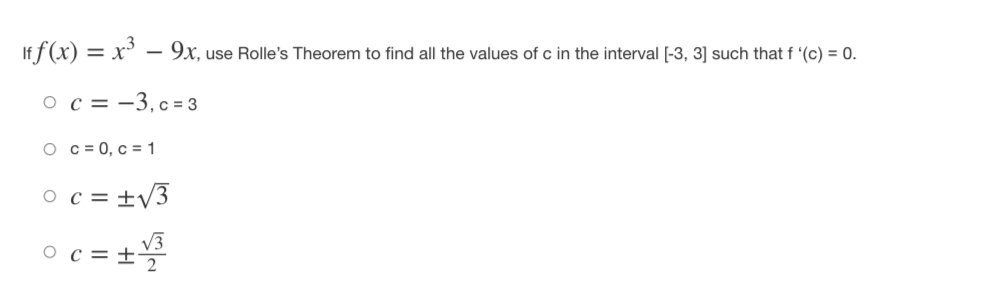
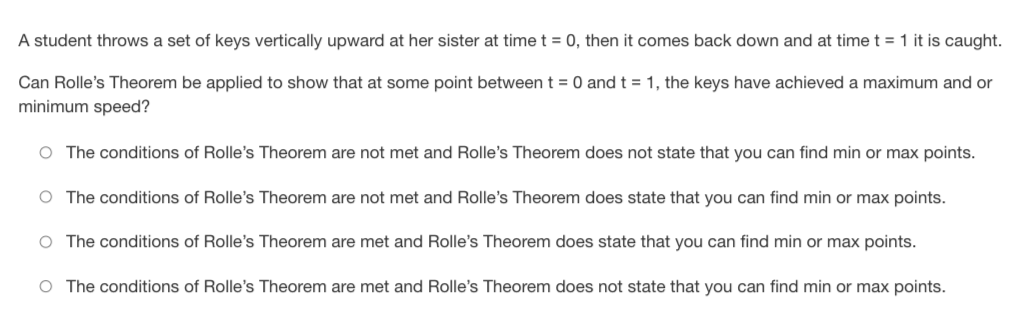
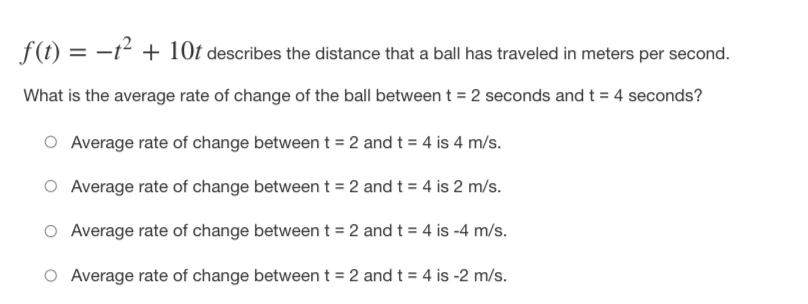
3 _ ForfOC) = % does the Mean Value theorem apply on the interval [0, 2] and why? 0 The Mean Value Theorem does not apply because x) is not continuous on the open interval {0. 2). O The Mean Value Theorem does not apply because x) is not differentiable on the closed interval [0, 2]. O The Mean Value Theorem does not apply because x) is not continuous on the closed interval [0, 2]. O The Mean Value Theorem applies because x) is differentiable on the open interval (0. 2). ForfCJC) = 12 3x 4 does the Mean Value theorem apply on the interval [-2, 2] and why? 0 The Mean Value Theorem applies because x) is not continuous on the closed interval [-2. 2]. O The Mean Value Theorem does not apply because x} is not continuous on the closed interval [-2. 2]. O The Mean Value Theorem does not apply because x} is not differentiable on the open interval {-2, 2). O The Mean Value Theorem applies because x) is differentiable on the open interval (-2. 2). For f (x) = x + -, find all the values of c on the interval [1, 2] that satisfy the Mean Value Theorem. o c= -V2 oc= M 2 O c = V2 O c = V3For f(x) = -Vx - 1, find all the values of c on the interval [2, 5] that satisfy the Mean Value Theorem. O C=. 13 4 O C= O C= O C =If f(x) = x' - 9x, use Rolle's Theorem to find all the values of c in the interval [-3, 3] such that f '(c) = 0. O c= -3, c=3 O C = 0, c= 1 OC= +V3 OC= 12 V3A student throws a set of keys vertically upward at her sister at time t = D, then it comes back down and at time t = 1 it is caught. Can Flolle's Theorem be applied to show that at some point between t = 0 and t = 1. the keys have achieved a maximum and or minimum speed? 0 The conditions of Flolle's Theorem are not met and Ftolle's Theorem does not state that you can find min or max points. 0 The conditions of Flolle's Theorem are not met and Ftolle's Theorem does state that you can find min or max points. 0 The conditions of Flolle's Theorem are met and Holle's Theorem does state that you can nd min or max points. 0 The conditions of Flolle's Theorem are met and Holle's Theorem does not state that you can find min or max points. f(t) = -1 + 10t describes the distance that a ball has traveled in meters per second. What is the average rate of change of the ball between t = 2 seconds and t = 4 seconds? O Average rate of change between t = 2 and t = 4 is 4 m/s. O Average rate of change between t = 2 and t = 4 is 2 m/s. O Average rate of change between t = 2 and t = 4 is -4 m/s. O Average rate of change between t = 2 and t = 4 is -2 m/s.f(t) = -2t- + 16t describes the distance that a ball has traveled in meters per second. What is the average rate of change of the ball between t = 4 seconds and t = 6 seconds? O Average rate of change between t = 4 and t = 6 is 8 m/s. O Average rate of change between t = 4 and t = 6 is -4 m/s. O Average rate of change between t = 4 and t = 6 is -8 m/s. O Average rate of change between t = 4 and t = 6 is 4 m/s.A cube is shown with all sides equal to x. Let x change with respect to t such that x(t) = 3t + 1. X X X What is the formula for the rate of change of the volume of the cube? O The rate of change of V(t) is V'(t) = -3(3t + 1)2. O The rate of change of V(t) is V*(t) = 9(3t + 1)2. O The rate of change of V(t) is V'(t) = 3(3t + 1)2. O The rate of change of V(t) is V*(t) = 27(3t + 1)?.Let the height in feet of an object ber) = r2 + 15! 7. What is the instantaneous rate of change of the object at t = 3 seconds? 0 15 feet per second 0 9 feet per second 0 5 feet per second C} 3 feet per second
Step by Step Solution
There are 3 Steps involved in it

Get step-by-step solutions from verified subject matter experts
 Study Help