



Question: Please answer all questions and show work(what functions are used and how to get there), thank you! Contact Manufacturing is considering two alternative investment proposals.
Please answer all questions and show work(what functions are used and how to get there), thank you!
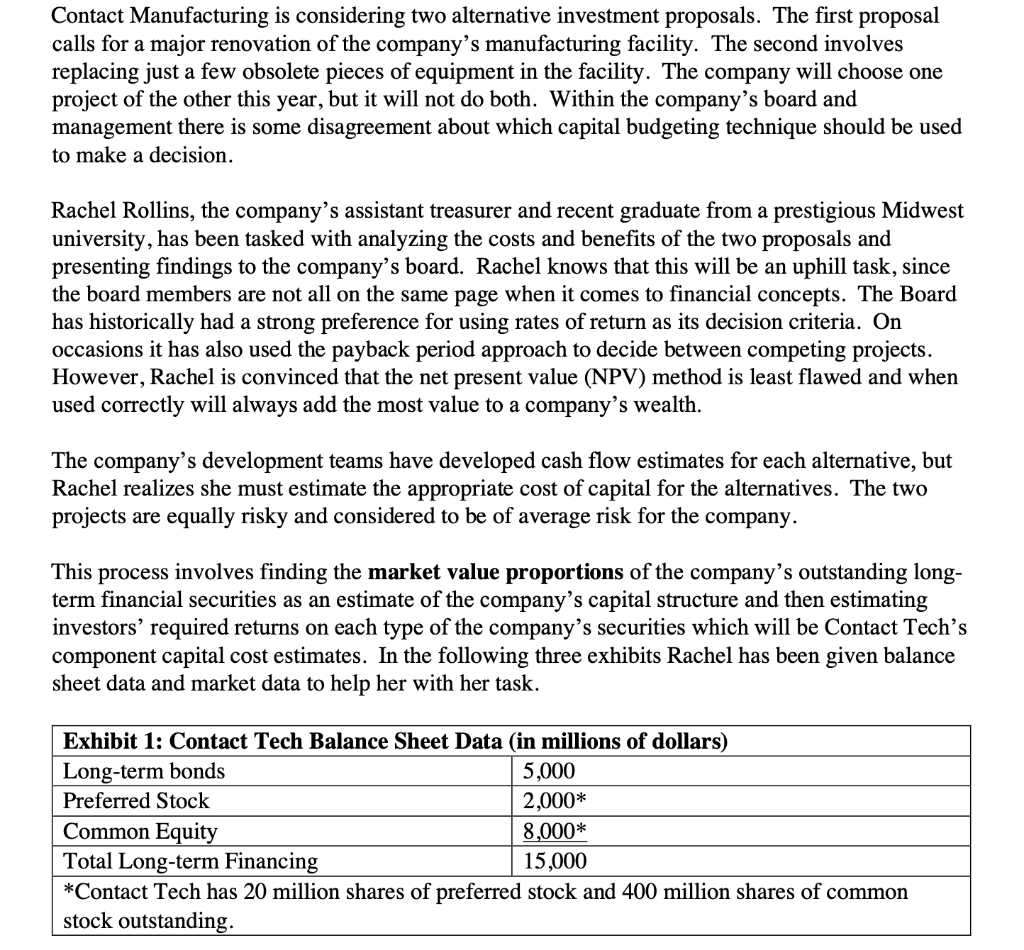
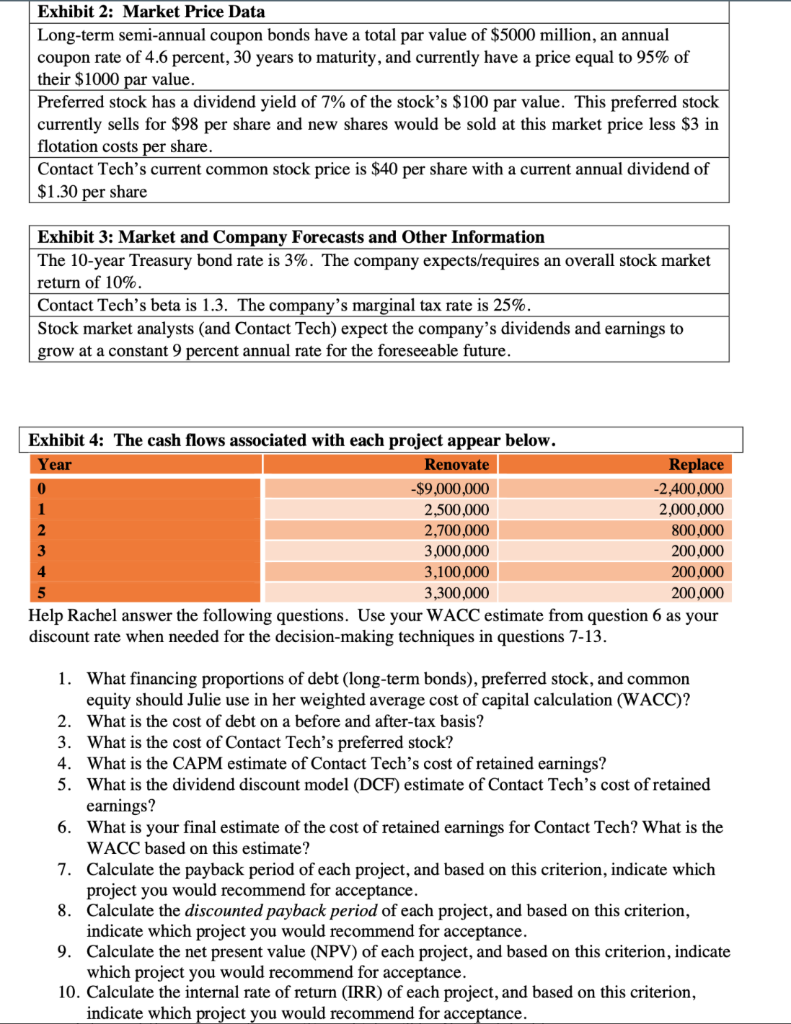
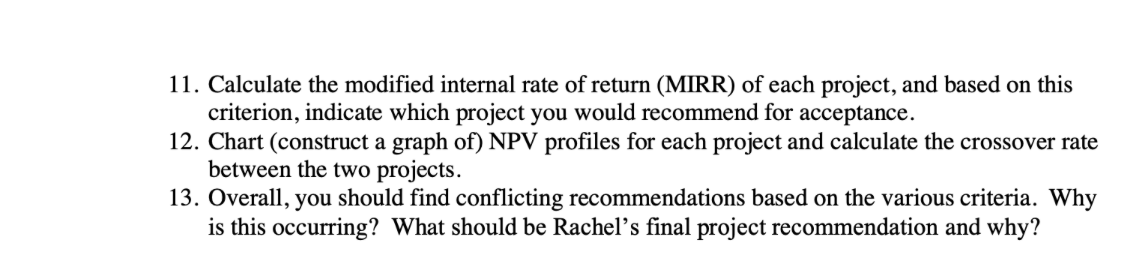
Contact Manufacturing is considering two alternative investment proposals. The first proposal calls for a major renovation of the company's manufacturing facility. The second involves replacing just a few obsolete pieces of equipment in the facility. The company will choose one project of the other this year, but it will not do both. Within the company's board and management there is some disagreement about which capital budgeting technique should be used to make a decision. Rachel Rollins, the company's assistant treasurer and recent graduate from a prestigious Midwest university, has been tasked with analyzing the costs and benefits of the two proposals and presenting findings to the company's board. Rachel knows that this will be an uphill task, since the board members are not all on the same page when it comes to financial concepts. The Board has historically had a strong preference for using rates of return as its decision criteria. On occasions it has also used the payback period approach to decide between competing projects. However, Rachel is convinced that the net present value (NPV) method is least flawed and when used correctly will always add the most value to a company's wealth. The company's development teams have developed cash flow estimates for each alternative, but Rachel realizes she must estimate the appropriate cost of capital for the alternatives. The two projects are equally risky and considered to be of average risk for the company. This process involves finding the market value proportions of the company's outstanding long- term financial securities as an estimate of the company's capital structure and then estimating investors' required returns on each type of the company's securities which will be Contact Tech's component capital cost estimates. In the following three exhibits Rachel has been given balance sheet data and market data to help her with her task. Exhibit 1: Contact Tech Balance Sheet Data (in millions of dollars) Long-term bonds 5,000 Preferred Stock 2,000* Common Equity 8,000* Total Long-term Financing 15,000 *Contact Tech has 20 million shares of preferred stock and 400 million shares of common stock outstanding. Exhibit 2: Market Price Data Long-term semi-annual coupon bonds have a total par value of $5000 million, an annual coupon rate of 4.6 percent, 30 years to maturity, and currently have a price equal to 95% of their $1000 par value. Preferred stock has a dividend yield of 7% of the stock's $100 par value. This preferred stock currently sells for $98 per share and new shares would be sold at this market price less $3 in flotation costs per share. Contact Tech's current common stock price is $40 per share with a current annual dividend of $1.30 per share Exhibit 3: Market and Company Forecasts and Other Information The 10-year Treasury bond rate is 3%. The company expects/requires an overall stock market return of 10%. Contact Tech's beta is 1.3. The company's marginal tax rate is 25%. Stock market analysts (and Contact Tech) expect the company's dividends and earnings to grow at a constant 9 percent annual rate for the foreseeable future. Exhibit 4: The cash flows associated with each project appear below. Year Renovate Replace 0 -$9,000,000 -2,400,000 1 2,500,000 2,000,000 2 2,700,000 800,000 3 3,000,000 200,000 4 3,100,000 200,000 5 3,300,000 200,000 Help Rachel answer the following questions. Use your WACC estimate from question 6 as your discount rate when needed for the decision-making techniques in questions 7-13. 1. What financing proportions of debt (long-term bonds), preferred stock, and common equity should Julie use in her weighted average cost of capital calculation (WACC)? 2. What is the cost of debt on a before and after-tax basis? 3. What is the cost of Contact Tech's preferred stock? 4. What is the CAPM estimate of Contact Tech's cost of retained earnings? 5. What is the dividend discount model (DCF) estimate of Contact Tech's cost of retained earnings? 6. What is your final estimate of the cost of retained earnings for Contact Tech? What is the WACC based on this estimate? 7. Calculate the payback period of each project, and based on this criterion, indicate which project you would recommend for acceptance. 8. Calculate the discounted payback period of each project, and based on this criterion, indicate which project you would recommend for acceptance. 9. Calculate the net present value (NPV) of each project, and based on this criterion, indicate which project you would recommend for acceptance. 10. Calculate the internal rate of return (IRR) of each project, and based on this criterion, indicate which project you would recommend for acceptance. 11. Calculate the modified internal rate of return (MIRR) of each project, and based on this criterion, indicate which project you would recommend for acceptance. 12. Chart (construct a graph of) NPV profiles for each project and calculate the crossover rate between the two projects. 13. Overall, you should find conflicting recommendations based on the various criteria. Why is this occurring? What should be Rachel's final project recommendation and why? Contact Manufacturing is considering two alternative investment proposals. The first proposal calls for a major renovation of the company's manufacturing facility. The second involves replacing just a few obsolete pieces of equipment in the facility. The company will choose one project of the other this year, but it will not do both. Within the company's board and management there is some disagreement about which capital budgeting technique should be used to make a decision. Rachel Rollins, the company's assistant treasurer and recent graduate from a prestigious Midwest university, has been tasked with analyzing the costs and benefits of the two proposals and presenting findings to the company's board. Rachel knows that this will be an uphill task, since the board members are not all on the same page when it comes to financial concepts. The Board has historically had a strong preference for using rates of return as its decision criteria. On occasions it has also used the payback period approach to decide between competing projects. However, Rachel is convinced that the net present value (NPV) method is least flawed and when used correctly will always add the most value to a company's wealth. The company's development teams have developed cash flow estimates for each alternative, but Rachel realizes she must estimate the appropriate cost of capital for the alternatives. The two projects are equally risky and considered to be of average risk for the company. This process involves finding the market value proportions of the company's outstanding long- term financial securities as an estimate of the company's capital structure and then estimating investors' required returns on each type of the company's securities which will be Contact Tech's component capital cost estimates. In the following three exhibits Rachel has been given balance sheet data and market data to help her with her task. Exhibit 1: Contact Tech Balance Sheet Data (in millions of dollars) Long-term bonds 5,000 Preferred Stock 2,000* Common Equity 8,000* Total Long-term Financing 15,000 *Contact Tech has 20 million shares of preferred stock and 400 million shares of common stock outstanding. Exhibit 2: Market Price Data Long-term semi-annual coupon bonds have a total par value of $5000 million, an annual coupon rate of 4.6 percent, 30 years to maturity, and currently have a price equal to 95% of their $1000 par value. Preferred stock has a dividend yield of 7% of the stock's $100 par value. This preferred stock currently sells for $98 per share and new shares would be sold at this market price less $3 in flotation costs per share. Contact Tech's current common stock price is $40 per share with a current annual dividend of $1.30 per share Exhibit 3: Market and Company Forecasts and Other Information The 10-year Treasury bond rate is 3%. The company expects/requires an overall stock market return of 10%. Contact Tech's beta is 1.3. The company's marginal tax rate is 25%. Stock market analysts (and Contact Tech) expect the company's dividends and earnings to grow at a constant 9 percent annual rate for the foreseeable future. Exhibit 4: The cash flows associated with each project appear below. Year Renovate Replace 0 -$9,000,000 -2,400,000 1 2,500,000 2,000,000 2 2,700,000 800,000 3 3,000,000 200,000 4 3,100,000 200,000 5 3,300,000 200,000 Help Rachel answer the following questions. Use your WACC estimate from question 6 as your discount rate when needed for the decision-making techniques in questions 7-13. 1. What financing proportions of debt (long-term bonds), preferred stock, and common equity should Julie use in her weighted average cost of capital calculation (WACC)? 2. What is the cost of debt on a before and after-tax basis? 3. What is the cost of Contact Tech's preferred stock? 4. What is the CAPM estimate of Contact Tech's cost of retained earnings? 5. What is the dividend discount model (DCF) estimate of Contact Tech's cost of retained earnings? 6. What is your final estimate of the cost of retained earnings for Contact Tech? What is the WACC based on this estimate? 7. Calculate the payback period of each project, and based on this criterion, indicate which project you would recommend for acceptance. 8. Calculate the discounted payback period of each project, and based on this criterion, indicate which project you would recommend for acceptance. 9. Calculate the net present value (NPV) of each project, and based on this criterion, indicate which project you would recommend for acceptance. 10. Calculate the internal rate of return (IRR) of each project, and based on this criterion, indicate which project you would recommend for acceptance. 11. Calculate the modified internal rate of return (MIRR) of each project, and based on this criterion, indicate which project you would recommend for acceptance. 12. Chart (construct a graph of) NPV profiles for each project and calculate the crossover rate between the two projects. 13. Overall, you should find conflicting recommendations based on the various criteria. Why is this occurring? What should be Rachel's final project recommendation and why
Step by Step Solution
There are 3 Steps involved in it

Get step-by-step solutions from verified subject matter experts