







Question: PLEASE ANSWER ALL QUESTIONS READ ATTACHED IMAGES WHICH IS THE CASE STUDY HOMEWORK HELP PLEASE Read Case 8.1 on page 129 in your textbook and
- PLEASE ANSWER ALL QUESTIONS READ ATTACHED IMAGES WHICH IS THE CASE STUDY HOMEWORK HELP PLEASE
- Read Case 8.1 on page 129 in your textbook and answer the following questions below. You may also need to use the Internet to answer some of these questions. Remember to cite in APA format and follow the assignment guidelines as presented below.
- Would you expect demand for Daraprim to be elastic or inelastic? (hint* This is a necessary drug for a rare infection)
- What change in the market would make demand for Daraprim more elastic?
- Could a company have raised the price of a drug like this in Canada? France? Australia?
- What are other examples of large price increases for off-patent drugs?
- What should the United States do about cases like Daraprim? (think from the perspective of policy)
- Should the federal government negotiate pharmaceutical prices? Why or Why not?
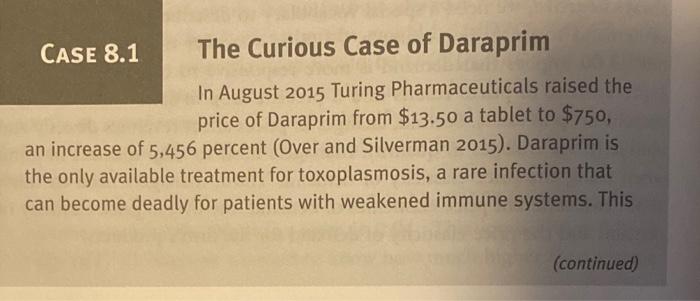
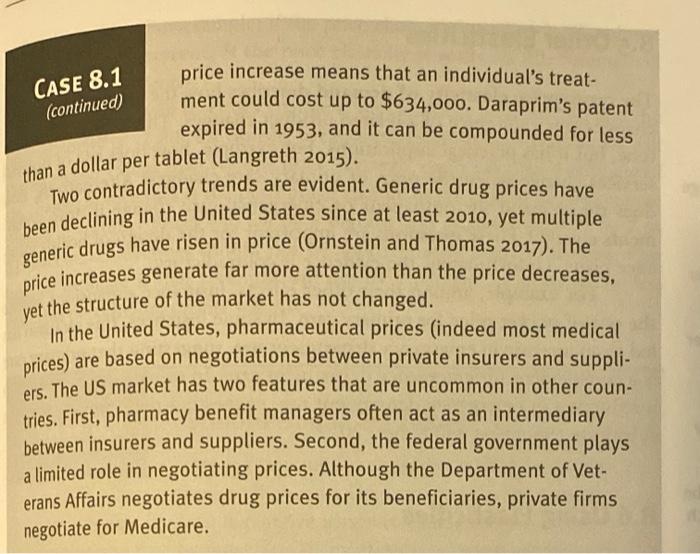
CASE 8.1 The Curious Case of Daraprim In August 2015 Turing Pharmaceuticals raised the price of Daraprim from $13.50 a tablet to $750, an increase of 5,456 percent (Over and Silverman 2015). Daraprim is the only available treatment for toxoplasmosis, a rare infection that can become deadly for patients with weakened immune systems. This (continued) CASE 8.1 (continued) price increase means that an individual's treat- ment could cost up to $634,000. Daraprim's patent expired in 1953, and it can be compounded for less than a dollar per tablet (Langreth 2015). Two contradictory trends are evident. Generic drug prices have been declining in the United States since at least 2010, yet multiple generic drugs have risen in price (Ornstein and Thomas 2017). The price increases generate far more attention than the price decreases, yet the structure of the market has not changed. In the United States, pharmaceutical prices (indeed most medical prices) are based on negotiations between private insurers and suppli- ers. The US market has two features that are uncommon in other coun- tries. First, pharmacy benefit managers often act as an intermediary between insurers and suppliers. Second, the federal government plays a limited role in negotiating prices. Although the Department of Vet- erans Affairs negotiates drug prices for its beneficiaries, private firms negotiate for Medicare
Step by Step Solution
There are 3 Steps involved in it

Get step-by-step solutions from verified subject matter experts
 Study Help