







Question: PLEASE ANSWER ALL THE 5 CASE QUESTIONS MENTIONED BELOW answer example > Answer Q1: Answer Q2: Answer Q3: Answer Q4: Answer Q5: PROJECT MANAGEMENT AT
PLEASE ANSWER ALL THE 5 CASE QUESTIONS MENTIONED BELOW
answer example >
Answer Q1:
Answer Q2:
Answer Q3:
Answer Q4:
Answer Q5:
PROJECT MANAGEMENT AT KUEHCHIC DESSERTS: REFRESHING A TRADITIONAL BUSINESS
It was the first Wednesday of February 2022 and the students in the Master of Science in Management programme at Singapore Management University (SMU) waited in anticipation. Like all Wednesdays, they knew that Daryl Lim, co-founder of Kuehchic Desserts, a boutique dessert company in Singapore, would bring an assortment of kueh, bite-sized Peranakan1 cakes, for his classmates to try. Despite the diverse backgrounds of the group, they all loved his weekly treats, which were sometimes sweet, sometimes savoury, but always colourful. Lim had educated them on the kueh making process and the technique to source for ingredients of the highest quality. However, the key ingredient to a great serving of kueh was passion, and Lims was evident. Lim was about to graduate and concentrate on his business full-time. He had to set a strategy to launch his products, along with his co-founders Sharon Tan and Shiva Kumar. While the initial feedback on the food was positive, Lim wanted to test his products with a wider tasting panel. The company also had to undertake various business development and website development tasks, which would be split among the team. Lim wondered if his strategy to manage the project was adequate, and if his entrepreneurship journey would be successful.
Singapore Food Culture Singapore is a small city-state of roughly 700 square kilometres. Located along an important trading route in the Straits of Malacca, it attracted traders from all over the world who traded with the indigenous Malays. Each group brought their own unique culinary fare along with their merchandise.
The result was a melting pot of food choices. The diverse culinary offerings created a food paradise for Singapores 5.4 million residents.3 Food was a huge part of the local lifestyle; dining was a social event and food was shared communally. Singaporeans loved their food, and the country was known globally as a food hub.
Origins of Kueh
The Peranakans, a term generally used to refer to people of mixed Chinese and Malay/Indonesian heritage, established their own culture after generations of inter-marriage between Chinese settlers
and natives from Southeast Asia. Kueh was a significant part of Peranakan cuisine. They used local ingredients such as pandan, coconut, rice, tapioca, and palm sugar (also known as gula melaka). The use of glutinous rice made many types of kueh soft, chewy, and bouncy - unlike Western pastries (refer to Exhibit 1 for an illustration of kueh). Besides baking, methods of kueh preparation included steaming, frying, and boiling. Traditional recipes for homemade kuehs, like family heirlooms, would be passed down from generation to generation.
Kuehchic Desserts
Lim loved to experiment with various ingredients and different cooking methods. He wanted to make less traditional but healthier and more elegant kuehs. His creation of new types of kueh had received positive response from friends and family. Eventually, his SMU classmates challenged him to build a business out of it. Sharon Tan, Operations Manager of Kuehchic, was a classmate who shared Lims passion for kueh, and it was agreed that she would be in charge of creating an online shop, making use of existing e-commerce platforms and home delivery services.
Together, they decided that Kuehchic would offer trendier kueh with a healthy twist, attuned to the taste of the millennium generation. Having attended a few sessions on project management, they decided to list the main tasks that would be necessary to launch the business, and quickly realised they also needed some IT support to create and manage the website. The duo then convinced Shiva Kumar, one of their classmates in the programme, to help them on a part-time basis, starting mid- August.
Initial Thoughts
Lim realised that he had to create a portfolio of kueh that would not only be attractive, but also easy to produce in large quantities. This would require far more resources than his usual experimentations at his parents kitchen. Though his parents were willing to support him and allowed him to use their kitchen for the launch of the company, he knew they would have to scale up and invest in additional kitchen equipment.
Tan too was aware that, in the preparation phase, they had to improve the branding of their products and examine whether the name was acceptable. The products also needed to be tested with a few panels of consumers in their target market. Additionally, she needed to finalise the exact cost of the kitchen equipment that was needed and develop a detailed business plan.
Once they had determined the final portfolio of products, there was the need for a wider market test before they could roll out their products. Kumar would develop the basic website with ordering and payment systems, take photographs of the actual products chosen, and then populate the website. Since Kumar was finishing an internship, he could not start before early August.
After some discussion Lim worked out a schedule for the various necessary tasks. He also estimated the time needed for these tasks and the sequence in which some of them needed to be carried out (refer to Exhibit 2 for the tasks, duration and sequencing for the launch). For reasons beyond their control, the team could only start work in July.
Lim mused: Assuming they did not work on the weekends but worked on official holidays, could the company be launched before the beginning of September, or two months after they start in early July?
If not, how could they organise for a September 1 start? Which tasks are on the critical path? He was also not sure if the suggested sequencing would work and was open to other proposed sequencing.
In addition, as they were eager to set-up their business quickly, the founders initially wanted to start all the tasks as soon as possible. But were there tasks they should start as late as possible? And would that change anything in the project plan?
Lim also wanted to evaluate which task had the highest free float (slack)? And what was the total float (slack)? If there was any delay on some of these tasks that had slack, which was the one that could change the critical path? Furthermore, assuming Lim, Tan, and Kumar paid themselves S$30 per hour, how much would the preparation of this business cost (excluding the procurement of the kitchen equipment)? Lim believed it was safe to assume that the total cost of ingredients in the early phases (before the launch) would not be higher than S$2,500.
Finally, he wanted to critically examine his workload, along with that for Tan and Kumar. Were any of them overloaded? Would they need some part-time support? Or should they take more time? Or should they reschedule tasks?
1. What is the Singapore food culture and that of Kuehchic Desserts? | 2 |
2. What are the issues and challenges in the case? | 2 |
3. From exhibit 2, what are the tasks on the critical path? | 2 |
4. Which task had the highest free float (slack)? | 2 |
5. Critically evaluate the workload of Lim, Tan, and Kumar | 2 |
The founders of Kuehchic Desserts, a boutique dessert company in Singapore, want to test their products with a wider tasting panel before launching them in the market. They also have to undertake various business development and website development tasks. Daryl Lim, one of the co-founders, wonders if his strategy to manage the project is adequate and if his entrepreneurship journey would be successful. The team could only start work in July, and Lim wants to know if they could launch the company before September 1, assuming they do not work on weekends but work on official holidays. He also wants to know which tasks are on the critical path and is open to other proposed sequencing.
To determine if the company could be launched before September 1, the team needs to create a project schedule and identify the critical path. The critical path is the sequence of tasks that must be completed on time in order for the project to finish on schedule.
EXPLANATION
According to Exhibit 2 in the case, the tasks, duration, and sequencing for the launch are as follows:
Develop final product portfolio (2 weeks)
Kitchen equipment procurement (4 weeks)
Improve product branding and testing (4 weeks)
Develop detailed business plan (4 weeks)
Conduct market test (4 weeks)
Website development (8 weeks)
Populate website with products (2 weeks)
Based on the given information, the critical path is as follows:
Develop final product portfolio (2 weeks) -> Kitchen equipment procurement (4 weeks) -> Improve product branding and testing (4 weeks) -> Develop detailed business plan (4 weeks) -> Conduct market test (4 weeks) ->
Website development (8 weeks) -> Populate website with products (2 weeks)
EXPLANATION
The total duration of the critical path is 28 weeks. Since the team can only start work in July, they have approximately 8 weeks before September 1. Therefore, they cannot complete all the tasks on the critical path before September 1.
To organize for a September 1 start, the team can consider the following options:
Reduce the duration of some tasks: The team can try to complete some tasks more quickly than the estimated duration. For example, they can try to reduce the duration of the website development task.
Reorder the tasks: The team can consider reordering the tasks to shorten the critical path. For example, they can conduct the market test earlier in the process to get feedback and make improvements before finalizing the product portfolio.
Prioritize tasks: The team can prioritize the tasks and focus on completing the most critical tasks first. For example, they can focus on developing the final product portfolio and procuring the kitchen equipment first since these tasks are at the beginning of the critical path.
Overall, the team will need to carefully consider their options and make trade-offs to launch the company before September 1. They may also need to adjust their project schedule and critical path based on new information or unexpected delays.
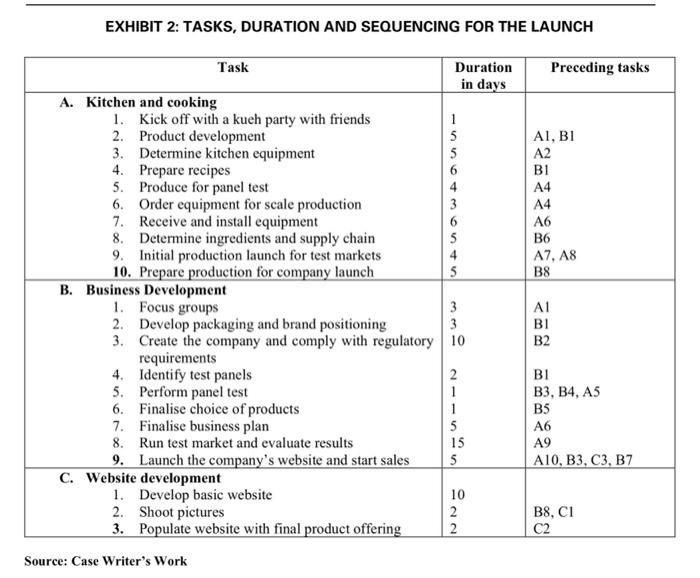
EXHIBIT 2: TASKS, DURATION AND SEQUENCING FOR THE LAUNCH
Step by Step Solution
There are 3 Steps involved in it

Get step-by-step solutions from verified subject matter experts
 Study Help