







Question: please answer all the correct answers. D Question 21 Those who abide by Kantian ethics behave by doing unto others as they would have done
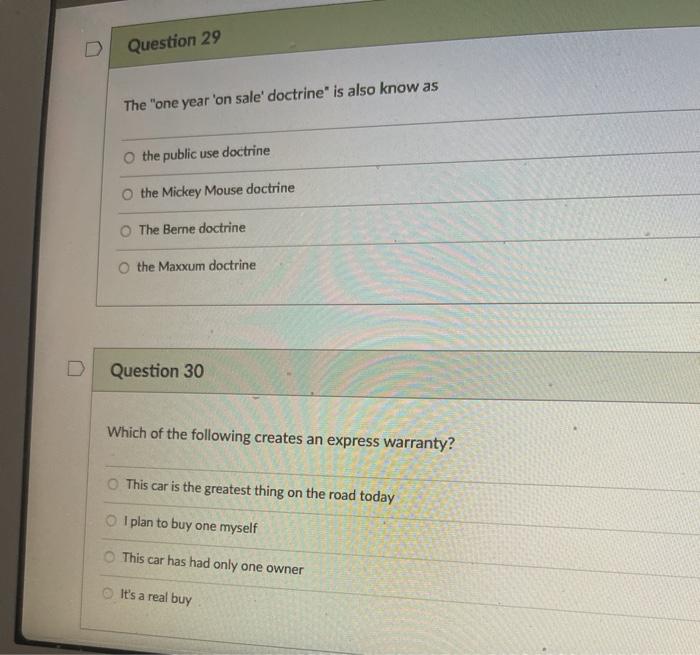
please answer all the correct answers.
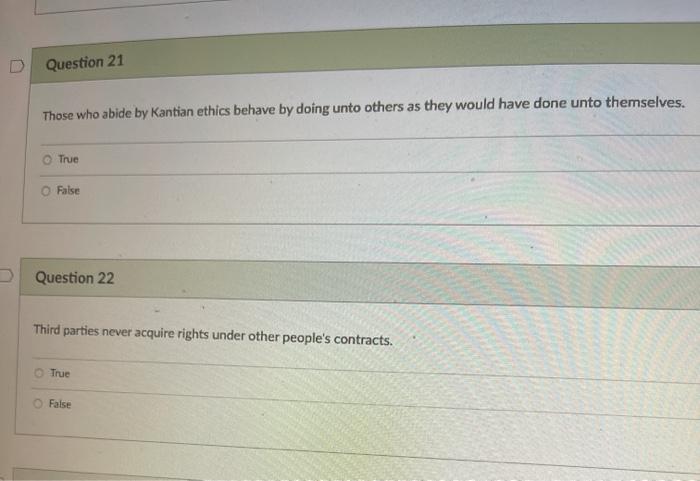
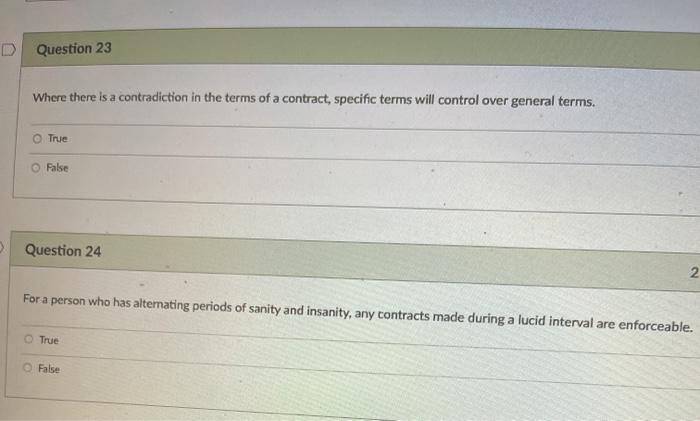
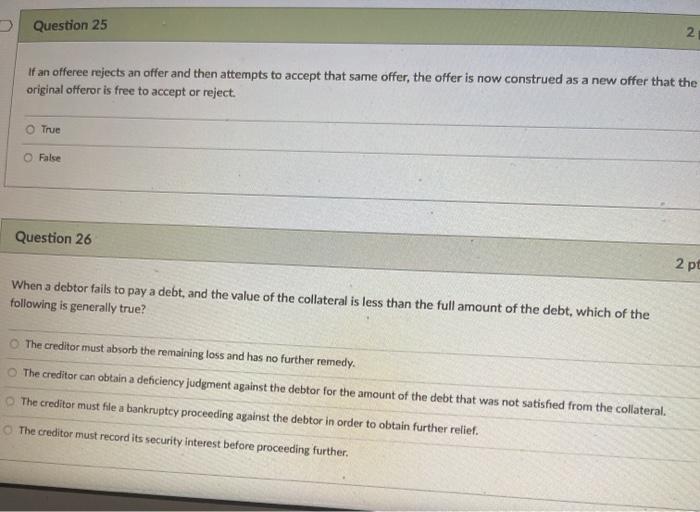
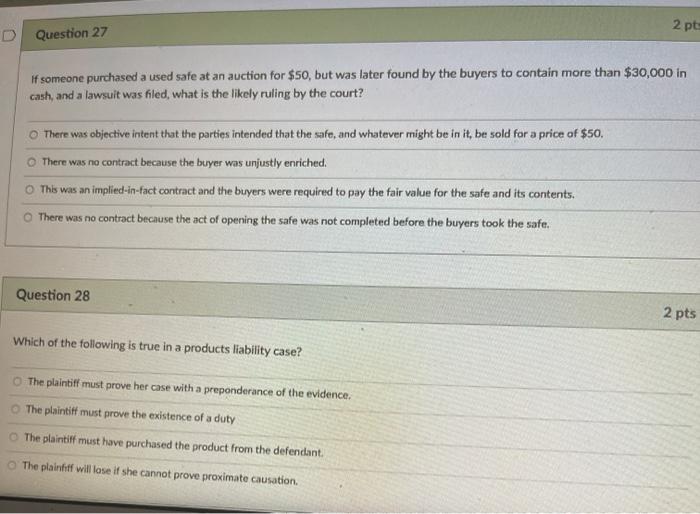
D Question 21 Those who abide by Kantian ethics behave by doing unto others as they would have done unto themselves. True False Question 22 Third parties never acquire rights under other people's contracts. True False D Question 23 Where there is a contradiction in the terms of a contract, specific terms will control over general terms. True False Question 24 2 For a person who has alterating periods of sanity and insanity, any contracts made during a lucid interval are enforceable. True False Question 25 2. If an offeree rejects an offer and then attempts to accept that same offer, the offer is now construed as a new offer that the original offeror is free to accept or reject. True False Question 26 2pt When a debtor fails to pay a debt, and the value of the collateral is less than the full amount of the debt, which of the following is generally true? The creditor must absorb the remaining loss and has no further remedy. The creditor can obtain a deficiency judgment against the debtor for the amount of the debt that was not satisfied from the collateral. The creditor must file a bankruptcy proceeding against the debtor in order to obtain further relief. The creditor must record its security interest before proceeding further. 2 pts Question 27 If someone purchased a used safe at an auction for $50, but was later found by the buyers to contain more than $30,000 in cash, and a lawsuit was filed, what is the likely ruling by the court? There was objective intent that the parties intended that the safe, and whatever might be in it, be sold for a price of $50, There was no contract because the buyer was unjustly enriched. This was an implied-in-fact contract and the buyers were required to pay the fair value for the safe and its contents. There was no contract because the act of opening the safe was not completed before the buyers took the safe. Question 28 2 pts Which of the following is true in a products liability case? The plaintiff must prove her case with a preponderance of the evidence. The plaintiff must prove the existence of a duty The plaintiff must have purchased the product from the defendant, The plaintiff will lose if she cannot prove proximate causation. D Question 29 The "one year 'on sale' doctrine is also know as o the public use doctrine O the Mickey Mouse doctrine The Berne doctrine the Maxxum doctrine D Question 30 Which of the following creates an express warranty? This car is the greatest thing on the road today I plan to buy one myself This car has had only one owner It's a real buy
Step by Step Solution
There are 3 Steps involved in it
1 Expert Approved Answer
Step: 1 Unlock

Question Has Been Solved by an Expert!
Get step-by-step solutions from verified subject matter experts
Step: 2 Unlock
Step: 3 Unlock
 Study Help