







Question: Please answer all the MCQs. 1. How much would $100, growing at 5% per year, be worth after 75 years? A) $3,689.11 B) $3,883.27 C)
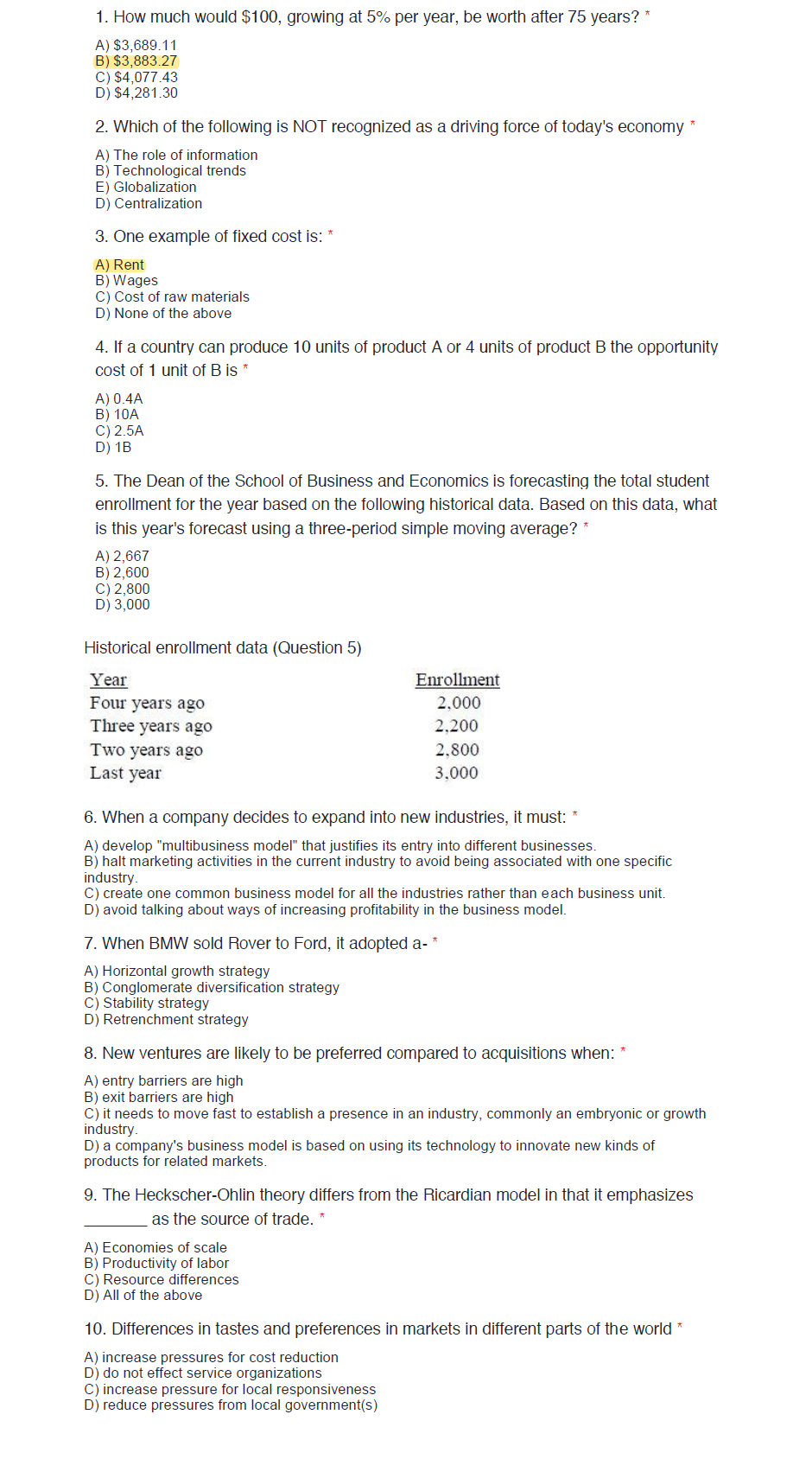
Please answer all the MCQs.
1. How much would $100, growing at 5% per year, be worth after 75 years? A) $3,689.11 B) $3,883.27 C) $4,077.43 D) $4,281.30 2. Which of the following is NOT recognized as a driving force of today's economy * A) The role of information B) Technological trends E) Globalization D) Centralization 3. One example of fixed cost is: * A) Rent B) Wages C) Cost of raw materials D) None of the above 4. If a country can produce 10 units of product A or 4 units of product B the opportunity cost of 1 unit of B is * A) 0.4A B) 10A C) 2.5A 5. The Dean of the School of Business and Economics is forecasting the total student enrollment for the year based on the following historical data. Based on this data, what is this year's forecast using a three-period simple moving average? * A) 2,667 B) 2,600 C) 2,800 D) 3,000 Historical enrollment data (Question 5) 6. When a company decides to expand into new industries, it must: * A) develop "multibusiness model" that justifies its entry into different businesses. B) halt marketing activities in the current industry to avoid being associated with one specific industry. C) create one common business model for all the industries rather than each business unit. D) avoid talking about ways of increasing profitability in the business model. 7. When BMW sold Rover to Ford, it adopted a- * A) Horizontal growth strategy B) Conglomerate diversification strategy C) Stability strategy D) Retrenchment strategy 8. New ventures are likely to be preferred compared to acquisitions when: * A) entry barriers are high B) exit barriers are high C) it needs to move fast to establish a presence in an industry, commonly an embryonic or growth industry. D) a company's business model is based on using its technology to innovate new kinds of products for related markets. 9. The Heckscher-Ohlin theory differs from the Ricardian model in that it emphasizes as the source of trade. * A) Economies of scale B) Productivity of labor C) Resource differences D) All of the above 10. Differences in tastes and preferences in markets in different parts of the world * A) increase pressures for cost reduction D) do not effect service organizations C) increase pressure for local responsiveness D) reduce pressures from local government(s)Step by Step Solution
There are 3 Steps involved in it
1 Expert Approved Answer
Step: 1 Unlock

Question Has Been Solved by an Expert!
Get step-by-step solutions from verified subject matter experts
Step: 2 Unlock
Step: 3 Unlock
 Study Help