







Question: please answer all the questions 1. How do you think Minneo should respond to the crew members? Should he give his input to the captain
please answer all the questions 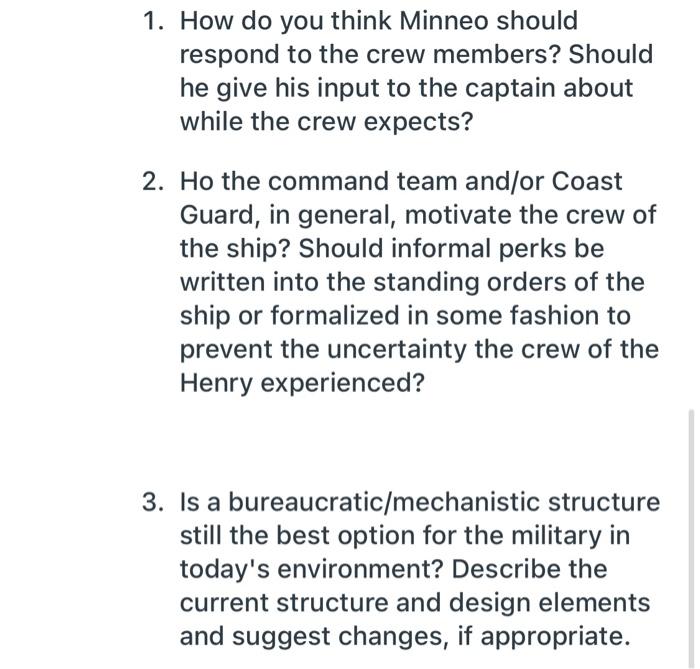
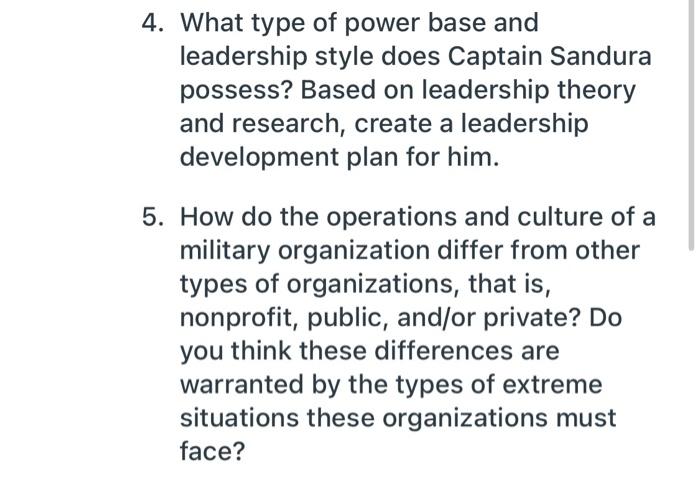
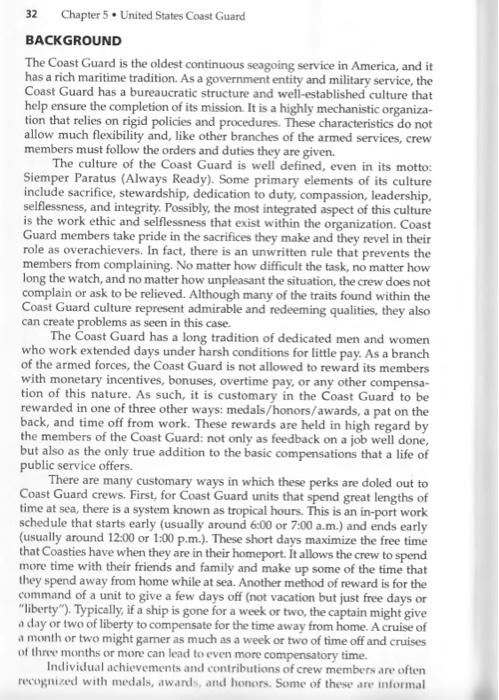
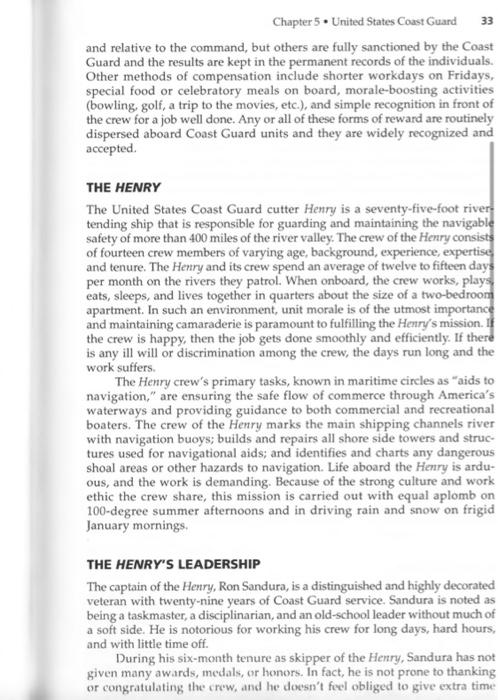
1. How do you think Minneo should respond to the crew members? Should he give his input to the captain about while the crew expects? 2. Ho the command team and/or Coast Guard, in general, motivate the crew of the ship? Should informal perks be written into the standing orders of the ship or formalized in some fashion to prevent the uncertainty the crew of the Henry experienced? 3. Is a bureaucratic/mechanistic structure still the best option for the military in today's environment? Describe the current structure and design elements and suggest changes, if appropriate. 4. What type of power base and leadership style does Captain Sandura possess? Based on leadership theory and research, create a leadership development plan for him. 5. How do the operations and culture of a military organization differ from other types of organizations, that is, nonprofit, public, and/or private? Do you think these differences are warranted by the types of extreme situations these organizations must face? 32 Chapter 5. United States Coast Guard BACKGROUND The Coast Guard is the oldest continuous seagoing service in America, and it has a rich maritime tradition. As a government entity and military service, the Coast Guard has a bureaucratic structure and well-established culture that help ensure the completion of its mission. It is a highly mechanistic organiza- tion that relies on rigid policies and procedures. These characteristics do not allow much flexibility and, like other branches of the armed services, crew members must follow the orders and duties they are given. The culture of the Coast Guard is well defined, even in its motto: Siemper Paratus (Always Ready). Some primary elements of its culture include sacrifice, stewardship, dedication to duty, compassion, leadership, selflessness, and integrity. Possibly, the most integrated aspect of this culture is the work ethic and selflessness that exist within the organization. Coast Guard members take pride in the sacrifices they make and they revel in their role as overachievers. In fact, there is an unwritten rule that prevents the members from complaining. No matter how difficult the task, no matter how long the watch, and no matter how unpleasant the situation, the crew does not complain or ask to be relieved. Although many of the traits found within the Coast Guard culture represent admirable and redeeming qualities, they also can create problems as seen in this case. The Coast Guard has a long tradition of dedicated men and women who work extended days under harsh conditions for little pay. As a branch of the armed forces, the Coast Guard is not allowed to reward its members with monetary incentives, bonuses, overtime pay, or any other compensa- tion of this nature. As such, it is customary in the Coast Guard to be rewarded in one of three other ways: medals/honors/awards, a pat on the back, and time off from work. These rewards are held in high regard by the members of the Coast Guard: not only as feedback on a job well done, but also as the only true addition to the basic compensations that a life of public service offers. There are many customary ways in which these perks are doled out to Coast Guard crews. First, for Coast Guard units that spend great lengths of time at sea, there is a system known as tropical hours. This is an in-port work schedule that starts early (usually around 6:00 or 7:00 a.m.) and ends early (usually around 12:00 or 1:00 p.m.). These short days maximize the free time that Coasties have when they are in their homeport. It allows the crew to spend more time with their friends and family and make up some of the time that they spend away from home while at sea. Another method of reward is for the command of a unit to give a few days off (not vacation but just free days or "liberty"). Typically, if a ship is gone for a week or two, the captain might give a day or two of liberty to compensate for the time away from home. A cruise of a month or two might garner as much as a week or two of time off and cruises of three months or more can lead to even more compensatory time. Individual achievements and contributions of crew members are often recognized with medals, awards, and honors. Some of these are informal 33 Chapter 5. United States Coast Guard and relative to the command, but others are fully sanctioned by the Coast Guard and the results are kept in the permanent records of the individuals. Other methods of compensation include shorter workdays on Fridays, special food or celebratory meals on board, morale-boosting activities (bowling, golf, a trip to the movies, etc.), and simple recognition in front of the crew for a job well done. Any or all of these forms of reward are routinely dispersed aboard Coast Guard units and they are widely recognized and accepted THE HENRY The United States Coast Guard cutter Henry is a seventy-five-foot river tending ship that is responsible for guarding and maintaining the navigable safety of more than 400 miles of the river valley. The crew of the Henry consists of fourteen crew members of varying age, background, experience, expertise and tenure. The Henry and its crew spend an average of twelve to fifteen days per month on the rivers they patrol. When onboard, the crew works, plays, eats, sleeps, and lives together in quarters about the size of a two-bedroom apartment. In such an environment, unit morale is of the utmost importance and maintaining camaraderie is paramount to fulfilling the Henry's mission. It the crew is happy, then the job gets done smoothly and efficiently. If there is any ill will or discrimination among the crew, the days run long and the work suffers The Henry crew's primary tasks, known in maritime circles as "aids to navigation," are ensuring the safe flow of commerce through America's waterways and providing guidance to both commercial and recreational boaters. The crew of the Henry marks the main shipping channels river with navigation buoys: builds and repairs all shore side towers and struc- tures used for navigational aids; and identifies and charts any dangerous shoal areas or other hazards to navigation. Life aboard the Henry is ardu- ous, and the work is demanding. Because of the strong culture and work ethic the crew share, this mission is carried out with equal aplomb on 100-degree summer afternoons and in driving rain and snow on frigid January mornings THE HENRY'S LEADERSHIP The captain of the Henry, Ron Sandura, is a distinguished and highly decorated veteran with twenty-nine years of Coast Guard service. Sandura is noted as being a taskmaster, a disciplinarian, and an old-school leader without much of a soft side. He is notorious for working his crew for long days, hard hours, and with little time off. During his six-month tenure as skipper of the Henry, Sandura has not given many awards, medals, or honors. In fact, he is not prone to thanking or congratulating the crew, and he doesn't feel obliged to give extra time 34 Chapter 5. United States Coast Guard off or compensatory time away from work for the crew. Sandura does not believe in tropical hours or extra liberty after a long voyage. This leader- ship style has led to many problems aboard the Henry, and the overall morale of the men has gradually declined since Sandura took command of the ship For the experienced personnel aboard the ship, many of Sandura's tactics run contrary to what they have encountered over the years. For the junior members aboard the Henry, it has been a rude awakening-not what most of them signed up for at the recruiter's office. The veteran Coasties have soured and lost their drive. Several of the novice Coasties have become disgruntled, rebellious, and restless. There are now discipline problems, requests for transfer, and attempts to leave the Coast Guard early, just to avoid being under Sandura's command. Captain Sandura is not the only player on the Henry. Although he has the autonomy to make most of the decisions concerning the command of his vessel, he has a command team that works beside him to run the day-to-day operations of the ship. Clark Minneo is the executive petty officer, the second in command and right hand man to Captain Sandura. He personally regu- lates the workflow and the climate aboard the Henry as much if not more than Sandura. Minneo is responsible for establishing the work list for all departments, ordering supplies, making financial decisions, deciding on matters such as sick leave and vacation, and dispensing punishment and discipline when necessary. He ultimately sets the tone and the mood aboard the ship Minneo and Captain Sandura have a cordial working relationship. Minneo is a rank below Sandura, but he has more direct experience and leadership credentials than the captain. This has been a sore spot for Minneo since Sandura became captain. Minneo believes that Sandura was appointed for political reasons without use of a fair hiring process. Furthermore, neither Minneo nor the other crew members were consulted when the captain's position became available. Although Minneo believes that he is more qualified than Sandura, he knows better than to challenge the system. He made the decision from the start to put his feelings aside for the betterment of the Henry and its crew, and he treats Sandura and his authority with respect CAPTAIN V. CREW This summer, the crew of the Henry set out on a particularly hot Monday morning, heading up the river on an excursion to service aids to navigation and to make any necessary repairs and adjustments to the existing struc tures along the river. The trip took the crew of the Henry eleven days round trip. This was the first lengthy trip that the crew had taken under Sandura's command. Crew members did not know exactly what to expect, but they were hopeful that it would mirror past trips that they had on the Henry under different command 35 Chapter 5. United States Coast Guard One of the benefits of being aboard a river tender, as opposed to a seagoing vessel, is that the work cannot be done at night. Navigating the river at night is one thing, but setting 1,500-pound buoys and dimbing towers along the bank is a whole different story. Because the crew could not work at night, the Henry usually pulled into a port, a town, or at least to the side of the river every evening and stayed put until first light the next day. This gave the crew a chance to get off of the boat to go for a walk or even see a movie, depending on where the Henry docked. The crew worked hard all day and greatly appreciated this personal time when the day was done. This was recognized and accepted behavior in the river-tender community, and the crew of the Henry expected it. Along the Henry's route were several towns that had the facilities to accommodate a large ship such as the Henry for the evening. Many of these towns also had distractions and amenities that the crew enjoyed. There were enough of these towns that on any given night, the captain could take his pick of ports. On this trip, however, Sandura did something contrary to the accepted norm: he seemingly went out of his way to stop the Henry each evening a few miles above or a few miles below any towns along the bank. He chose places that, although suitable for the ship to anchor, did not allow for any recreation for the crew. Some of the stopping points were so isolated that the crew could not even exit the ship once moored. The members of the crew started to grumble among themselves. They had been working diligently and had completed every task asked of them on this trip. Why was the captain not giving them the one perk that he had the power to give? As the trip progressed, Sandura continued to forgo the ritual of spending the night in port and proceeded to find various uninhabitable locales along the river. The morale of the crew was visibly affected. There was infighting, bicker- ing among shipmates, lethargy, and a general uneasiness that was not normal aboard the Henry On the eleventh day of the journey, the Henry slipped back into its home port, having covered more than 400 miles of river. The crew had placed more than seventy navigational buoys along the route and effected repairs to more than twenty shore-side structures. The temperatures had been in the nineties and the humidity had made the air thick enough to cut with a knife, but the members of the crew had performed their jobs in typical Coast Guard fashion Upon returning to port, the crew is required to perform numerous ritual- ized tasks before anyone is allowed to go home. These include washing the ship from top to bottom offloading expended supplies, refueling, and writing reports that are required by headquarters. Another longstanding tradition upon returning from a mission is known as "quarters." Quarters takes place after all of the mundane returning tasks are completed. The crew of the ship gathers to discuss the trip it just completed. Crew members highlight any lessons learned, recall any close calls or safety concems, and set the stage for the next mission. This is also a time for the captain to recognize the hard work and dedication of any or all of the crew members. Since the crew members do not get overtime pay, bonuses, merit raises, or any other form of compensation, this praise in front of their shipmates is important to morale 36 Chapter 5. United States Coast Guard During quarters for the preceding Henry mission, Sandura did not say a word apart from the review of the work done and some minor details regard- ing the next trip. Crew members were left wondering what they had done wrong on their mission that had made the captain act so abnormally harsh. THE LAST STRAW After the crew broke from quarters, Minneo briefed them about when they had to report back to the ship for work. It is an unwritten rule in the Coast Guard that the crew should usually expect a day or two off after a ten- or eleven-day trip with no breaks. Clark announced to the crew that they were all to report back to work the very next day to resume in-port duties. They were not to receive any extra time off-a decision that, although presented by Minneo, had Sandura's fingerprints all over it. There would be no free time during the excursion, no pats on the back upon return, and no liberty for a job well done. The crew members were dumbfounded. Some shook their heads in disbelief, some sighed in disgust, and others had to muffle their shouts of anger. Although everyone was angry, no one aboard the Henry had the fortitude to question Sandura's tactics, and no one on the command team stood up for the crew. This trend continued for the next several months, and the morale and drive of the crew members continued to plummet. There was no recognition, no extra liberty, no port calls, and no tropical hours. Instead, the crew received days and days of hot, backbreaking work for a wage that barely kept them above the poverty level. In spite of the obvious effects that this was having on the crew, Sandura did not waiver in his leadership style or in his decision making when it came to matters of the crew. Minneo knew things were not going well. He was well aware that the crew's expectations were not being met, but for some time neither he nor anyone else on the command staff did anything to influence the captain's decisions. In a culture where everyone must pull his or her own weight and there is nowhere to hide when the work begins, Sandura's leadership style went unchecked. No one complained directly to the command and the work continued to get done. The usual perks offered to the crew of a Coast Guard vessel were unofficial, not guaranteed. Under Captain Sandura, they were not even considered. Eventually, even Minneo becomes impatient with Sandura. Even though he is a senior officer and has to set an example for the crew, Minneo wants to spend some time with his family and away from the boat. After a particularly hot, humid, and exhausting trip in August, Minneo decides to go to the captain's chambers to discuss the situation Step by Step Solution
There are 3 Steps involved in it
1 Expert Approved Answer
Step: 1 Unlock

Question Has Been Solved by an Expert!
Get step-by-step solutions from verified subject matter experts
Step: 2 Unlock
Step: 3 Unlock
 Study Help