







Question: Please read this brief case study Johannes Linden: Managing the Global Executive Committee by Linda A. Hill, Mark Rennella. Once you finish reading the case
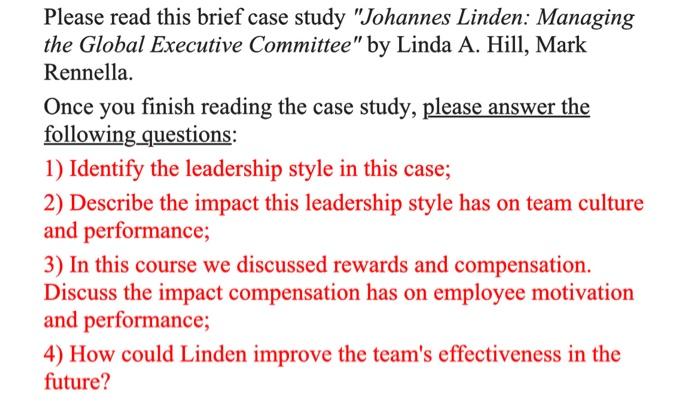
Please read this brief case study "Johannes Linden: Managing the Global Executive Committee" by Linda A. Hill, Mark Rennella.
Once you finish reading the case study, please answer the following questions:
1) Identify the leadership style in this case;
2) Describe the impact this leadership style has on team culture and performance;
3) In this course we discussed rewards and compensation. Discuss the impact compensation has on employee motivation and performance;
4) How could Linden improve the team's effectiveness in the future?
Johannes Linden: Managing the Global Executive Committee
On February 1, 2011, Johannes Linden, Director of the Washer and Dryer Division of a Swiss appliance company, Fluss, was alone in his Beijing hotel during a rare break in the quarterly Global Executive Committee (GEC) meeting. As he reflected on the meeting thus far, he felt energized by how well they had performed in 2010. The prospects next year looked even better for Fluss Washer and Dryer (FWD). However, he had to admit some frustration that they were not reaching consensus on the issue at hand.
Because the business planning cycle for the coming fiscal year had finished three months earlier based on an assumption of higher material costs, the new lower steel price FWD had just negotiated with suppliers would result in an unanticipated savings of 10%20%. As a result of these savings, the GEC faced some tough decisions. First, they had to decide whether or not to change the business targets for each country to reflect the new price. If they chose to alter the targets, they had to address the even more sensitive matter of whether country managers bonuses, which were based principally on the achievement of those targets, should be based on the old or new figures.
Linden had begun the meeting by praising the team for their tireless efforts over the past few years. He shared with them the CEOs remarks at the last board meeting about the invaluable contribution FWD had made to the overall corporate performance during the worst financial crisis in generations. Thanks to their hard work and what looked like an improving world economic outlook, FWD was in a position to restart a gradual expansion of manufacturing capacity that had been suspended in 2010. (See Exhibit 1 for FWDs organizational chart and Exhibits 2a and 2b for the companys overall and region-specific revenue figures.)
Linden had continued the meeting with an update about Flusss primary competitorthe Korean appliance giant, RiverTech. Fluss and RiverTech had both made the strategic decision in the mid- 2000s to go green (environmentally friendly, energy-efficient, or both) with their entire product lines. FWD had focused its innovations in two domains: developing smart washers and dryers, and manufacturing both ventless dryers and combination washerdryers that featured a novel heat pump technology. (Exhibit 3 briefly describes these technologies.) Linden then launched into some welcome news about which he knew the rumors had been flying: You know we have been exploring multiple ways to find an edge in this industry. An effort, spearheaded by David, our tireless RD (regional director) from Australia, has paid off. He finally got us to get our act together, combine our volumes across the region, and renegotiate a single contract with our primary supplier. As you know, each of you had handled your own purchasing, and the terms of your contracts varied considerably as David found out. As we all know, because steel is the major raw material used to manufacture our products, even small changes in steel prices can significantly affect our prospects. We think the new terms will not only improve our margins, but may also give us the opportunity to undercut RiverTechs prices and capture market share. We project that there should be almost immediate cost savings of 10% to 15% in most of our regions during this fiscal year.
While this was indeed encouraging news, Linden was privately concerned about whether the GEC could steer FWD in the future. The young division (established in 2004) had been focused on growing revenues and market share since inception. The divisions innovative products had garnered solid profit margins, butespecially in the appliance industrythose margins would inevitably be eroded. Reducing material costs was keybut it was only the beginning of what they needed to do to maintain, much less grow, their market position in a slower growth environment. Linden, along with all of Flusss other divisional directors, had been recently tasked by the CEO to focus on profitable growth. He knew there were two major corporatewide initiatives in the works. Flusss divisions would be asked to standardize parts where possible to allow for more global outsourcing. And, of course, the shared services model for IT and accounting would begin implementation in the third quarter of the coming year. Linden knew the GEC had many strategic issues and decisions with which to grapple in the near future.
The spirit in the room became buoyant with the prospects of FWDs rising fortunes, but the tone of the meeting changed when Linden brought up the target issue. I know we just went through a pretty grueling time setting the targets for fiscal 2011 three months ago, but we need to decide whether to adjust them to reflect the gains in sales and margins we can expect as a result of the new steel prices? Linden believed that both the targets and bonuses should be adjusted, although he had kept his opinion to himself at first.
When the GEC membersthe six regional directors (RD) and the four corporate staffseemed unwilling to engage the issue, Linden commented that they could ill afford to let the country managers become complacent. He went on to say, These were windfall gains for the country managers; they had done nothing to earn them. When the conversation seemed to be going nowhere, Linden suggested a 15-minute break. He went up to his room to make a quick call to his kids at home. He hoped the GEC members would take the time to reflect and stop thinking like country managers and instead do what was best for the company, even if it meant giving their people unpopular news. Given their disappointing discussion of the targets, he wondered if they were up to the task.
Lindens Outlook on the Washer and Dryer Industry Landscape in 2011
Linden was confident in the future growth potential at FWDprovided that the division was ready to move decisively to adapt to the ever-changing economic landscape. As the first decade of the twenty-first century demonstrated, economic realities could change rapidly. Since 2005, global GDP had gone from a high of about 6% down to near zero in 2009. It was back up around 4% in 2010 and, according to the Fluss economic forecasts, was expected to remain at that level until 2015. Fluss predicted that the emerging economies would grow at an average 4% more than developed ones.
Two trends that would have a long-term impact on FWDs prospects in emerging economies were increasing urbanization and the rise of disposable income. FWDs green/efficient products were well-suited to the needs of these consumers to save time, space, and energy costs. Although green appliances were typically more expensive than conventional appliances, many consumers were willing to pay some premium for green appliances. Besides, more governments and energy companies were offering incentives, such as rebates, to those who bought smart appliances.
Where exactly FWDs growth would come from was uncertain. Egypt, for example, was on the Fluss list as a fast-growing emerging country, but recent political upheavals now made business prospects unclear. And consumers evolving perceptions of climate change appeared to be having an impact on their interest in green technologies. In Eastern Australia, for example, unusually long stretches of rainy weather the previous year had caused dryer sales to climb sharply. Focus group results showed that more Australians felt they no longer could rely on the sun as a cheap and reliable way to dry their clothes.
But it was not enough to be prepared to respond to these long-term global or regional trends; FWD also had to keep its eye on local preferences as well. Consumer laundering habits varied around the world. Just consider the habits of two of FWDs most important national markets Germany and Brazil. In Germany, a top priority for consumers was to eliminate bacteria from dirty clothes. Consequently, Germans tended to wash clothes with very hot water. Water temperatures were commonly set at 45 degrees Celsius compared with 30 degrees in the United States and 20 degrees in Japan. Brazilian laundering habits provided an even greater contrast: instead of using very hot water or strong detergents to eliminate tough stains, Brazilians often relied on hand washing. Would these laundering habits converge over time? No one really knew.
As Linden saw it, the economic and cultural mosaic in which FWDs products had to fit in 2011 and the years ahead was in a state of unprecedented flux. There were great opportunities to be had, but the challenges were as plentiful. Linden needed an agile organization led by executives with both strategic and operational expertise.
Flusss Evolution
Fluss AG, the Swiss parent company of FWD, had 51,000 employees and earned $15 billion in revenues in 2010. Since its founding in 1947, Fluss specialized in the design and manufacture of large household appliances. From 1947 to 2004, Fluss expanded globally and established geographic divisions: Fluss Americas, Fluss Asia, and Fluss Europe.
In 2004, CEO Hans Kehrer faced two conflicting goals: finding efficiencies whenever possible by pooling resources globally, and tailoring their products and operations for the local consumer and competitive landscape. After much deliberation, Kehrer and the board reorganized Fluss; the company went from a geographic to a product-oriented structure. Specifically, they established divisions, each of which focused on a particular appliance product line (e.g., refrigeration, stoves, dishwashers, washers, and dryers). In this new structure, each strategic business unit could develop deep expertise in its particular market segment, as well as capitalize on sharing best practices across the globe.
Fluss Washer and Dryer: Johannes Linden at the Helm
Linden, age 40, became director of FWD in 2004 with the reorganization after four years as COO of Flusss European division. As a director, he now reported directly to CEO Hans Kehrer. The son of a world-traveling Swiss journalist, Linden had earned an MBA from a prominent European business school. He was excited about his new responsibilities as a general manager running a global business with 3,000 employees. The Fluss culture was one of decentralization and accountability. Although he had enjoyed his role as COO, Linden had felt constrained by his bosss tendency for conservative and slow decision making. Of course, his boss had accused Linden on more than one occasion of being too impatient. Linden was eager to try out his own leadership ideas and drive the business to new heights. His intention was to foster a more open, collaborative, yet aggressive culture.
Linden was careful to recruit other high-energy executives to his executive team. His COO was an American who had worked for a German appliance company. The other three principal executives the Chief Human Resources Officer (CHRO), the Chief Financial Officer (CFO), and the Chief Marketing Officer (CMO)had worked previously with Linden at Fluss Europe.
When Linden took over FWD in 2004, the division was divided into three geographic regions: Asia, Europe, and the Americas. The country managers in each region reported to an RD who had profit-and-loss responsibility for the region. Country managers were expected to run their countries the way they saw fit as long as they did so in alignment with the division strategy and mutually agreed upon business targets.
To keep his finger on the pulse of the organization, Linden traveled 50% of the time. He liked to visit RDs and country managers alike to have face-to-face, eyeball-to-eyeball discussions about the business. He asked tough questions to get behind their ideas and hear what they were really thinking. He participated very actively in the discussions and development of the annual business plans for most country managers. These plans in turn became the foundation of regional plans and budgets. My personal visits give me a great chance to connect with every country manager and every national market, Linden commented. Inevitably the bonus program is important to both me and my staff. Its a carrot I use to motivate the country managers to stretch. It also helps me to understand exactly how they plan to make the targets in their respective markets. How solid are their forecasts? Have they got good contingency plans?
In the spirit of open communication, Linden tried to encourage the RDs and their country managers to feel free to approach him about any topic on their minds. Everybody knows that none of this information is considered in confidence, Linden explained. If a country manager, for instance, brings up a question to me, I am likely to share it with his RD. And they are free to share anything I say to any of them with their RD and others.
Reflecting on Lindens leadership style, his CFO remarked: Johannes is open to ideas and suggestions, but he knows how to wield a stick, too. Any country manager who resists his vision or hands-on approach usually has one chance to get with the program. If they dont, theyll be out of a job. Johannes is polite, but very firm.
Refining the Regional Structure and Responsibilities in 2006
Linden enjoyed his personal interactions with RDs and country managers around the world, but his travel schedule at times threatened to overwhelm him. Given the dynamism of the markets, he knew he had to delegate more oversight and management responsibilities to his RDs. In response to the growth of the emerging economies, in early 2006, Linden concluded they should increase the number of FWD regions from three to six.
Linden decided to ask the RDs to work together and offer a recommendation about how to reconfigure the regions. He was pleased with how they worked through the issues. He explained: We split the Americas into two regions, reflecting the growing strength of South America. I had to do some convincing to get the North American RD to agree to share the American region with somebody else, but it was the practical thing to do. Europe was slowing, so we added North Africa to that regions business. The geographic arrangements the RDs created (like dividing Asia between mature and developing economies) made sense. It was something I wouldnt have thought of on my own. I had always viewed territories in terms of continents or subcontinents.
The European RD recalled: That initial work on geographic structure was excitingit helped to get us all aligned with the strategic vision for FWD. As a result, Johannes seemed more comfortable with our principle that not only operations, but also, acquisitions would remain largely the responsibility of RDs working in concert with their country managers. Of course, he would still get very engaged when he thought it was necessary.
These changes also resulted in the RDs driving more deeply the business planning process in their regions, which focused on projecting (and defending) targets for revenues, market share, and profits for each national market. The business-planning process for the fiscal year starting in 2007, for example, followed this schedule:
October 2006: Country managers prepare their business plans.
Early November 2006: Country managers meet with RDs to review the business plans.
Late November 2006: RDs meet with Linden and the CFO to review national and regional goals.
December 2006: RDs meet with country managers to discuss final plans and targets with either the CFO or Linden present.
At the final December meetings, country managers were encouraged to offer any last objections or concerns they had. After some give and take, the parties in attendance were to reach consensus. The CFO described their practice in this way: Because bonuses are tied to revenues, discussing the revenue numbers often becomes a focus of the meetings. Johannes allows country managers to have their say. But the group always leaves these December meetings with a firm agreement on revenue and profit targets and bonus percentages. The bonus structure was generous for the industry. I believe in an aggressive bonus plan, Linden had once remarked. It usually pays off in terms of productivity and profits.
One country manager commented: When were at a meeting and Johannes brings all of his knowledge of the business to bear on your national plan, it can be pretty intimidating. Its more than agreeing on the terms of a contract; its like taking a solemn vow.
FWDs executives agreed that Lindens grasp of the business was impressive and recognized that he often used his knowledge to push agreement between RDs and country managers when they seemed at odds. Linden felt that his high level of participation was an important part of executing his strategy: Effective strategy requires communicating with people about strategic goals. Sometimes a leader must communicate with a little extra emphasis. Its one method I use to run a regional organization while maintaining a global vision.
The GEC Begins
After implementing the new FWD regional structure, Linden created the GEC, which consisted of his corporate staff and the six regional directors with himself at the helm. The world is too big for me to run by myself, Linden sometimes quipped to his staff. It is my hope that GEC will be our forum for making strategic and major investment decisions. We have to be responsive to local conditions, but unless executive management discusses the world frequently, the company cant accurately perceive, much less exploit, opportunities for global synergy. The GEC agreed to meet three times a year in Basel to focus on operational matters and important initiatives, and once a year they would hold the meeting at a regional headquarters to discuss long-term strategy.
A week before the first GEC meeting in September 2006, Linden solicited questions and concerns from the RDs, vetted them with the corporate staff, and sent out an agenda. The most pressing issues for the first meeting included clarifying the authority and decision-making rights between RDs and country managers and RDs and the corporate staff.
It did not take long for the GEC to agree on some guidelines concerning the roles and responsibilities of the RDs and country managers. (Exhibit 4 describes a partial list the GEC generated as a result of their deliberations about the roles and responsibilities of FWDs RDs and country managers.) The conversation about the line versus staff relationships was more complicated and heated. Linden emphasized that the corporate staff were not there to dictate to the RDs how to run their businesses, but rather to provide support and expertise to help them execute the divisional strategy and look for regional synergies. He reminded them that they all reported to him directly.
The South American RD expressed the views of many RDs when he remarked that RDs had little or no role during the first meetings of the GEC: The corporate staff, like the CMO and CFO, and Johannes had a point of view on regionwide issues, it seemed, but we werent sure how we were supposed to work with them at these meetings. Another RD characterized these early meetings as a bit overwhelming: It would have been nice for the RDs to work together more like we did in early 2006, when we planned out the six regions. But we were so busy getting our own regions in order when the GEC first met that we mainly deferred to Johannes on global questions. Johannes certainly wanted the meetings to be livelier. Whats the point of getting together if Im not learning from you all? he asked us at the meeting in June 2007.
By early 2008, the RDs were becoming more comfortable working through problems together, and they began to contribute more ideas in the quarterly gatherings. Ernst Martin, the RD for North America, noted: After we became more familiar with our territories and had some early successes in our regionsmaking successful acquisitions on our own, for examplewe got the confidence to speak up more about our experiences and our views on where the company should be going. When we knew our regions were doing well, we could then think a little more about working as the FWD team.
Working Together
By 2010, the GEC had been functioning for more than three years. They had fallen into a routine. Each GEC meeting began with the CFOs discussion of the state of the business and where they were with regard to financial targets and the CMOs review of the latest developments in the washer and dryer product category. Linden then discussed important competitive and economic trends and they talked about their potential impact on their plans. The meeting ended with updates from RDs about developments in their regional operations. Even though regional markets are very different, Linden commented, RDs have a lot to learn from one another. Learning about other parts of the corporation encourages them to get involved in global strategy.
Outside the GEC meetings, Linden kept in close contact with the RDs, but it was his sense the RDs did not interact with one another frequently with one exception. The RDs for China/Southeast Asia and India/IndonesiaVinata Das and Achir Sharmahad both grown up in northern India and were now in charge of neighboring regions. Recently, they had proposed a new joint recruitment strategy to FWDs corporate human resources manager. Attracting and retaining talent was a major business challenge in their regions.
The GEC members began to adopt different roles in the group. Das and Sharma were the experts on developing countries; Martin, a Swiss expatriate and former operations manager for a retail chain in Canada, was the go-to-person on supply chain issues; and King, the Australian RD, was the one they turned to for the latest on sourcing and materials matters. (See Exhibit 5 for short biographies of the GEC members.)
Over time, the formal and informal meetings of the RDs fostered a sense of camaraderie among themand competition. At one GEC meeting in Bangalore, Sharma delighted the other members of the GEC with a surprise visit from one of Indias premier classical musicians. The RD responsible for hosting the next meeting tried to show up Sharma with his own surprise activity. At one Basel meeting, Linden stole the show by daring members of the GEC to play drums with him at a prominent club with a local band. According to the CFO, this was all part of the healthy combination of competition and friendship we have among the members of the GEC. Were all ambitious individually, of course, but we respect each other a lot. Theres no jealousy among us.
Competition between the GEC members also had another source, as one senior staff member explained: Johannes is only 40. Although he was happy with directing FWD after the re-org, somebody like him always has his sights set on the C-level positions in the parent corporation. Everybody senses his ambition.
GEC members varied in their opinions about the meetings themselves and Lindens role in them. The CHRO remarked: Johannes is always looking for consensus. He seems genuinely pleased when we get to a decision after a good debate. But in the end, especially when he firmly believes in a course of action, he can be what I might call a smooth dictator. Very likable, very persuasive, but very determined to get where he wants to go. That has to happen sometimes in a big organization.
An RD from Asia observed: There are some difficulties getting through to Johannes at these meetings. If you speak about another region, like the Americas, you probably wont get his attention. And if you do get his attention, youve got to back up your idea in detail. It makes it hard to be creative sometimes. I find it much easier to talk to him one-on-one. I get more done with him that way.
Martin said: Since were investing a lot of resources in these GEC meetings, I feel an obligation to offer my point of view about where the whole company is going. It seems like some people at the GEC appreciate that, and some good conversations have developed at these meetings. Whether or not the whole GEC agrees with me is another matter.
The RD from South America commented: On the one hand, its hard to argue with his success. Weve been doing pretty well despite the crazy economy. On the other hand, Linden can be stubborn sometimes. Although we like working together in the GEC, we mainly focus on getting things done in our regions. Its obvious who the company strategist is. Once strategic decisions are finally set by Johannes, the RDs have wide latitude on how they can execute on them. FWD is too global to be micromanaged. He continued with a chuckle, If only I could argue with him in Spanish maybe Id win more often.
Another committee member expressed that the GEC was not a place where hard decisions had been made: If it is really a sensitive matter, Linden often meets with us each one-by-one. The decision is made before we come to the meeting, although we still might talk about it together. You know, FWD has been growing pretty steadily and done better than the competition, especially through the financial crisis. So all the GEC members are usually content. But have we run into a situation in which very difficult trade-offs had to be made? Not yet.
Linden was aware of the team members ambivalence about the value of the GEC meetings and how he used them. But he insisted that the meetings were part of a long and careful decision-making process. On any important issue, he would solicit lots of opinions from GEC members on a one-to- one basis to inform his own views. While admitting that he sometimes forcefully advocated for his own point of view, Linden expressed some disappointment about the lack of initiative by members of the GEC to help shape FWDs strategy and openly debate issues. On the other hand, Linden reflected, the personalities are so varied in the GEC that it may make it easier for me to get my agenda through than for the members of the GEC to formulate their own. But given that the last few years have been pretty good, its hard to think about altering my approach too much.
The February 2011 GEC Meeting
After their brief break, Linden and the GEC returned to their small conference room. Linden began with a short message from the CEO stating that FWD, along with all of Flusss divisions, should have solid contingency plans in place given the continued signs of economic volatility. He also reminded them of the company initiative to look for opportunities to outsource parts used in building appliances that did not contribute to Flusss green differentiation strategy. We need to come up with our recommendations about what can be outsourced and develop the required parts specifications. Anybody want to take charge of getting this done?
Linden noticed that they all seemed to be avoiding the pressing issue at hand. The GEC needed seriously to consider not only adjusting the business targets, but also the bonus basis. They needed to decide whether or not to adjust budget and bonus targets. Members of the GEC began to talk about how geopolitical factors were making it difficult to forecast demand. The political upheaval in the Middle East and Thailand were topics of concern, impacting FWDs supply chains, energy costs, and consumer spending in the area. And extreme weather patterns were having a noticeable impact on consumer habits. David King commented: Perceived climate change in Australia is pretty severe in some areas of the country. Its a new variable that makes running things in this region even harder. I was happy that my recent petition to ramp up manufacturing of dryers for the Australian market was approved by Johannes last yearit turned out to be a good move.
During a pause, Linden remarked, I am worried. I think we should change the business and bonus targets. Weve done some homework, Linden told the group, that costs in the regions should fall between 10% and 15%. We can pass some of the savings on to our consumers, and make our products even more attractive to a broader base of consumers. Our sales could increase by as much as 10% in some regions according to our initial calculations. Besides, keeping the bar high for everybody sends the right message and will encourage us all to continue to work together to find creative ways to cut costs.
Before the meeting Linden had asked the CMO to work out both the conservative and optimistic scenarios of the impact of the lower steel costs on sales. He had then asked the CMO to work with the CFO to figure out expected revenues and margins under both scenarios. (They both had been surprised when Linden had requested the further step of recalculating the business and bonus targets as well.) During the meeting, the CFO looked down at the numbers on his spreadsheet. Yes, he said, even with conservative assumptions there would be a substantial surplus. The CMO went on to suggest that they put any surplus in an investment fund for the entire company. Sharma countered that that would just add another layer of bureaucracy. He added, The country managers always have to justify their investments; RDs should just exercise their usual discretion before signing off on major investments. The others nodded and the CFO withdrew his proposal for creating a separate fund.
FY10 payouts had reflected the steady success of FWD. The division had exceeded the FY10 plan targets by 15%, and accordingly the bonuses paid to eligible executives and managers ranged from 15% to 25%. FY11 promised to be a different story. Without a substantial unforeseen downturn in business by December 31, the bonuses for every eligible executive and manager would risesome dramatically.
After a pause, one RD said that revising business targets at this point seemed strange: I was a little surprised when Johannes mentioned changing business targets. Ive been very supportive of working together for corporate goals, but weve never changed business targets, either up or down, due to any external changes in the marketplace or internal developments.
Martin asked to review the spreadsheet. He commented, Housing construction in North America is not picking up as much as we had projected a few months ago. Lower prices might not have a big impact on our market if people arent buying new houses with new appliances. Maybe we can do this: if were going to make a big change that affects all of the regions, why cant we come up with a way for bonuses to reflect, at least in part, some measure of the divisions overall performance?
Linden paused briefly. Thats an interesting idea we should think about. But for now, we have to focus on how we are going to keep everybody working hard. If we dont do something, some guys will have achieved their bonuses before the third quarter. Shouldnt the country managers be held accountable for the savings from the reduced costs?
Linden continued, Each country manager may have his or her own unique challenges, but we should use this opportunity to make further gains in the market worldwide. In any case, most country managers wont have to work too hard to make their adjusted sales and revenue targets, he argued. We believe sales of our green applications will continue to grow. Making no changes in business targets will make people happy this year, but what about the companys prospects next year? We need to keep our managers aiming high. How are easy targets going to help that?
Linden glanced around the room. He was disappointed in the GEC members. Things had turned out a little different than he had imagined; he had hoped the group would interface on strategic matters. He had hoped they would contribute to problems beyond their regional responsibility. Linden wondered if he should drop the issue for now or provoke them by saying what was on his mind: I suspect you are all just taking the path of least resistance. You dont want to have to sell your teams on a change.
FWDs Innovations in Laundry Appliances
Johannes Linden concentrated on two kinds of innovations to differentiate FWDs laundry equipment:
Smart washers and dryers. These appliances use sensors to monitor laundry systems and notify owners when a unit is no longer running at peak efficiency and maintenance is required, thus reducing water and electricity consumption. Also, timely maintenance was associated with appliance longevity. FWD also held patents for smart grid technology, for example, sensors that connect appliances to the internetan emerging technology that the company hoped to commercialize in the next five years.
Heat-pump technology for ventless dryers and combination washer-dryers. Instead of pushing hot wet air through a vent to the outdoors, ventless dryers use a water-extraction device that diverts and cools hot air within a dryer, condensing and collecting the water while recycling the heated air. (In contrast to conventional venting to the outdoors, a ventless dryer conserves some heatand the energy required to create that heat.) The water is then expelled through a drainpipe or stored in a container in the dryer. This enclosed design also allows the appliances to fit into small spaces. When a heat-pump is added to a ventless dryer, the drying efficiency increases considerably, saving consumers up to 60% on the energy used to dry clothes. Ventless dryers were sold mainly in Europe and Asia.
Notes from the Flip Chart Outlining the Roles of RDs and Country Managers
Each RD and his or her country managers will work closely together to implement the division strategy, but their roles are distinct.
The country manager generally performs the following functions in a localational context:
Develop business strategy and plan for the country.
Maintain relationships and oversee negotiations with unions and labor.
Sustain relationships with local financial institutions.
Conduct regular meetings with government officials and regulatory agencies.
Administer business dealings with national distributors and large retailers.
Implement advertising campaigns and marketing initiatives customized to the local market.
Share news and information with adjacent country managers.
Performance management of country staff.
The RD generally performs the following functions for the region:
Develop business strategy and plan for the region
Allocate resources among countries within a region, usually directing resources where the opportunity for growth is strongest.
Oversee futures contracts for materials needed for manufacturing in the region.
Conduct macroeconomic risk assessments across multiple countries.
Coordinate regional brand management, advertising, and marketing.
Monitor distribution networks for FWDs goods, and search for efficiencies across the region.
Performance management of country mangers.
Step by Step Solution
There are 3 Steps involved in it
1 Expert Approved Answer
Step: 1 Unlock

Question Has Been Solved by an Expert!
Get step-by-step solutions from verified subject matter experts
Step: 2 Unlock
Step: 3 Unlock
 Study Help