



Question: Please answer all the questions because they all go together. Go to the next question I posted and please answer that one. And that is
Please answer all the questions because they all go together. Go to the next question I posted and please answer that one. And that is all the information that I have if I had anymore I would not be asking you. Then only other thing I can give you is the whole chapter page by page.
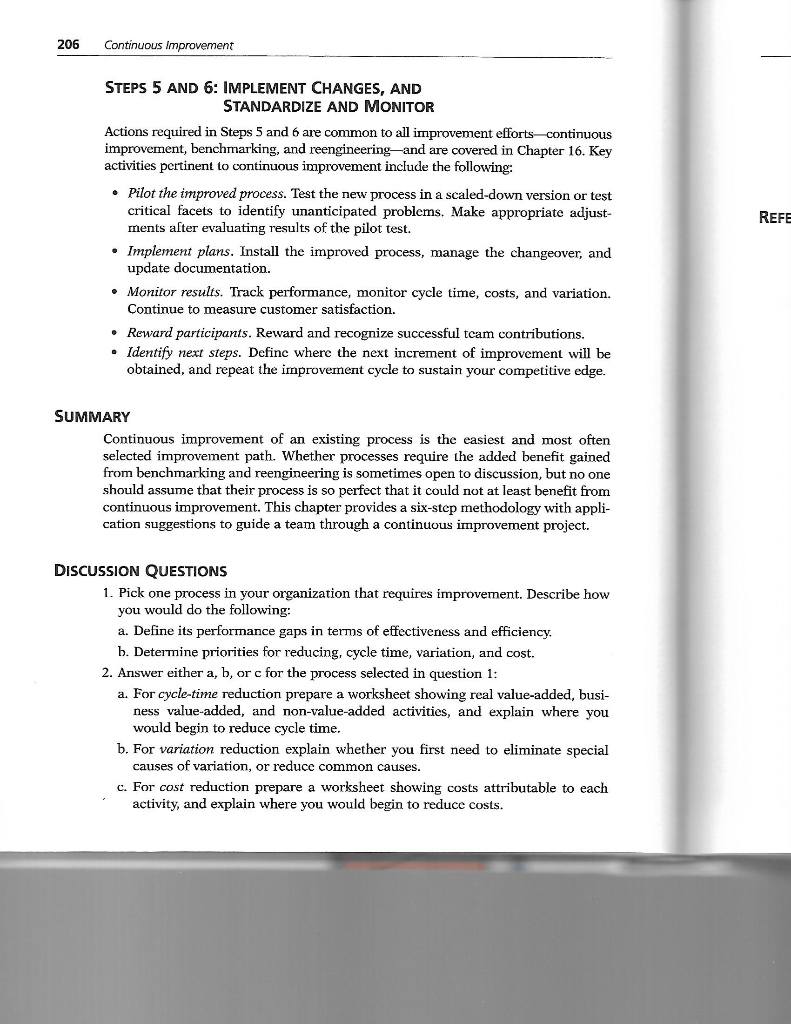
206 Continuous Improvement REFE STEPS 5 AND 6: IMPLEMENT CHANGES, AND STANDARDIZE AND MONITOR Actions required in Steps 5 and 6 are common to all improvement efforts continuous improvement, benchmarking, and reengineering and are covered in Chapter 16. Key activities pertinent to continuous improvement include the following: Pilot the improved process. Test the new process in a scaled-down version or test critical facets to identify unanticipated problems. Make appropriate adjust- ments after evaluating results of the pilot test. Implement plans. Install the improved process, manage the changeover, and update documentation. Monitor results. Track performance, monitor cycle time, costs, and variation. Continue to measure customer satisfaction. Reward participants. Reward and recognize successful team contributions. Identify next steps. Define where the next increment of improvement will be obtained, and repeat the improvement cycle to sustain your competitive edge. SUMMARY Continuous improvement of an existing process is the easiest and most often selected improvement path. Whether processes require the added benefit gained from benchmarking and reengineering is sometimes open to discussion, but no one should assume that their process is so perfect that it could not at least benefit from continuous improvement. This chapter provides a six-step methodology with appli- cation suggestions to guide a team through a continuous improvement project. DISCUSSION QUESTIONS 1. Pick one process in your organization that requires improvement. Describe how you would do the following: a. Define its performance gaps in terms of effectiveness and efficiency. b. Determine priorities for reducing, cycle time, variation, and cost. 2. Answer either a, b, or for the process selected in question 1: a. For cycle-time reduction prepare a worksheet showing real value-added, busi- ness value-added, and non-value-added activities, and explain where you would begin to reduce cycle time. b. For variation reduction explain whether you first need to eliminate special causes of variation, or reduce common causes. c. For cost reduction prepare a worksheet showing costs attributable to each activity, and explain where you would begin to reduce costs. 206 Continuous Improvement REFE STEPS 5 AND 6: IMPLEMENT CHANGES, AND STANDARDIZE AND MONITOR Actions required in Steps 5 and 6 are common to all improvement efforts continuous improvement, benchmarking, and reengineering and are covered in Chapter 16. Key activities pertinent to continuous improvement include the following: Pilot the improved process. Test the new process in a scaled-down version or test critical facets to identify unanticipated problems. Make appropriate adjust- ments after evaluating results of the pilot test. Implement plans. Install the improved process, manage the changeover, and update documentation. Monitor results. Track performance, monitor cycle time, costs, and variation. Continue to measure customer satisfaction. Reward participants. Reward and recognize successful team contributions. Identify next steps. Define where the next increment of improvement will be obtained, and repeat the improvement cycle to sustain your competitive edge. SUMMARY Continuous improvement of an existing process is the easiest and most often selected improvement path. Whether processes require the added benefit gained from benchmarking and reengineering is sometimes open to discussion, but no one should assume that their process is so perfect that it could not at least benefit from continuous improvement. This chapter provides a six-step methodology with appli- cation suggestions to guide a team through a continuous improvement project. DISCUSSION QUESTIONS 1. Pick one process in your organization that requires improvement. Describe how you would do the following: a. Define its performance gaps in terms of effectiveness and efficiency. b. Determine priorities for reducing, cycle time, variation, and cost. 2. Answer either a, b, or for the process selected in question 1: a. For cycle-time reduction prepare a worksheet showing real value-added, busi- ness value-added, and non-value-added activities, and explain where you would begin to reduce cycle time. b. For variation reduction explain whether you first need to eliminate special causes of variation, or reduce common causes. c. For cost reduction prepare a worksheet showing costs attributable to each activity, and explain where you would begin to reduce costsStep by Step Solution
There are 3 Steps involved in it
1 Expert Approved Answer
Step: 1 Unlock

Question Has Been Solved by an Expert!
Get step-by-step solutions from verified subject matter experts
Step: 2 Unlock
Step: 3 Unlock