







Question: Please answer all the questions FULLY! thanks hero Question 1. Consider a person standing on a bus holding a bus strap as shown. As the
Please answer all the questions FULLY! thanks hero
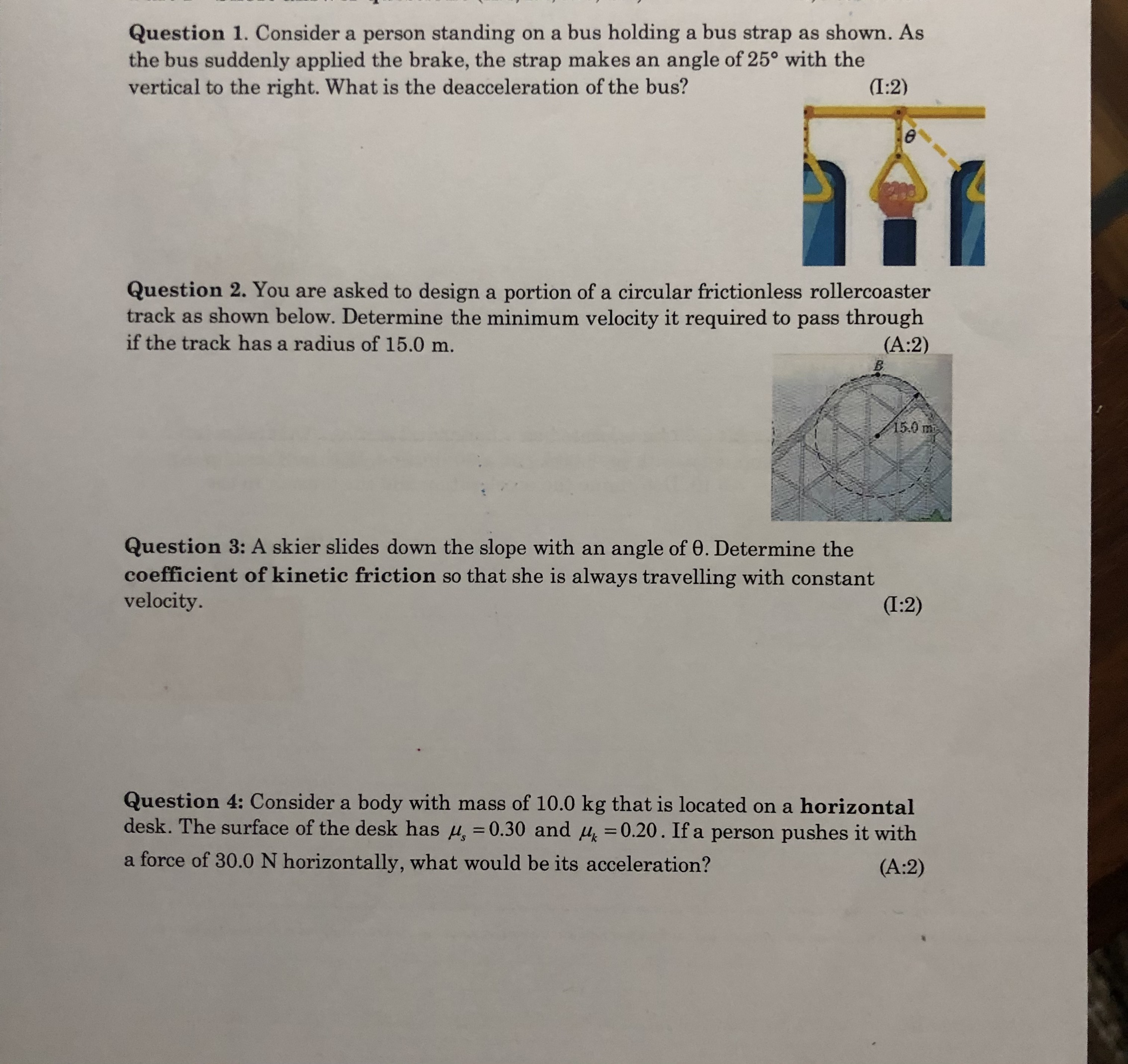
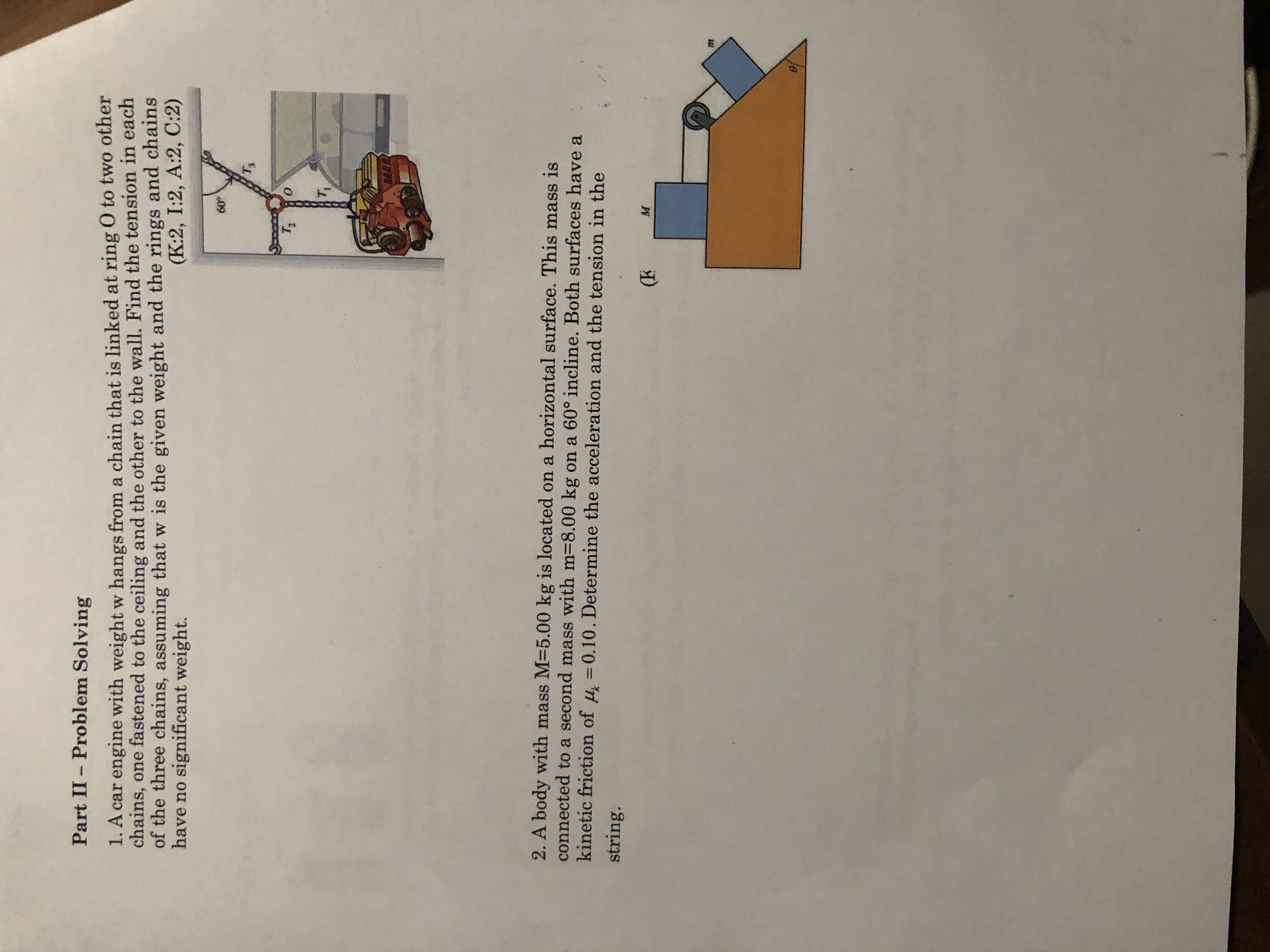
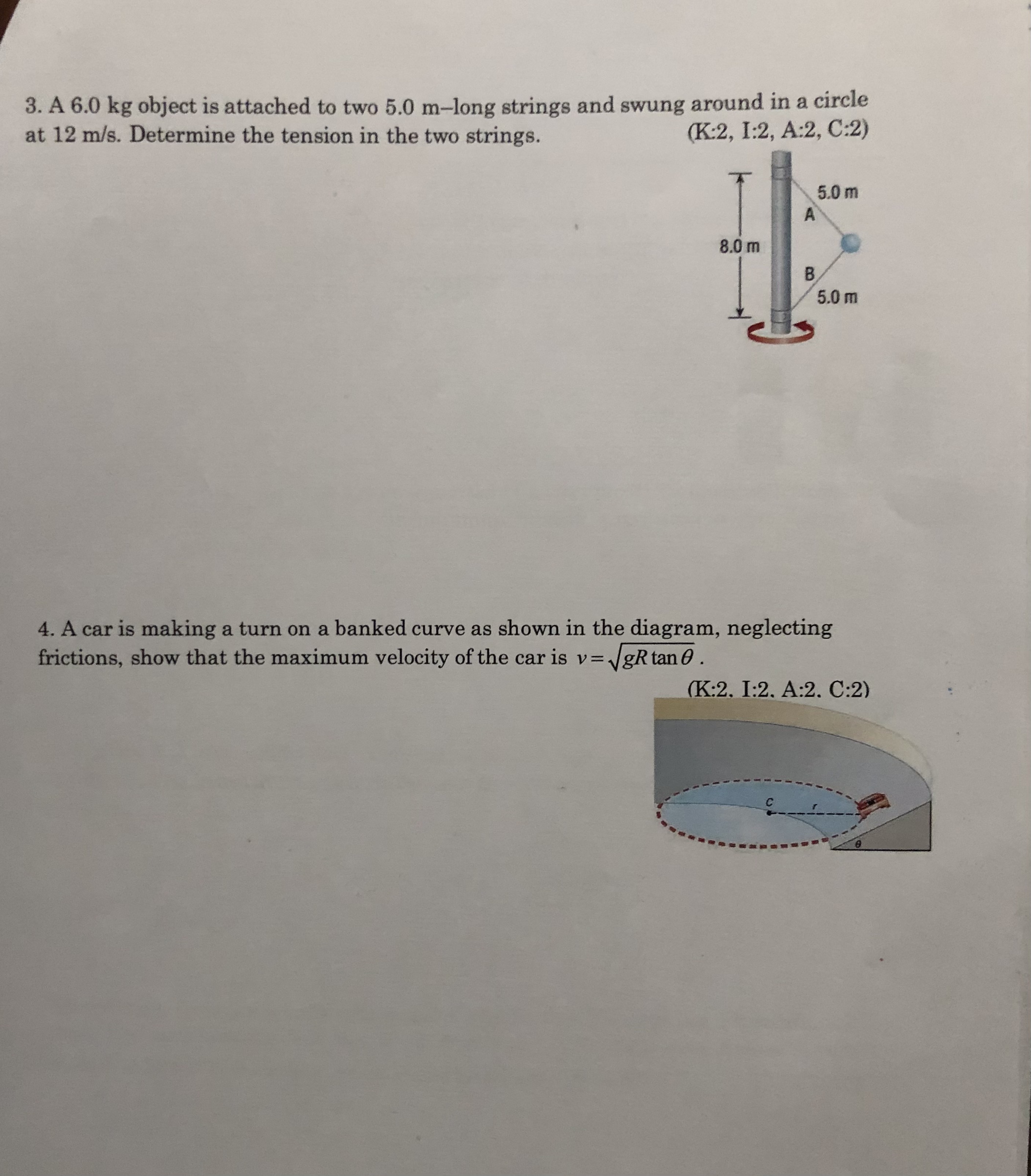
Question 1. Consider a person standing on a bus holding a bus strap as shown. As the bus suddenly applied the brake, the strap makes an angle of 25 with the vertical to the right. What is the deacceleration of the bus? (1:2 Question 2. You are asked to design a portion of a circular frictionless rollercoaster track as shown below. Determine the minimum velocity it required to pass through if the track has a radius of 15.0 m. (A:2) 15.0 m Question 3: A skier slides down the slope with an angle of 0. Determine the coefficient of kinetic friction so that she is always travelling with constant velocity. (1:2) Question 4: Consider a body with mass of 10.0 kg that is located on a horizontal desk. The surface of the desk has /, =0.30 and / =0.20. If a person pushes it with a force of 30.0 N horizontally, what would be its acceleration? (A:2)Part II - Problem Solving 1. A car engine with weight w hangs from a chain that is linked at ring O to two other chains, one fastened to the ceiling and the other to the wall. Find the tension in each of the three chains, assuming that w is the given weight and the rings and chains have no significant weight. (K:2, 1:2, A:2, C:2) 60 2. A body with mass M=5.00 kg is located on a horizontal surface. This mass is connected to a second mass with m=8.00 kg on a 60 incline. Both surfaces have a kinetic friction of M, =0.10. Determine the acceleration and the tension in the string. K M3. A 6.0 kg object is attached to two 5.0 m-long strings and swung around in a circle at 12 m/s. Determine the tension in the two strings. (K:2, 1:2, A:2, C:2) 5.0 m A 8.0 m B 5.0 m 4. A car is making a turn on a banked curve as shown in the diagram, neglecting frictions, show that the maximum velocity of the car is v= \\gR tan . (K:2. I:2. A:2. C:2)
Step by Step Solution
There are 3 Steps involved in it

Get step-by-step solutions from verified subject matter experts
 Study Help