Question: PLEASE ANSWER ALL THREE QUESTIONS! A think local, act local multicountry type of strategy is most likely to be competitively successful when a company's chief

PLEASE ANSWER ALL THREE QUESTIONS!
PLEASE ANSWER ALL THREE QUESTIONS! A "thinkPLEASE ANSWER ALL THREE QUESTIONS! A "thinkPLEASE ANSWER ALL THREE QUESTIONS! A "think

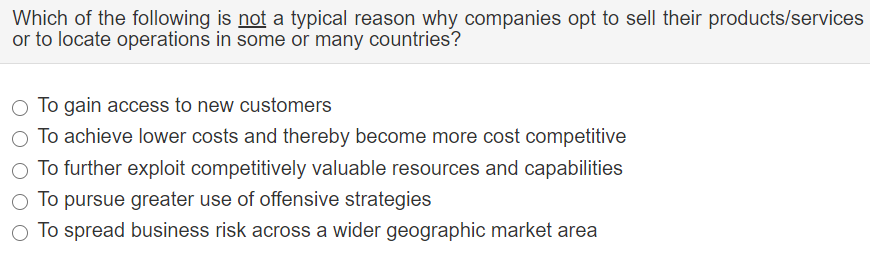
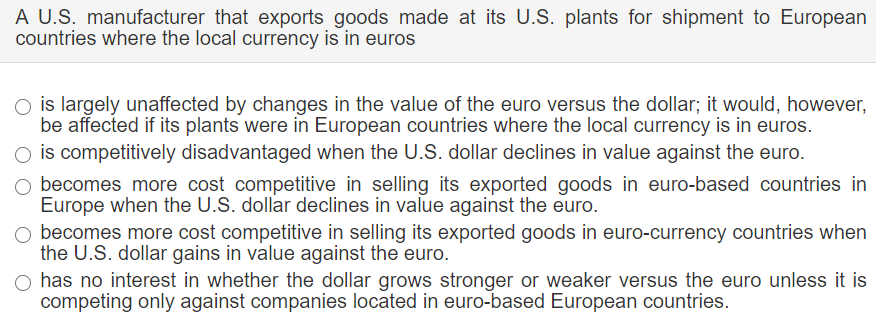
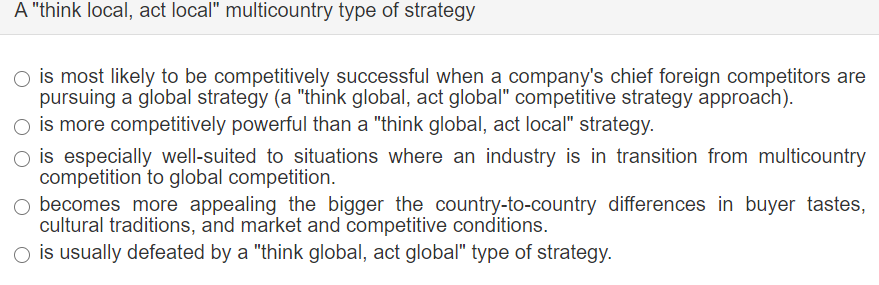
A "think local, act local" multicountry type of strategy is most likely to be competitively successful when a company's chief foreign competitors are pursuing a global strategy (a "think global, act global" competitive strategy approach). o is more competitively powerful than a "think global, act local" strategy. is especially well-suited to situations where an industry is in transition from multicountry competition to global competition. o becomes more appealing the bigger the country-to-country differences in buyer tastes, cultural traditions, and market and competitive conditions. o is usually defeated by a "think global, act global" type of strategy. Which of the following is not a typical reason why companies opt to sell their products/services or to locate operations in some or many countries? To gain access to new customers To achieve lower costs and thereby become more cost competitive To further exploit competitively valuable resources and capabilities To pursue greater use of offensive strategies To spread business risk across a wider geographic market area A U.S. manufacturer that exports goods made at its U.S. plants for shipment to European countries where the local currency is in euros o is largely unaffected by changes in the value of the euro versus the dollar; it would, however, be affected if its plants were in European countries where the local currency is in euros. is competitively disadvantaged when the U.S. dollar declines in value against the euro. o becomes more cost competitive in selling its exported goods in euro-based countries in Europe when the U.S. dollar declines in value against the euro. o becomes more cost competitive in selling its exported goods in euro-currency countries when the U.S. dollar gains in value against the euro. has no interest in whether the dollar grows stronger or weaker versus the euro unless it is competing only against companies located in euro-based European countries

Step by Step Solution

There are 3 Steps involved in it

1 Expert Approved Answer
Step: 1 Unlock blur-text-image

Question Has Been Solved by an Expert!

Get step-by-step solutions from verified subject matter experts

Step: 2 Unlock
Step: 3 Unlock

Students Have Also Explored These Related General Management Questions!