







Question: please answer all will give thumbs up! Question 5 (1 point) What effect is observed on the ionization energy when the angular momentum quantum number
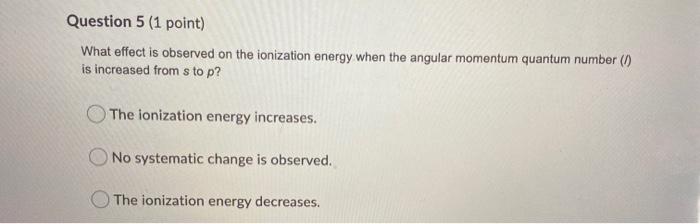
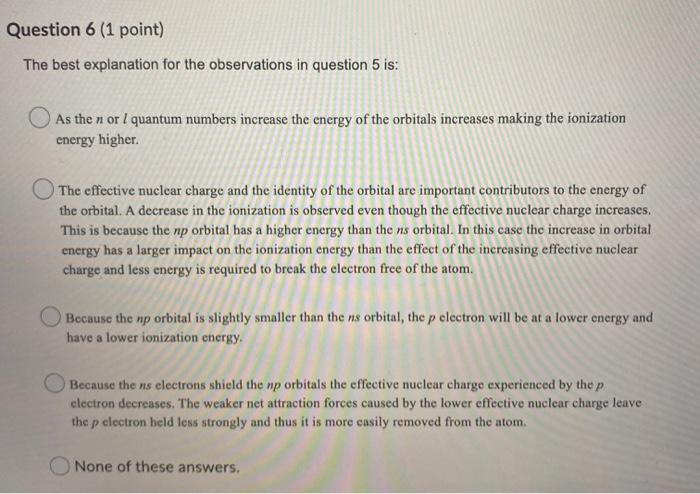

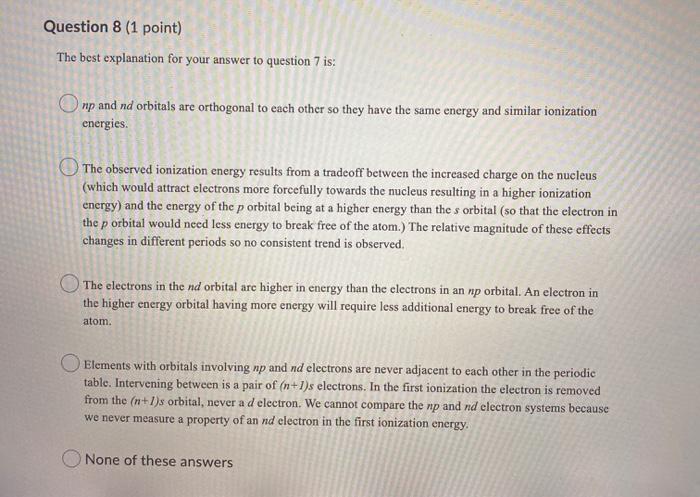
Question 5 (1 point) What effect is observed on the ionization energy when the angular momentum quantum number (1) is increased from s to p? The ionization energy increases. No systematic change is observed. The ionization energy decreases. Question 6 (1 point) The best explanation for the observations in question 5 is: As the n or I quantum numbers increase the energy of the orbitals increases making the ionization energy higher. The effective nuclear charge and the identity of the orbital are important contributors to the energy of the orbital. A decrease in the ionization is observed even though the effective nuclear charge increases. This is because the np orbital has a higher energy than the ns orbital. In this case the increase in orbital energy has a larger impact on the ionization energy than the effect of the increasing effective nuclear charge and less energy is required to break the electron free of the atom. Because the np orbital is slightly smaller than the ns orbital, the p electron will be at a lower energy and have a lower ionization energy Because the ns electrons shield the np orbitals the effective nuclear charge experienced by the p clectron decreases. The weaker net attraction forces caused by the lower effective nuclear charge leave the p electron held less strongly and thus it is more easily removed from the atom. None of these answers. Question 7 (1 point) What effect can be attributed to the quantum number changing from p to d? The ionization energy decreases No such change can be observed. The ionization energy increases. Question 8 (1 point) The best explanation for your answer to question 7 is: Onp and nd orbitals are orthogonal to each other so they have the same energy and similar ionization energies. The observed ionization energy results from a tradeoff between the increased charge on the nucleus (which would attract electrons more forcefully towards the nucleus resulting in a higher ionization energy) and the energy of the p orbital being at a higher energy than the s orbital (so that the electron in the p orbital would need less energy to break free of the atom.) The relative magnitude of these effects changes in different periods so no consistent trend is observed. The electrons in the nd orbital are higher in energy than the electrons in an np orbital. An electron in the higher energy orbital having more energy will require less additional energy to break free of the atom. Elements with orbitals involving np and nd electrons are never adjacent to each other in the periodic table. Intervening between is a pair of (n+1)s electrons. In the first ionization the electron is removed from the (n+1)s orbital, never a d electron. We cannot compare the np and nd electron systems because we never measure a property of an nd electron in the first ionization energy. None of these answers
Step by Step Solution
There are 3 Steps involved in it

Get step-by-step solutions from verified subject matter experts
 Study Help