







Question: please answer and calculate the questions below. with Excell formula and explanations Excel Window Help File Edit View insert Format Tools Data B. 5 Uncu
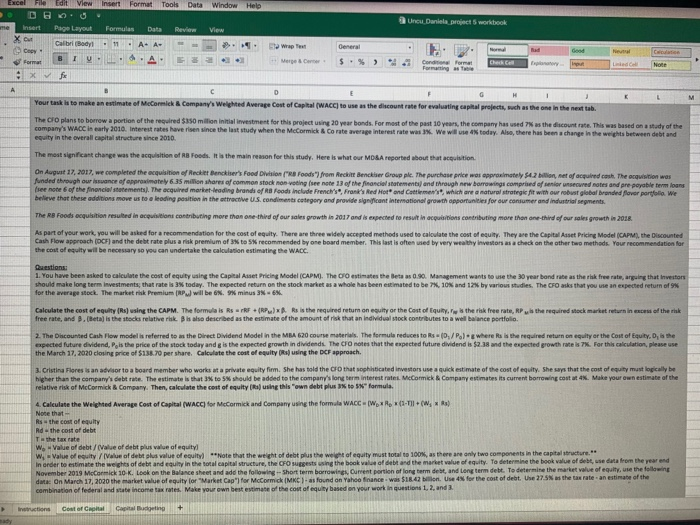
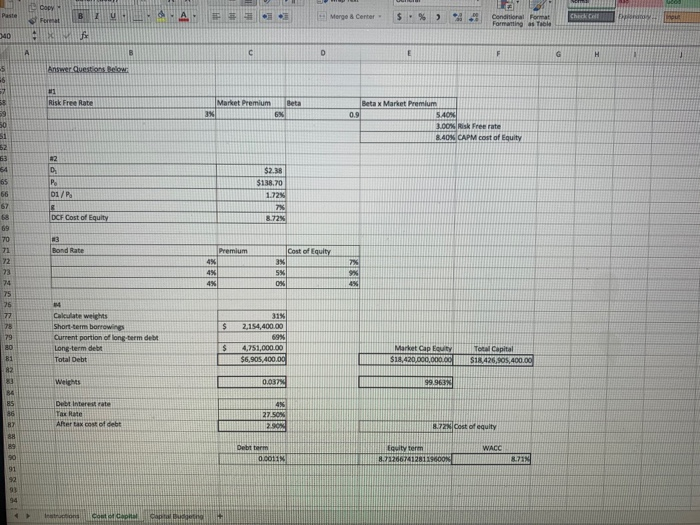
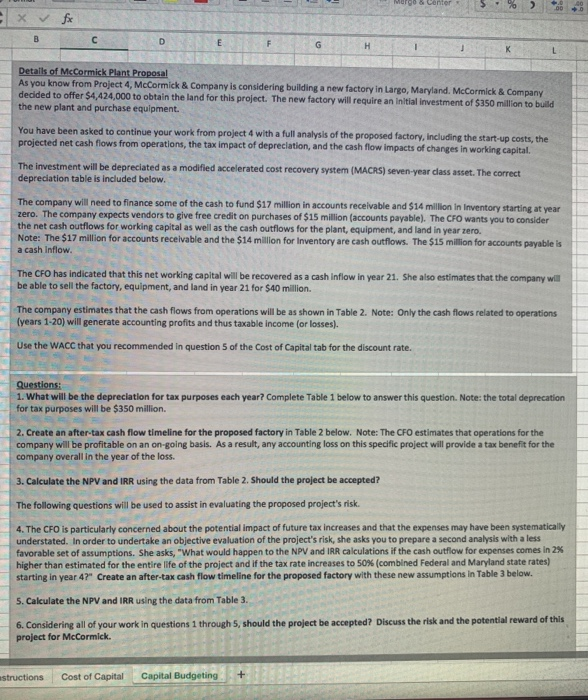
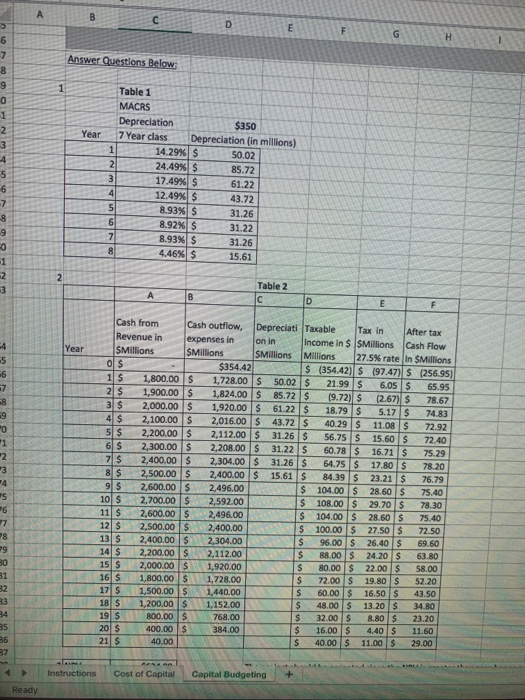
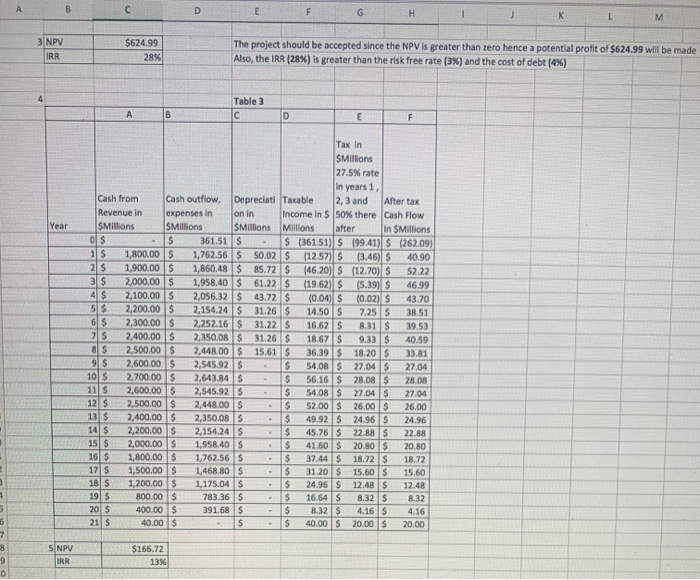
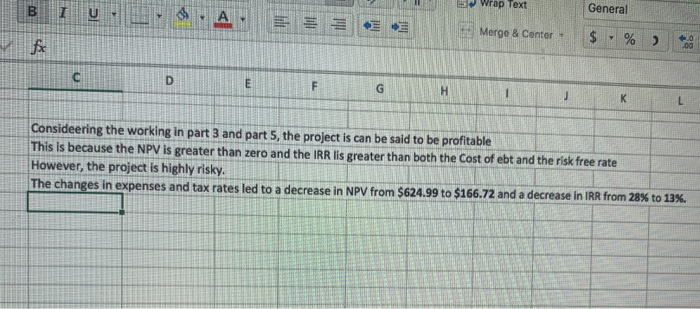
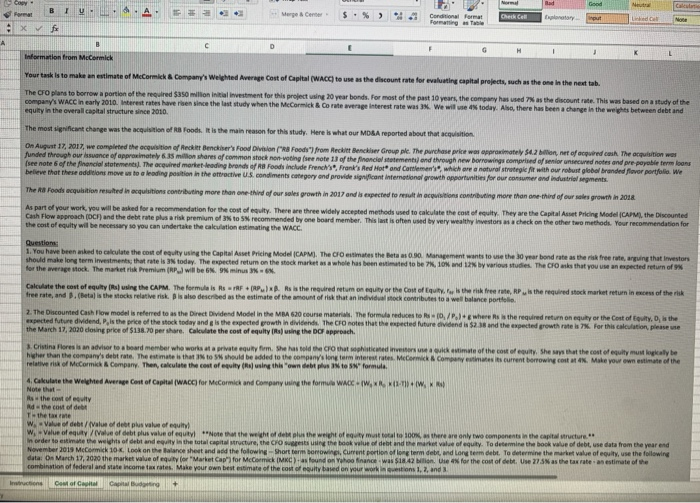
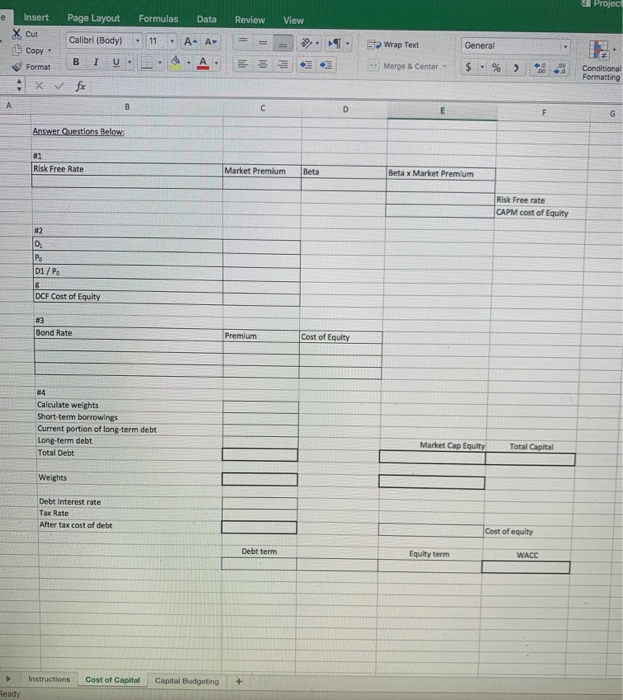
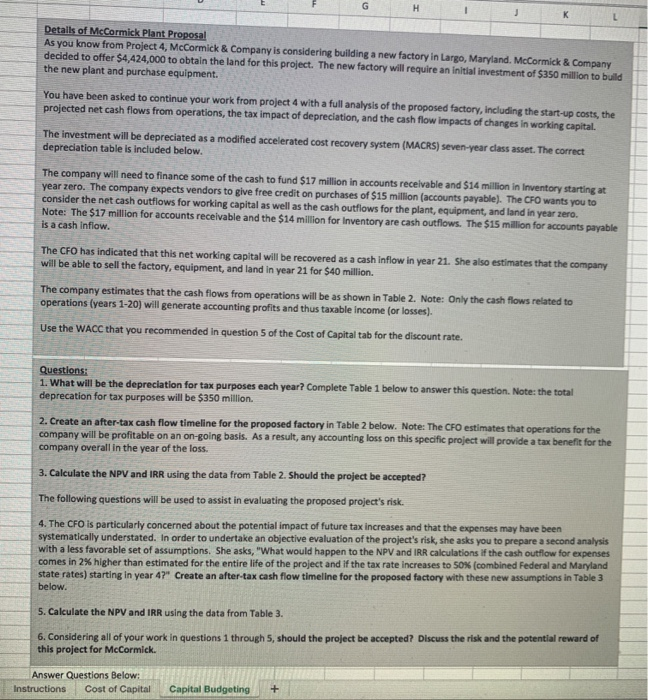
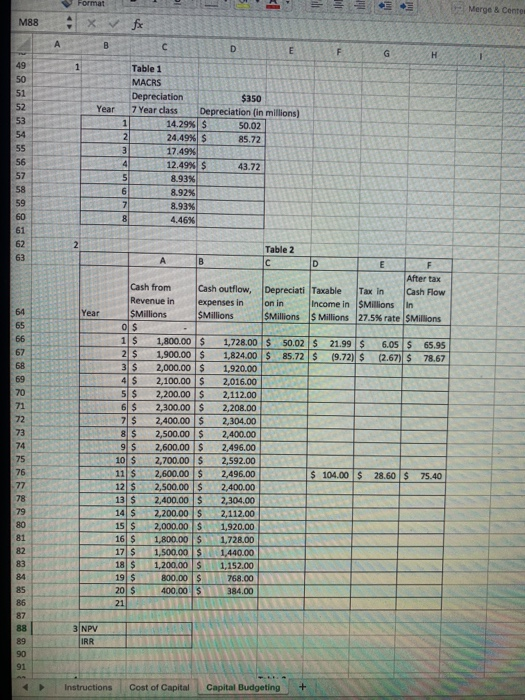
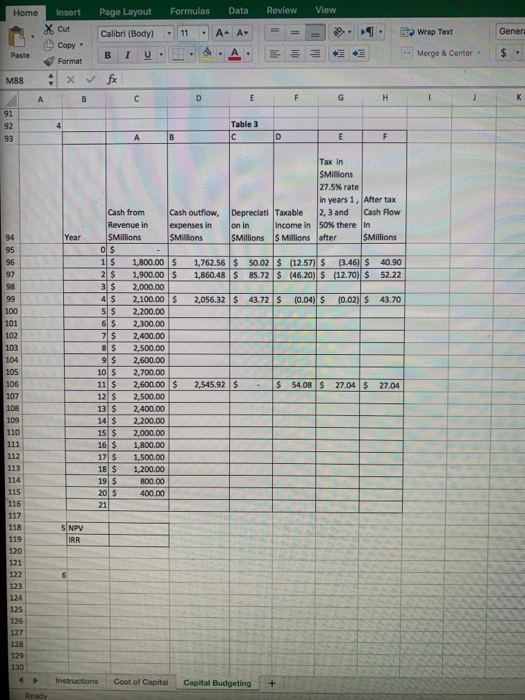
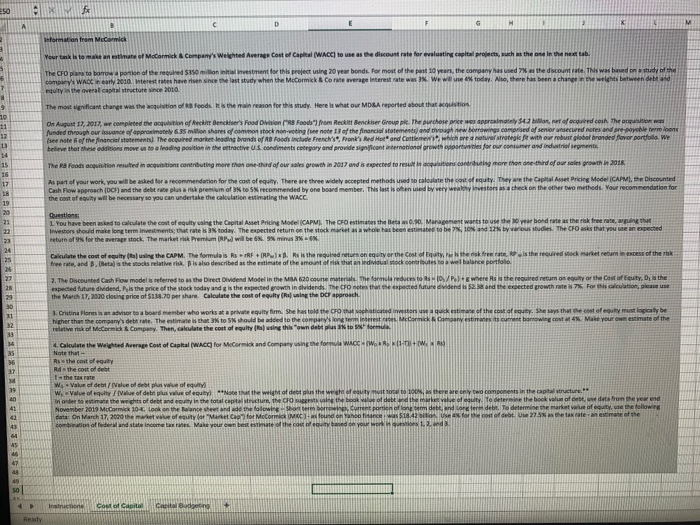
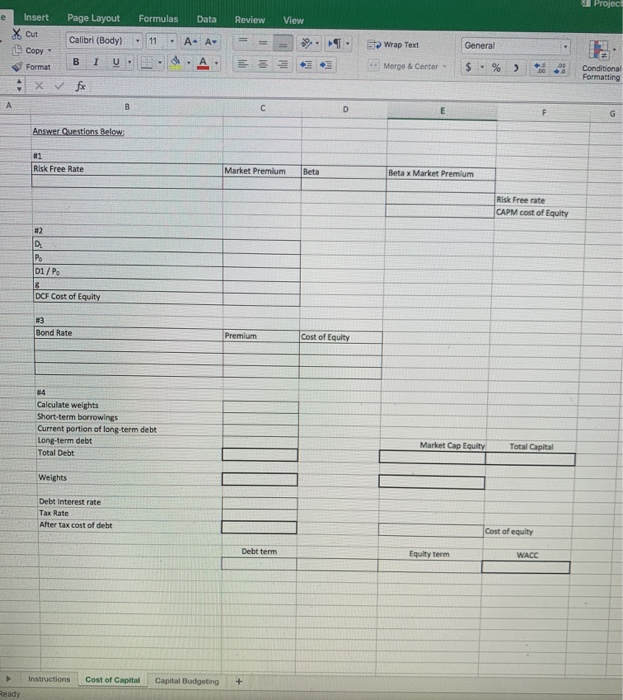
Excel Window Help File Edit View insert Format Tools Data B. 5 Uncu Daniela project workbook me Insert Formulas Data Review View Page Layout Calibri Bayi I U ta Wrap General Good Format + Merger $ %) Conforme Forming at Chem Lied f M D Your task is to make an estimate of MeCormick & Company's Weighted Average cost of Captal (WACC) to use as the discount rate for evaluating capital projects, wuch as the In the next tab. The CFO plans to borrow a portion of the required $350 milion initial investment for this project using 20 year bonds. For most of the past 10 years, the company has used as the discount rate. This was based on a study of the company's WACC in early 2010. Interest rates have risen since the last study when the McCormick & Co rate average interest rate 3%. We will see today. Also, there has been change in the weights between debt and equity in the overall capital structure since 2010 The most significant change was the acquisition of RB Foods. It is the main reason for this study. Here is what our MD&A reported out that acquisition On August 17, 2017, we completed the acquisition of Reckitt Benckiser's Food Division Foods") from Reckitt Benckiser Group ple. The purchase price was approximately $4.2 bilion, net of acquired cash. The acquisition was funded through our ance of approximately 6,35 milion shares of common stock non voting see note 13 of the financial statements and through new borrowing comprised of senior unsecured notes and prepayable term loans free note of the financial statements. The acquired market leading brands of foods include French's, Frank's Red Hot and Cattlemen'st, which are a natural strategis fit with our robust global branded flover portfolio We believe that these addition move us to a leading position in the attractive U.S.condiments category and provides an international growth opportunities for our consumer and industrial segments The RB Foods quition resulted in acquisitions contributing more than one-third of our sales growth in 2017 and is expected to result in acquisitions contributing more than one-third of our sales growth in 2018 As part of your work, you will be asked for a recommendation for the cost of equity. There are three widely accepted methods used to calculate the cost of equity. They are the Capital Asset Pricing Model (CAPM), the Discounted Cash Flow approach (OCF) and the debt rate plus a risk premium of 3% to 5% recommended by one board member This last is often used by very wealthy investors as a check on the other two methods. Your recommendation for the cost of equity will be necessary so you can undertake the calculation estimating the WACC. Questions 1. You have been asked to calculate the cost of equity using the Capital Asset Pricing Model (CAPM). The estimates the Betsas 0.90. Management wants to use the 30 year band rate as the risk free rata, arguing that investors should make long term Investments, that rate is 3 today. The expected return on the stock market as a whole has been estimated to be 7%, 10% and 12% by various studies. The CFO asks that you use an expected return of 9% for the average stock. The market risk Premium RP) will be 6.9% minus 3% 6%. Calculate the cost of equity (Rs) using the CAPM. The formula is Rs PRF + (P) Rs is the required return on eculty or the cost of Equity. In the risk free rate, Pull the required stock market return in excess of the rink free rate, and B. (Beta) is the stocks relative riik Bis also described as the estimate of the amount of risk that an individual stock contributes to a well balance portfolio 2. The Discounted Cash Flow model is referred to as the Direct Dividend Model in the MBA 620 course materials. The formula reduces to Rs.0./Pol where Rs is the required return on equity or the cost of Equity, D, the expected future dividend, Po is the price of the stock today and g is the expected growth individends. The CFO notes that the expected future dividend is $2.38 and the expected growth rate is 7%. For this calculation, please use the March 17, 2020 closing price of $132.70 per share. Calculate the cost of equity Rs using the DCF approach. 3. Cristina Flores is an advisor to a board member who works at a private equity firm. She has told the CFO that sophisticated investors use a quick estimate of the cost of equity. She says that the cost of equity must logically be higher than the company's debt rate. The estimate is that 3% to 5% should be added to the company's long term interest rate McCormick & Company estimates its current borrowing cost at 4%. Make your own estimate of the relative risk of McCormick & Company. Then, calculate the cost of equity Rausing this own debt plus x t formula 4. Calculate the weighted Average Cost of Capital (WACC) for McCormick and Company using the formula WACC-1W*H*(1-111+(W, **) Note that Rs the cost of equity Rd - the cost of debt Tethe tax rate W Value of debt/Value of debt plus value of equity W, -Value of equity value of delt slus value of equity) Note that the weight of debt plus the weight of equity must total to 100%, as there are only two components in the capital structure." In order to estimate the weight of debt and equity in the total capital structure, the CFO suggests using the book value of and the market value of equity. To determine the book value of debt, use data from the year and November 2019 MeComick 10 K. Look on the Balance sheet and add the following - Short term borrowines, Current portion of long term est, and long term debt. To determine the market value of equity, use the following data on March 17, 2020 the market value of equity for Market Cap" for McCormick (MKC - as found on Yahoo finance was $18.4 bilion. Use 4. for the cost of debt. Use 27.5 as the tax rate an estimate of the combination of federal and rate income tax rates. Make your own bestimate of the cost of equity based on your work in questions 1. 2. und . Instructions Cost of Capital Capital Budgeting Paste Copy F B 17 U Merge & Center $ % Check Conditional Format Formatting Table 340 f B c D E F G 1 Answer Questions for -5 26 7 1 Risk Free Rate Market Premium Beta 3% 6% Beta x Market Premium 0.9 5.40% 3.00% Risk Free rate 8.40% CAPM cost of Equity 59 50 si 52 53 54 65 66 D. Po 01/P $2.38 $138.70 1.72% 7% 8.72% DCF Cost of Equity 68 69 70 71 13 Bond Rate Premium Cost of Equity 23 74 4% 4% 3% 5% OX 7% 9% 4% 75 26 $ 77 75 79 80 81 2 23 4 Calculate weights Short-term borrowing Current portion of long-term debt Long-term deb Total Debt 31% 2,154,400.00 69% 4,751,000.00 $6,905,400.00 $ Market Cap Equity $18,420,000,000.00 Total Capital $18.426,905,400.00 Weights 0.037% 99.363 34 85 86 RT Debt interest rate Tax Rate After tax cost of debt 4% 27.50% 20N 8.72N Cost of equity WACC Debt term 0.0011 88 189 90 91 92 93 Equity term 8.7126674128119600 8.71N 94 leton Cout cap Center 00 - x fx B D E F G H Details of McCormick Plant Proposal As you know from Project 4, McCormick & Company is considering building a new factory in Largo, Maryland. McCormick & Company decided to offer $4,424,000 to obtain the land for this project. The new factory will require an Initial investment of $350 million to build the new plant and purchase equipment. You have been asked to continue your work from project 4 with a full analysis of the proposed factory, including the start-up costs, the projected net cash flows from operations, the tax impact of depreciation, and the cash flow impacts of changes in working capital. The investment will be depreciated as a modified accelerated cost recovery system (MACRS) seven-year class asset. The correct depreciation table is included below. The company will need to finance some of the cash to fund $17 million in accounts receivable and $14 million in Inventory starting at year zero. The company expects vendors to give free credit on purchases of $15 million (accounts payable). The CFO wants you to consider the net cash outflows for working capital as well as the cash outflows for the plant, equipment, and land in year zero. Note: The $17 million for accounts receivable and the $14 million for Inventory are cash outflows. The $15 million for accounts payable is a cash Inflow. The CFO has indicated that this net working capital will be recovered as a cash Inflow in year 21. She also estimates that the company will be able to sell the factory, equipment, and land in year 21 for $40 million The company estimates that the cash flows from operations will be as shown in Table 2. Note: Only the cash flows related to operations (years 1-20) will generate accounting profits and thus taxable income (or losses). Use the WACC that you recommended in question 5 of the Cost of Capital tab for the discount rate. Questions: 1. What will be the depreciation for tax purposes each year? Complete Table 1 below to answer this question. Note: the total deprecation for tax purposes will be $350 million. 2. Create an after-tax cash flow timeline for the proposed factory in Table 2 below. Note: The CFO estimates that operations for the company will be profitable on an on-going basis. As a result, any accounting loss on this specific project will provide a tax benefit for the company overall in the year of the loss. 3. Calculate the NPV and IRR using the data from Table 2. Should the project be accepted? The following questions will be used to assist in evaluating the proposed project's risk. 4. The CFO is particularly concerned about the potential impact of future tax increases and that the expenses may have been systematically understated. In order to undertake an objective evaluation of the project's risk, she asks you to prepare a second analysis with a less favorable set of assumptions. She asks, "What would happen to the NPV and IRR calculations if the cash outflow for expenses comes in 2% higher than estimated for the entire life of the project and if the tax rate increases to 50% (combined Federal and Maryland state rates) starting in year 4?" Create an after-tax cash flow timeline for the proposed factory with these new assumptions in Table 3 below. 5. Calculate the NPV and IRR using the data from Table 3. 6. Considering all of your work In questions 1 through 5, should the project be accepted? Discuss the risk and the potential reward of this project for McCormick. astructions Cost of Capital Capital Budgeting A B D E F G H 6 Answer Questions Below: -7 8 9 0 1 2 3 4 5 6 Year Table 1 MACRS Depreciation $350 7 Year class Depreciation (in milions) 1 14.29%$ 50.02 2 24.49% $ 85.72 3 17.49% $ 61.22 4 12.49% $ 43.72 5 8.93%$ 31.26 6. 8.92% $ 31.22 7 8.93%$ 31.26 8 4.46% $ 15.61 -7 8 9 0 61 2 3 2 B Table 2 D E F Year -4 -5 -6 37 8 99 0 2 3 4 75 16 27 Cash from Cash outflow, Depreciati Taxable Tax in After tax Revenue in expenses in on in Income in s SMillions Cash Flow SMillions $Millions SMillions Millions 27.5% rate in Millions OS $354.42 $ (354.42) $ (97.47) S (256.95) 1 $ 1,800.00 1,728.00 $ 50.02 $ 21.99 $ 6.05 65.95 2 $ 1,900.00 $ 1,824.00 S 85.72 $ (9.72) $ (2.67) 78.67 3 $ 2,000.00 $ 1,920.00 $ 61.22$ 18.79$ 5.17$ 74.83 4 $ 2,100.00 $ 2,016.00 43.72 40.29 $ 11.08$ 72.92 5$ 2,200.00 $ 2,112.00 $ 31.26 $ 56.75 $ 15.60 $ 72.40 6 $ 2,300.00 $ 2,208.00 $ 31.22$ 60.78$ 16.71 75.29 7 $ 2,400.00 S 2,304.00$ 31.26 $ 64.75S 17.80 $ 78.20 8 $ 2,500.00 2,400.00 $ 15.61 $ 84.39 $ 23.21 $ 76.79 9 $ 2,600.00 S 2,496.00 $ 104.00 $ 28.60 $ 75.40 10$ 2,700.00 $ 2,592.00 $ 108.00$ 29.70 S 78.30 11 $ 2,600.00 $ 2,496.00 $ 104.00 $ 28.60 $ 75.40 12 $ 2,500.00 $ 2,400.00 $ 100.00 $ 27.50 $ 72.50 13 S 2,400.00 $ 2,304.00 $ 96.00 $ 26.40$ 69.60 14 $ 2,200.00 2,112.00 88.00 $ 24.20 $ 63.80 2,000.00 $ 1,920.00 $ 80.00 $ 22.00 S 58.00 16 S 1,800.00 $ 1,728.00 $ 72.00 19.80S 52.20 17 S 1,500.00 1,440.00 $ 60.00 $ 16.50 $ 43.50 18 $ 1,200.00 1,152.00 $ 48.00 $ 13.20 $ 34.80 19 S 800.00 $ 768.00 $ 32.00 $ 8.80 23.20 20$ 400.00 $ 384.00 $ 16.00 $ 4.405 11.60 21 $ 40.00 $ 40.00 1.00 $ 29.00 .... $ 15$ 29 B0 31 B2 83 34 35 36 37 Instructions Cost of Capital Capital Budgeting Ready B D E G H - K L M 3 NPV IRR $624.99 28% The project should be accepted since the NPV is greater than zero hence a potential profit of $624.99 will be made Also, the IRR (28%) is greater than the risk free rate (3%) and the cost of debt (4%) 4 Table 3 B D E F Year Tax in SMillions 27.5% rate In years 1, Cash from Cash outflow, Depreciati Taxable 2, 3 and After tax Revenue in expenses in on in Income in $ 50% there Cash Flow $Millions SMillions SMillions Millions after In SMillions OS $ 361.51 $ $ (361.51) S (99.41) S (262.09) 1$ 1,800.00 1,762.56 $ 50.02 $ (12.57) $ (3.46) S 40.90 2 $ 1,900.00 1,860.48 $ 85.72 $ (46.20) $ (12.70) S 52.22 3 $ 2,000.00 1,958.40 $ 61.22 $ (19.62) $ (5.39) 46.99 4 $ 2,100.00 S 2,056.32 $ 43.72 $ (0.04) $ (0.02) $ 43.70 5 $ 2,200.00 2,154.24 $ 31.26 S 14.50 S 7.25$ 38.51 6 $ 2,300.00 2,252.16 $ 31.22 $ 16.625 8.31 S 39.53 75 2,400.00 2,350.08 $ 31.26 S 18.67$ 9.33 $ 40.59 8 $ 2,500.00 $ 2,448.00 $ 15.61$ 36.39S 18.20 S 33.81 9 $ 2,600.00 $ 2,545.92 S $ 54.08 27.04s 27.04 10 $ 2,700.00 $ 2,643.84S S 56.16 $ 28.08$ 28.08 11 $ 2,600.00 $ 2,545.92 S $ 54.08 $ 27.04S 27.04 12$ 2,500.00 2,448.00 S $ 52.00 $ 26.00 $ 26.00 13 $ 2,400.00 S 2,350.08S $ 49.92 $ 24.965 24.96 14 $ 2,200.00 $ 2,154.24S $ 45.76 $ 22.885 22.88 15S 2,000.00 1,958.40 $ $ 41.50 $ 20.80S 20.80 16 $ 1,800.00 1,762.56 $ $ 37.44 $ 18.72 $ 18.72 175 1,500.00 $ 1,468.80$ $ 31.20 S 15.60 $ 15.60 18$ 1,200.00 1,175.04 $ 24.96 $ 12.48$ 12.48 19 $ 800.00 S 783.36 $ $ 16.64 $ 8.32 $ 8.32 20 $ 400.00 $ 391.68 $ $ 8.32 $ 4.16 S 4.16 21 $ 40.00 $ $ $ 40.00 $ 20.00 $ 20.00 3 IT in 6 s 7 SNPV IRR $166.72 13% 0 B Wrap Text I General IC A TE lul Mergo & Conter $ %) D E F G H u K Consideering the working in part 3 and part 5, the project is can be said to be profitable This is because the NPV is greater than zero and the IRR lis greater than both the Cost of ebt and the risk free rate However, the project is highly risky. The changes in expenses and tax rates led to a decrease in NPV from $624.99 to $166.72 and a decrease in IRR from 28% to 13%. Co- Bad Good B 1 U- - Merge Center $ 1 Conditional Format Formas Check Cel tary put Liked Note xf A B D K Information from McCormick Your task is to make an estimate of MeCormick & Company's Weighted Average cost of Capital (WACC) to use as the discount rate for evaluating capital projects, such as the one in the next tab. The CFO plans to borrow a portion of the required $350 million initial investment for this project using 30 year bonds. For most of the past 10 years, the company has used as the discount rute. This was based on a study of the company's WACC in early 2010. Wterest rates have been since the last study when the McCormick & Co rute average interest rate was. We will see today. Also, there has been a change in the weights between debt and equity in the overall capital structure since 2010 The most pificant change was the acquisition of Rs Food it is the main reason for this study. Here is what our MD&A reported about that acquisition On August 17, 2017, we completed the acquisition of Reckitt Benckiser's Food Division Foods") from Heckitt Benckiser Group ple. The purchase price was approximately $4.2 bilion of acquired cash. The acquisition was funded through our suance of approximately 6.35 million shares of common stock on ting see note 13 of the financial statements and though new borrowing comprised of senior need notes and prepoyable to loons (see note of the financial statements. The acquired market-leading brands of Foods include French Frank's Red Hot and Contlemen's", which are a natural strategier with our robust le branded flavor portfolio We believe that these additions move to a leading position in the attractive us condiments category and provide significant international growth its for our consumer and industriel prents. The RS Food acquisition resulted in acquisitions contributing more than one-third of our sales growth in 2017 and is expected to result in action contributing more than one-third of our sales growth in 2018 As part of your work, you will be asked for a recommendation for the cost of equity. There are three widely accepted methods used to calculate the cost of equity. They are the Capital Asset Pricing Model CAMI, the Discounted Cash Flow approach (OCF) and the debt rote plus a risk premium of N to recommended by one board member. This last is often used by very wealthy investors a check on the other two methods. Your recommendation for the cost of equity will be necessary so you can undertake the calculation estimating the WACC. Questions 1. You have been asked to calculate the cost of equity using the Capital Art Pricing Model CAPM), The CFO estimates the team Management wants to use the 30 year bond rate as the risk free rute, arguing that investors should make long term investments that rate is today. The expected return on the stock market whole has been estimated to be 7, 10% and 12 by various studies. The Crowns that you use an expected return of for the wenge Mock. The market risk Premium (RP) will be minus 6 Calculate the cost of equitys using the CAPM. The formula is s RF (RP)As is the required return on equity or the cont Equity k free rute, Pull the required stock market return in exces of the risk free rate, and has the Mocks relative risk. Dis also described as the estimate of the amount of risk that an individual stock contributes to balance portfolio 2. The Discounted Cash Flow model is referred to as the Direct Dividend Model in the MBA 620 course material. The formula reduces to 0./P.I where the required return on equity or the cost of owity, is the expected future dividend, P, is the price of the stock today and is the expected growth in dividends. The Cronotes that the expected tre dividend is $2.38 and the expected growth rate is 7%. For this calculation, please use the March 17, 2020 dosing price of $138.70 per share. Calculate the cost of equity using the approach. 3. Cristina Flores is an advisor to a board member who works at a private equity. She has told the CFO that he uicktimat of the cost of equity. She start the cost of equity must log ay be higher than the company's debt rate. The estimate is that it would be added to the compan rates McCormick Cometimes its current borrowing. Make your own estimate of the relative risk of McCormick & Company. Then, calculate the cost of wity (using Tormule 4.Cakulate the Weyhted Average cost of Capital (WACC)for McCormick and Company in the form WACI, KOLIKO Note that As the cost of Rd the cost of debt T the taxe W Vodeb value of debt plus value of equity W-Vilue ofequity / of debt plus value of equityl Note that the weight of deals the weight of ty must totalt 100, there are only two components in the capitalucture. In order to estimate the wis of debt and equity in the total capitalructure, the crowing the book value of debt and market value of equity. To determine the book value of debt, use data from the year end November 2019 McCormick 10K. Look on the balance sheet and and the following-Short term borrowie current portion of long term debt, and long term debt. To determine the market value of equity, use the following data: Os March 17, 2020 the market value of equity for Market Cap for McCormick (MC)-as found on Yahoo finance was six 42 Milione e for the cost of debt Us 275N as the tax rate an estimate of the combination of federal and state income tax rates. Make your own estimate of the cost of my based on your work is 1.2 and con Color Capital Projec e Page Layout Formulas Data Review View Insert X cut Copy + Calibri (Body) 11 A- A 9. Wrap Text General B 1 U- Format Morge & Center $ - % ) Conditional Formatting x fx 8 D E G Answer Questions Below #1 Risk Free Rate Market Premium Beta Beta x Market Premium Risk Free rate CAPM cost of Equity #2 D. Po 01/P IR DCF Cost of Equity 3 Bond Rate Premium Cost of Equity 14 Calculate weights Short-term borrowings Current portion of long-term debt Long-term debt Total Debt Market Cap Equity Total Capital Weights Debt Interest rate Tax Rate After tax cost of debt Cost of equity Debt term Equity term WACC Instructions Cost of Capital Capital Budgeting + Ready G H K Details of McCormick Plant Proposal As you know from Project 4, McCormick & Company is considering building a new factory in Largo, Maryland. McCormick & Company decided to offer $4,424,000 to obtain the land for this project. The new factory will require an initial investment of $350 million to build the new plant and purchase equipment. You have been asked to continue your work from project 4 with a full analysis of the proposed factory, including the start-up costs, the projected net cash flows from operations, the tax impact of depreciation, and the cash flow impacts of changes in working capital. The investment will be depreciated as a modified accelerated cost recovery system (MACRS) seven-year class asset. The correct depreciation table is included below. The company will need to finance some of the cash to fund $17 million in accounts receivable and $14 million in Inventory starting at year zero. The company expects vendors to give free credit on purchases of $15 million (accounts payable). The CFO wants you to consider the net cash outflows for working capital as well as the cash outflows for the plant, equipment, and land in year zero. Note: The $17 million for accounts receivable and the $14 million for Inventory are cash outflows. The $15 million for accounts payable is a cash inflow. The CFO has indicated that this net working capital will be recovered as a cash inflow in year 21. She also estimates that the company will be able to sell the factory, equipment, and land in year 21 for $40 million. The company estimates that the cash flows from operations will be as shown in Table 2. Note: Only the cash flows related to operations (years 1-20) will generate accounting profits and thus taxable income for losses). Use the WACC that you recommended in question 5 of the cost of Capital tab for the discount rate. Questions: 1. What will be the depreciation for tax purposes each year? Complete Table 1 below to answer this question. Note: the total deprecation for tax purposes will be $350 million 2. Create an after-tax cash flow timeline for the proposed factory in Table 2 below. Note: The CFO estimates that operations for the company will be profitable on an on-going basis. As a result, any accounting loss on this specific project will provide a tax benefit for the company overall in the year of the loss. 3. Calculate the NPV and IRR using the data from Table 2. Should the project be accepted? The following questions will be used to assist in evaluating the proposed project's risk. 4. The CFO is particularly concerned about the potential impact of future tax increases and that the expenses may have been systematically understated. In order to undertake an objective evaluation of the project's risk, she asks you to prepare a second analysis with a less favorable set of assumptions. She asks, "What would happen to the NPV and IRR calculations if the cash outflow for expenses comes in 2% higher than estimated for the entire life of the project and if the tax rate increases to 50% (combined Federal and Maryland state rates) starting in year 4?" Create an after-tax cash flow timeline for the proposed factory with these new assumptions in Table 3 below. 5. Calculate the NPV and IRR using the data from Table 3. 6. Considering all of your work in questions 1 through 5, should the project be accepted? Discuss the risk and the potential reward of this project for McCormick. Answer Questions Below: Instructions Cost of Capital Capital Budgeting + Format - TE JE lit M 3 i Merge & Center M88 x x B D E F G 1 Year 49 50 51 52 53 54 55 56 57 58 59 60 61 62 63 1 2 3 4 5 6 7 8 Table 1 MACRS Depreciation $350 7 Year class Depreciation (in millions) 14.29% 50.02 24.49% $ 85.72 17.49% 12.49% S 43.72 8.93% 8.92% 8.93% 4.46% 2 Year 64 65 66 67 68 69 70 71 72 73 74 75 76 77 78 79 80 81 82 83 84 85 86 87 88 89 90 91 Table 2 A B C D E F After tax Cash from Cash outflow, Depreciati Taxable Tax in Cash Flow Revenue in expenses in on in Income in Millions in $Millions $Millions SMillions $ Millions 27.5% rate SMillions os 1 $ 1,800.00 $ 1,728.00 $ 50.02 $21.99 $ 6.05$ 65.95 2 $ 1,900.00 $ 1,824.00 $ 85.72 $ (9.72) $ (2.67) $ 78.67 3 $ 2,000.00 $ 1,920.00 4 $ 2,100.00 $ 2,016.00 5 $ 2,200.00 S 2,112.00 6 $ 2,300.00 $ 2,208.00 7 $ 2,400.00 $ 2,304.00 8 $ 2,500.00 $ 2,400.00 9 $ 2,600.00 2,496.00 10 $ 2,700.00 $ 2,592.00 11 s 2,600.00 $ 2,496.00 $ 104.00 $ 28.60 $ 75.40 12 s 2,500.00 $ 2,400.00 13 S 2,400.00 $ 2,304.00 14 $ 2,200.00 $ 2,112.00 15$ 2,000.00 1,920.00 16 $ 1,800.00 $ 1,728.00 17 $ 1,500.00 $ 1,440.00 18$ 1,200.00 $ 1,152.00 19 $ 800.00 $ 768.00 20$ 400.00 $ 384.00 21 3 NPV IRR Instructions Cost of Capital Capital Budgeting + Home Page Layout Formulas Data Review View Insert of cut Calibri (Bodyl 11 A- A+ Wrap Text Gener: Copy Paste B I U- Merge & Center $- Format M88 x fx - B D E F G K 91 92 93 4 Table 3 B D E F Year 94 95 96 97 98 99 100 101 102 103 104 105 106 107 108 109 110 111 112 113 114 115 116 117 118 119 120 121 122 123 124 125 126 127 128 129 130 Tax In SMillions 27.5% rate in years 1. After tax Cash from Cash outflow, Depreciati Taxable 2, 3 and Cash Flow Revenue in expenses in on in Income in 50% there in SMillions SMillions $Millions $ Millions after SMillions OS 1 $ 1,800.00 $ 1,762.56 $ 50.02 $ (12.57) $ (3.46) $ 40.90 2 $ 1,900.00 1,860.48 S 85.72 S (46.20) $ (12.70) $ 52.22 3 $ 2,000.00 4 $ 2,100.00 $ 2,056.32 43.72 (0.04) (0.02) 43.70 5$ 2,200.00 6 $ 2,300.00 7 S 2,400.00 8$ 2,500.00 9 $ 2,600.00 10$ 2,700.00 11 $ 2,600.00 $ 2,545.92 $ $ 54.08 $ 27.04$ 27.04 12$ 2,500.00 13 $ 2.400.00 14 $ 2,200.00 15$ 2,000.00 16 $ 1,800.00 17 $ 1,500.00 18 $ 1,200.00 19 $ 800.00 20$ 400.00 21 SNPV IRR 6 Instructions Cost of Capital Capital Budgeting + Ready E50 C D F G H 1 K formaton from McCormick 3 Your task to me to McCormick & Company's Weighted Average Conte Capital (WACC) to use as the discount rate for evaluating to chan the one in the next tab. The CFO plans to borwapon of the recured 5350 million investment for this project using 20 year bonds. For most of the past 10 years, the company used the discount rate. This was based on any of the company wary 2010 nterest rates have since the last study when the McCormick & Co rate average interest rate ww . We will see today. Also, there has been change in tre welches between deben equity is the overal capital structure since 2010 6 7 9 10 The most significant change was the oqulation of foods trains for this study. Here is what our MDA reported about that wouston 12 13 1s 16 17 On August 17, 2017, we completed the son of Reckitt Benckiser's Food Division Foods" from Recht Bencker Group. The archase prices approximately $12, wc The acquisition was funded through our hand approximately 6.5 milion shares of common stock non-woting bell of the financial statements and through w borrowing comprised of secured Notes and re-coole termins see note of the financial statements. The equired market leading brands of R8 Foods include French Pont Red Hot and Cattle which are not strategie with our roulobal branded fovor portfol. We believe that these moves to leading position in the attractive us condiments colgary and provide an international growth opportunities for our contra industrial segments The Ra Foods acquisitioned in to contributing more than one-thardfowl growth in 2017 and is expected to resultater than one-third of our sales growth in 2016 As part of your work, you will be asked for a recommendation for the cost of equity. There are three widely accepted methods used to callate the cost of quity. They are the Capital Asset Pricing Model CAPMI, the Chicounted Cash Flow approach (DC) and the dete plus riskpremum of to recommended by one board member This last is often used by very low to check on the other two methods. Your recommendation for the cost of equity will be necessary so you can undertake the calculation estimating the WACC 19 21 24 25 22 23 30 11 32 Questions 1. You have been asked to calculate the cost of equity using the Capital Asset Pricing Model (CAPM. The CFO estimates the leam.. Management wants to use bord rate as the risk free Investors should make long term investments that rate is today. The expected return on the stock who has been estimated to be 7.1 and 12 by our studies. The Cross that you use an aspected return of 9 for the average stock. The market Premium RP will be N. 9 min 3.6 Calculate the cost of equity in the CAPM. The formas R RF + RP is the required returson equity or the cost of real the required stock retreur in excess of the free rate, and as the creative is also described as the estimate of the amount of the individual contestowel balance portfolio 2. The Discounted Cash Flow model is referred to as the Direct Dividend Model in the MBA 620 coune materials. The reduct/Powers the required return on culty or the cost of outy, the expected future dividend is the price of the stock today and is the expected growth individende Cospected future dividend 52, and the expected growth at 7%. For the action, please use the March 17, 2020 closing price of $11.70 per share. Calculate the cost of equity in the DC approach. 1. Cristina Here is an advisor to a board member who works at a private equity firm. She has told the Croatientences of the cost of equity. She says that the cost ofeguky must locally be Higher than the company wie. The estimates that 3 to 5 should be added to the con McCormick Company estimates its current wing 14. Mate your own estimate of the relative risk of McCormick & Company. Then, calculate the cost of equity ausing this own del formula 4. Calculate the Wedere cont of Capital (WACC for McCormick and Compete for WC IWR (1-T+W. Note that Rss the cost of Rd the cost of dent the true W Value of debt/Value of debt plus value of equity W Value ofequity of debt gull **Note that the weight of debt plus the wholeauty of the two components in the capital structure. In order to estimate the weights of deady is the total costructure, the CFO Seget the beak of debt wiedy to determine the book value of data on the year and November 2019 McC10-6. look on the Balance and the flowing usert and contendebt. To determifitthe following data: on March 17, 2000 theme of Map for McCormick MC found on the forest of debt. Um 22.5 the taxatean estimate of the combination of federal and state income tax rates. Make your own est estimate of the cost ofegaty ased on your work to 1.2 14 35 36 37 29 20 41 42 43 4 4 47 49 50 Instruction cost of capital Cerita SA Ready Projec e Page Layout Formulas Data Review View Insert X cut Copy + Calibri (Body) 11 A- A 9. Wrap Text General B 1 U- Format Morge & Center $ - % ) Conditional Formatting x fx 8 D E G Answer Questions Below #1 Risk Free Rate Market Premium Beta Beta x Market Premium Risk Free rate CAPM cost of Equity #2 D. Po 01/P IR DCF Cost of Equity 3 Bond Rate Premium Cost of Equity 14 Calculate weights Short-term borrowings Current portion of long-term debt Long-term debt Total Debt Market Cap Equity Total Capital Weights Debt Interest rate Tax Rate After tax cost of debt Cost of equity Debt term Equity term WACC Instructions Cost of Capital Capital Budgeting + Ready
Step by Step Solution
There are 3 Steps involved in it

Get step-by-step solutions from verified subject matter experts
 Study Help