Question: please answer and explain thoroughly. The article is attached below. 3. Today, corporations operate in zones of conflict, terror, and war (similar to IBM's situation
please answer and explain thoroughly. The article is attached below.
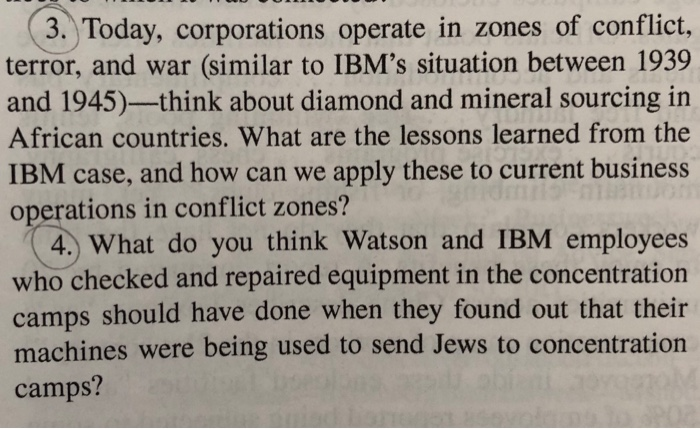
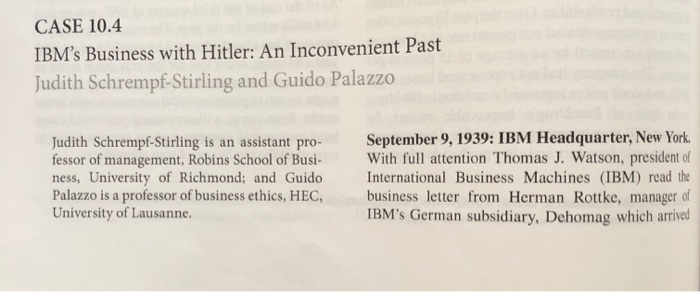
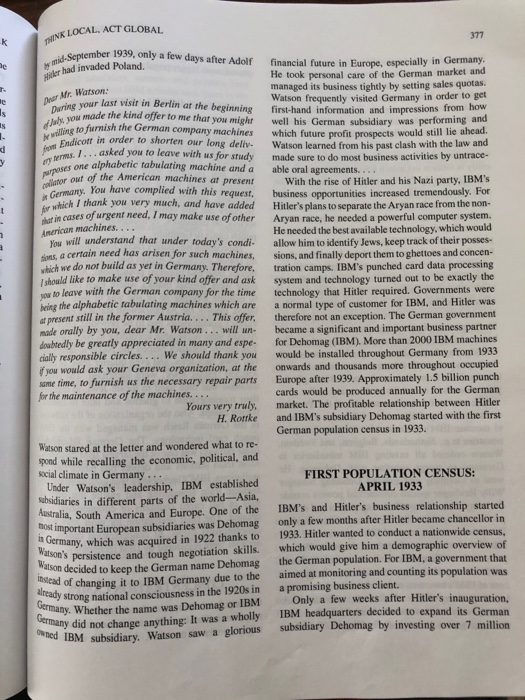
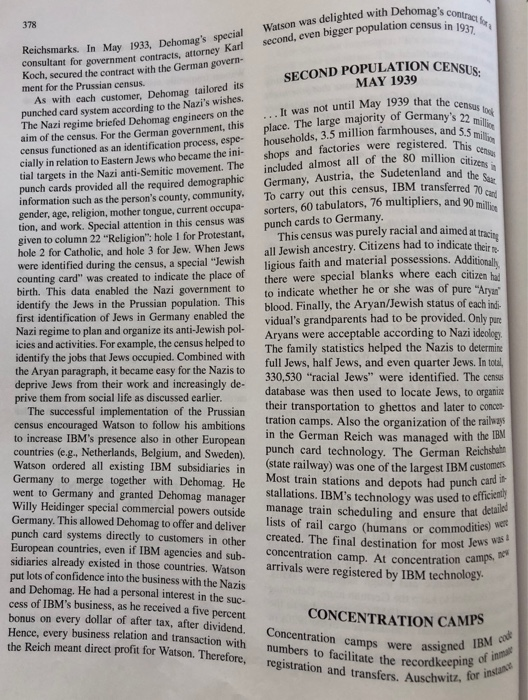
3. Today, corporations operate in zones of conflict, terror, and war (similar to IBM's situation between 1939 and 1945)think about diamond and mineral sourcing in African countries. What are the lessons learned from the IBM case, and how can we apply these to current business operations in conflict zones? 4. What do you think Watson and IBM employees who checked and repaired equipment in the concentration camps should have done when they found out that their machines were being used to send Jews to concentration camps? CASE 10.4 IBM's Business with Hitler: An Inconvenient Past Judith Schrempf-Stirling and Guido Palazzo Judith Schrempf-Stirling is an assistant pro- fessor of management, Robins School of Busi- ness, University of Richmond; and Guido Palazzo is a professor of business ethics, HEC, University of Lausanne, September 9, 1939: IBM Headquarter, New York, With full attention Thomas J. Watson, president of International Business Machines (IBM) read the business letter from Herman Rottke, manager of IBM's German subsidiary, Dehomag which arrived Owned IBM subsidiary. Watson saw a glorious 377 K he Dear Mr. Watson: of July y American machines.... THINK LOCAL, ACT GLOBAL by mid-September 1939, only a few days after Adolf Hier had invaded Poland. During your last visit in Berlin at the beginning fo Endicoft in order to shorten our long deliv I willing to furnish the German company machines wydermus /... asked you to leave with us for study poses one alphabetic fabulating machine and a Aitor out of the American machines at present in Germany. You have complied with this request, Watson decided to keep the German name Dehomag instead of changing it to IBM Germany due to the Germany. Whether the name was Dehomag or IBM Germany did not change anything: It was a wholly he Is you made the kind offer to me that you might is 1. for which I thank you very much, and have added t hat in cases of urgent need, I may make use of other You will understand that under today's condi- tions, a certain need has arisen for such machines, which we do not build as yet in Germany. Therefore, should like to make use of your kind offer and ask you to leave with the German company for the time being the alphabetic tabulating machines which are af present still in the former Austria. ... This offer, made orally by you, dear Mr. Watson... will un- doubtedly be greatly appreciated in many and espe- cially responsible circles.... We should thank you if you would ask your Geneva organization, at the same time, to furnish us the necessary repair parts for the maintenance of the machines. ... Yours very truly, H. Rottke Watson stared at the letter and wondered what to re- spond while recalling the economic, political, and social climate in Germany Under Watson's leadership, IBM established subsidiaries in different parts of the worldAsia, Australia, South America and Europe. One of the host important European subsidiaries was Dehomag in Germany, which was acquired in 1922 thanks to Watson's persistence and tough negotiation skills. financial future in Europe, especially in Germany. He took personal care of the German market and managed its business tightly by setting sales quotas. Watson frequently visited Germany in order to get first-hand information and impressions from how well his German subsidiary was performing and which future profit prospects would still lie ahead. Watson learned from his past clash with the law and made sure to do most business activities by untrace- able oral agreements.... With the rise of Hitler and his Nazi party, IBM's business opportunities increased tremendously. For Hitler's plans to separate the Aryan race from the non- Aryan race, he needed a powerful computer system. He needed the best available technology, which would allow him to identify Jews, keep track of their posses- sions, and finally deport them to ghettoes and concen- tration camps. IBM's punched card data processing system and technology turned out to be exactly the technology that Hitler required. Governments were a normal type of customer for IBM, and Hitler was therefore not an exception. The German government became a significant and important business partner for Dehomag (IBM). More than 2000 IBM machines would be installed throughout Germany from 1933 onwards and thousands more throughout occupied Europe after 1939. Approximately 1.5 billion punch cards would be produced annually for the German market. The profitable relationship between Hitler and IBM's subsidiary Dehomag started with the first German population census in 1933. FIRST POPULATION CENSUS: APRIL 1933 IBM's and Hitler's business relationship started only a few months after Hitler became chancellor in 1933. Hitler wanted to conduct a nationwide census, which would give him a demographic overview of the German population. For IBM, a government that aimed at monitoring and counting its population was a promising business client. Only a few weeks after Hitler's inauguration, IBM headquarters decided to expand its German subsidiary Dehomag by investing over 7 million already strong national consciousness in the 1920s in MAY 1939 punch cards to Germany. Watson was delighted with Dehomag's contra second, even bigger population census in 1937 Reichsmarks. In May 1933, Dehomag's special SECOND POPULATION CENSUS: ...It was not until May 1939 that the census tok place. The large majority of Germany's 22 milline households, 3.5 million farmhouses, and 5.5 millon shops and factories were registered. This included almost all of the 80 million citizens in Germany, Austria, the Sudetenland and the Sex To carry out this census, IBM transferred 70 cand sorters, 60 tabulators, 76 multipliers, and 90 million This census was purely racial and aimed at racing ligious faith and material possessions. Additionally manage train scheduling and ensure that detailed lists of rail cargo (humans or commodities) were created. The final destination for most Jews was! concentration camp. At concentration camps, Concentration camps were assigned IBM cout numbers to facilitate the recordkeeping of in registration and transfers. Auschwitz, for instant 378 consultant for government contracts, attorney Karl Koch, secured the contract with the German govern- ment for the Prussian census. As with each customer, Dehomag tailored its punched card system according to the Nazi's wishes The Nazi regime briefed Dehomag engineers on the aim of the census. For the German government, this census functioned as an identification process, espe- cially in relation to Eastern Jews who became the ini- tial targets in the Nazi anti-Semitic movement. The punch cards provided all the required demographic information such as the person's county, community, gender, age, religion, mother tongue, current occupa- tion, and work. Special attention in this census was given to column 22 "Religion": hole 1 for Protestant, hole 2 for Catholic, and hole 3 for Jew. When Jews all Jewish ancestry. Citizens had to indicate their were identified during the census, a special "Jewish counting card" was created to indicate the place of there were special blanks where each citizen had birth. This data enabled the Nazi government to to indicate whether he or she was of pure "Aryan identify the Jews in the Prussian population. This blood. Finally, the Aryan/Jewish status of each indi first identification of Jews in Germany enabled the vidual's grandparents had to be provided. Only pure Nazi regime to plan and organize its anti-Jewish pol- Aryans were acceptable according to Nazi ideology icies and activities. For example, the census helped to The family statistics helped the Nazis to determine identify the jobs that Jews occupied. Combined with the Aryan paragraph, it became easy for the Nazis to full Jews, half Jews, and even quarter Jews. In total, deprive Jews from their work and increasingly de- 330,530 "racial Jews" were identified. The census prive them from social life as discussed earlier. database was then used to locate Jews, to organize The successful implementation of the Prussian their transportation to ghettos and later to concen census encouraged Watson to follow his ambitions tration camps. Also the organization of the railways to increase IBM's presence also in other European in the German Reich was managed with the IBM countries (e.g., Netherlands, Belgium, and Sweden). punch card technology. The German Reichsbahn Watson ordered all existing IBM subsidiaries in (state railway) was one of the largest IBM customers Germany to merge together with Dehomag. He Most train stations and depots had punch card in went to Germany and granted Dehomag manager stallations. IBM's technology was used to efficient Willy Heidinger special commercial powers outside Germany. This allowed Dehomag to offer and deliver punch card systems directly to customers in other European countries, even if IBM agencies and sub- sidiaries already existed in those countries. Watson put lots of confidence into the business with the Nazis arrivals were registered by IBM technology. and Dehomag. He had a personal interest in the suc- cess of IBM's business, as he received a five percent bonus on every dollar of after tax, after dividend. CONCENTRATION CAMPS Hence, every business relation and transaction with the Reich meant direct profit for Watson. Therefore, check, repair, and replace machines. Whether those was Each concentration camp operated a department where IBM tabulators, sorters, and printers kept its client. The service contract between Dehomag and the Nazi regime also included regular mainte- nance services of the machines. Dehomag (IBM) technicians and workers made on-site visits to 5001, Buchenwald was 002, and Dachau was 003. track of inmates. Most IBM activity took place in the Labor Assignment Office of the camp, which dealt with daily work assignments and processed inmate data and labor transfer rosters. The office also kept a camp hospital index and kept track of all kinds of inmate statistics. This allowed the full tracking of each single inmate. The Nazis knew where the in- mates came from (from another concentration camp or ghetto), what their working skills were, why they were deported, what their health status was, and why they were sent to the camp. The tabulating machine departments in concen- tration camps needed experts operating the ma- chines and keeping track of all the processed data. The people working in those departments were directly trained by IBM in Germany or in another country depending on the IBM location and the con- centration camps. This was included in the leasing, service, and maintenance contract between IBM and 379 machines were in concentration camps or regular office buildings did not matter. Hence, IBM workers repaired and checked IBM equipment in concentra- tion camps like Buchenwald and Dachau









 Study Help