







Question: please answer as soon as possible please When making changes to optimize part of a processor, it is often the case that speeding up one
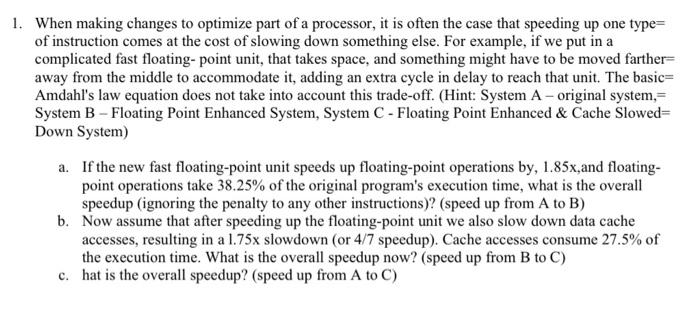
When making changes to optimize part of a processor, it is often the case that speeding up one type = of instruction comes at the cost of slowing down something else. For example, if we put in a complicated fast floating- point unit, that takes space, and something might have to be moved farther= away from the middle to accommodate it, adding an extra cycle in delay to reach that unit. The basic= Amdahl's law equation does not take into account this trade-off. (Hint: System A - original system,= System B - Floating Point Enhanced System, System C - Floating Point Enhanced \& Cache Slowed= Down System) a. If the new fast floating-point unit speeds up floating-point operations by, 1.85x, and floatingpoint operations take 38.25% of the original program's execution time, what is the overall speedup (ignoring the penalty to any other instructions)? (speed up from A to B) b. Now assume that after speeding up the floating-point unit we also slow down data cache accesses, resulting in a 1.75x slowdown (or 4/7 speedup). Cache accesses consume 27.5% of the execution time. What is the overall speedup now? (speed up from B to C) c. hat is the overall speedup? (speed up from A to C)
Step by Step Solution
There are 3 Steps involved in it

Get step-by-step solutions from verified subject matter experts
 Study Help