



Question: Please answer below questions How would you describe the way vision was used at Mentor Graphics? 2. Did it strengthen or weaken the company? How?
Please answer below questions
- How would you describe the way vision was used at Mentor Graphics?
2. Did it strengthen or weaken the company? How? Why?
3. Based on what happened at Mentor Graphics, what are the implications for the three debates discussed in this chapter: whether vision drives change or emerges during change; whether vision helps or hinders change; and whether vision is an attribute of heroic leaders or heroic organizations?
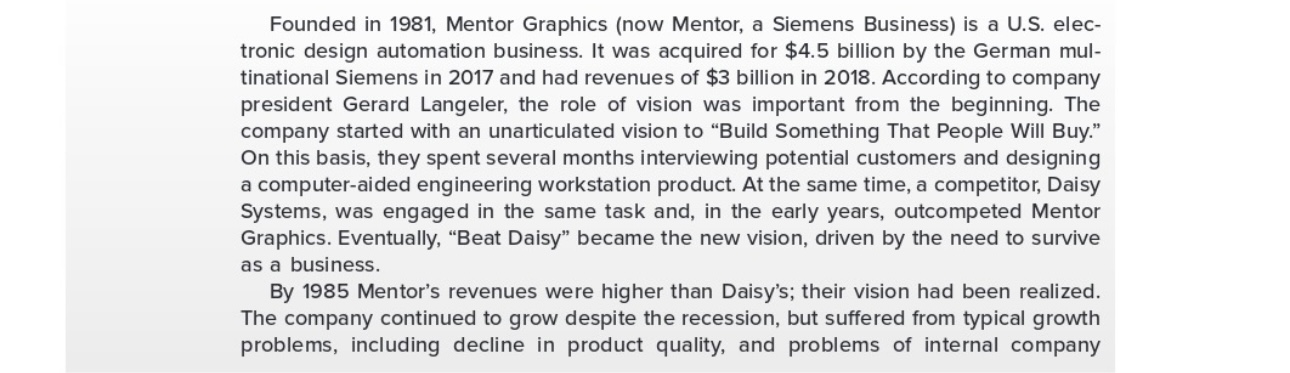
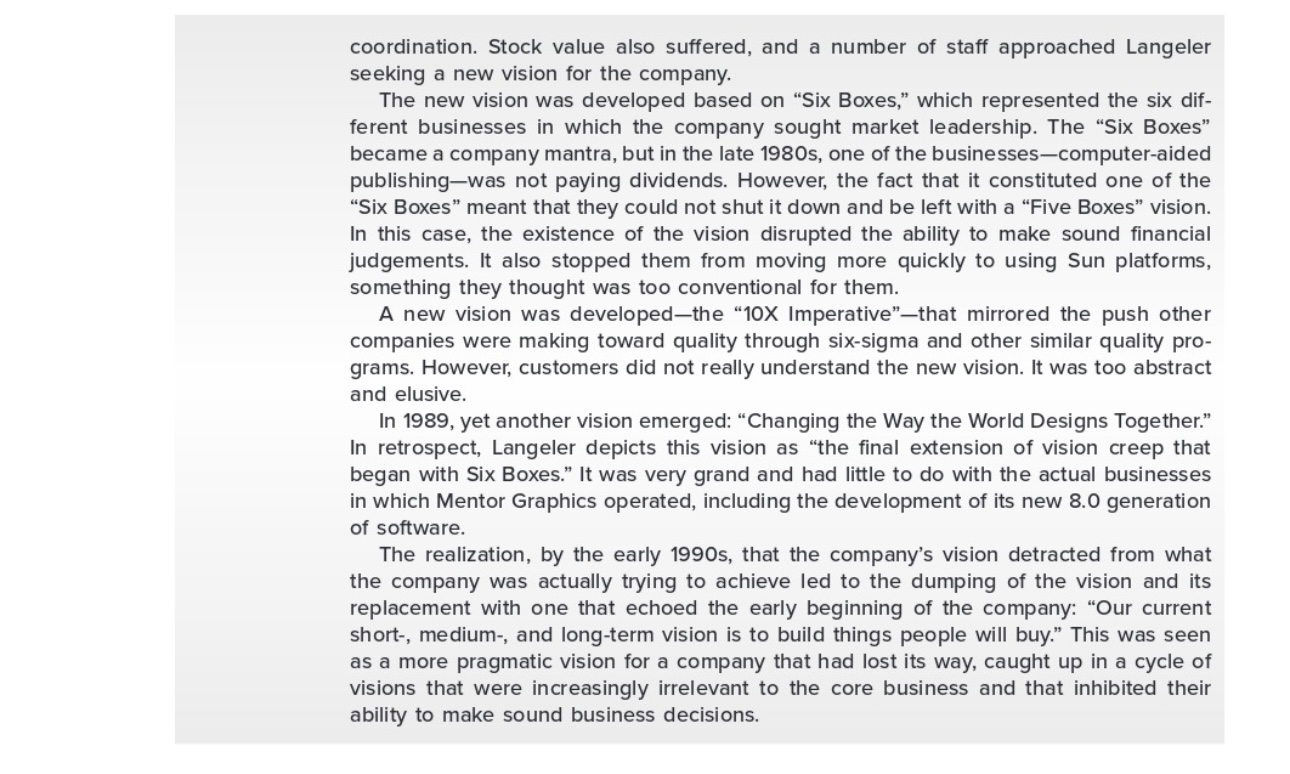
Founded in 1981, Mentor Graphics (now Mentor, a Siemens Business) is a U.S. electronic design automation business. It was acquired for $4.5 billion by the German multinational Siemens in 2017 and had revenues of $3 billion in 2018. According to company president Gerard Langeler, the role of vision was important from the beginning. The company started with an unarticulated vision to "Build Something That People Will Buy." On this basis, they spent several months interviewing potential customers and designing a computer-aided engineering workstation product. At the same time, a competitor, Daisy Systems, was engaged in the same task and, in the early years, outcompeted Mentor Graphics. Eventually, "Beat Daisy" became the new vision, driven by the need to survive as a business. By 1985 Mentor's revenues were higher than Daisy's; their vision had been realized. The company continued to grow despite the recession, but suffered from typical growth problems, including decline in product quality, and problems of internal company coordination. Stock value also suffered, and a number of staff approached Langeler seeking a new vision for the company. The new vision was developed based on "Six Boxes," which represented the six different businesses in which the company sought market leadership. The "Six Boxes" became a company mantra, but in the late 1980 s, one of the businesses-computer-aided publishing-was not paying dividends. However, the fact that it constituted one of the "Six Boxes" meant that they could not shut it down and be left with a "Five Boxes" vision. In this case, the existence of the vision disrupted the ability to make sound financial judgements. It also stopped them from moving more quickly to using Sun platforms, something they thought was too conventional for them. A new vision was developed-the "10X Imperative"-that mirrored the push other companies were making toward quality through six-sigma and other similar quality programs. However, customers did not really understand the new vision. It was too abstract and elusive. In 1989, yet another vision emerged: "Changing the Way the World Designs Together." In retrospect, Langeler depicts this vision as "the final extension of vision creep that began with Six Boxes." It was very grand and had little to do with the actual businesses in which Mentor Graphics operated, including the development of its new 8.0 generation of software. The realization, by the early 1990s, that the company's vision detracted from what the company was actually trying to achieve led to the dumping of the vision and its replacement with one that echoed the early beginning of the company: "Our current short-, medium-, and long-term vision is to build things people will buy." This was seen as a more pragmatic vision for a company that had lost its way, caught up in a cycle of visions that were increasingly irrelevant to the core business and that inhibited their ability to make sound business decisions
Step by Step Solution
There are 3 Steps involved in it

Get step-by-step solutions from verified subject matter experts