







Question: Please answer both questions based on the Sony case: 1. How would you describe Sony's environment (as it is described in the case)? 2. What
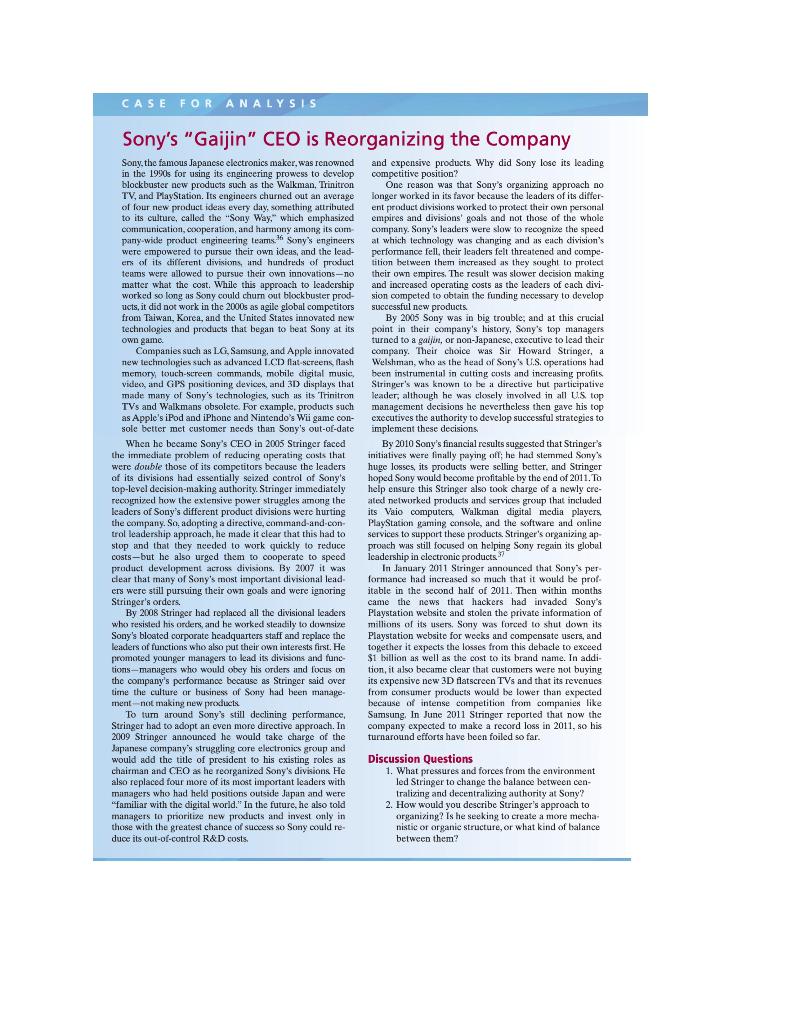
Please answer "both" questions based on the Sony case:
1. How would you describe Sony's environment (as it is described in the case)?
2. What do you think of his approach? Would you have handled it differently? Why/Why not?
CASE FOR ANALYSIS Sony's "Gaijin" CEO is Reorganizing the Company Sony, the famous Japanese electronics maker,was renowned in the 1990s for using its engineering prowess to develop blockbuster new products such as the Walkman, Trinitron TV, and PlayStation. Its engineers churned out an average of four new product ideas every day, something attributed to its culture, called the "Sony Way," which emphasized communication, cooperation, and harmony among its cum pany-wide product engineering teams. Sony's engineers were empowered to pursue their own ideas, and the lead- ers of its different divisions, and hundreds of proxluct teams were allowed to pursue their own innovations-no matter what the cost. While this approach to leadership worked so long as Sony could chum out blockbuster prod- ucts, it did not work in the 2000s as agile global competitors from Taiwan, Korea, and the United States innovated new technologies and products that began to beat Sony at its own game. Companies such as LG, Samsung, and Apple innovated new technologies such as advanced LCD llat-screens, flash memory, touch-screen commands, mobile digital music, videos, and GPS positioning devices, and 3D displays thal made many of Sony's technologies, such as its Trinitrom TVs and Walkmans obsolete. For example, products such as Apple's iPod and iPhone and Nintendo's Wii game con- sole better met customer needs thun Sony's out-of-date When he became Sony's CEO in 2005 Stringer faced the immediate problem of reducing operating costs that were double those of its competitors because the leaders of its divisions had essentially seized control of Sony's top-level decision-making authority. Stringer immediately recognized how the extensive power struggles among the leaders of Sony's different product divisions were hurting the company. So, adopting a directive, command-and-con trol leadership approach, he made it clear that this had to stop and that they needed to work quickly to reduce costs--but he also urged them to cooperate to speed product development across divisions. By 2007 it was clear that many of Sony's most important divisional lead crs were still pursuing their own goals and were ignoring Stringer's orders. By 2008 Stringer had replaced all the divisional leaders who resisted his orders, and he worked steadily to downsize Sony's bloated corporate headquarters staff and replace the leaders of functions who also put their own interests first. He promoted younger managers to lead its divisions and func tions--managers who would obey his orders and focus on the company's performance because as Stringer said over time the culture or business of Sony had been manage ment not making new products To turn around Sony's still declining performance, Stringer had to adopt an even more directive approach. In 2009 Stringer announced he would take charge of the Japanese cumpany's struggling cure electronics group and would add the title of president to his existing roles as chairman and CEO as he reorganized Sony's divisions. He also replaced four more of its most important leaders with managers who had held positions outside Japin and were "familiar with the digital world." In the future, he also told managers to prioritize new products and invest only in those with the greatest chance of success so Sony could re- duce its out-of-control R&D costs. and expensive products. Why did Sony lose its leading competitive position? One reason was that Sony's organizing approach no longer worked in its favor because the leaders of its differ- ent product divisions worked to protect their own personal empires and divisions' goals and not those of the whole company. Sony's leaders were slow to recognize the speed at which technology was changing and as each division's performance fell their leaders felt threatened and compe- tition between them increased as they sought to protect their own empires. The result was slower decision making and increased operating costs as the leaders of cach divi- sion competed to obtain the funding necessary to develop successful new products By 2005 Sony was in big trouble, and at this crucial point in their company's history, Sony's top managers turned to a galjon, or non-Japanese. cxccutive to lead their Welshman, who as the head of Sony's U.S. operations had company. Their choice was Sir Howard Stringer, a been instrumental in cutting costs and increasing profits Stringer's was known to be a directive hut participative leader, although he was closely involved in all US top management decisions he nevertheless then gave his top executives the authority to develop successful strategies to implement these decisions By 2010 Sony's financial results suggested that Stringer's initiatives were finally praying off, he had stemmed Sony's huge losses, its products were selling better and Stringer hoped Sony would become profitable by the end of 2011. To help ensure this Stringer also took charge of a newly cre- ated networked products and services group that included its Vaio computers Walkman digital media players. PlayStation gaming console, and the software and online services to support these products. Stringer's organizing ap- proach was still focused on helping Sony regain its global leadership in electronic products 37 In January 2011 Stringer announced that Sony's per formance had increased so much that it would be prof. itable in the second half of 2011. Then within months came the news that hackers had invaded Sony's Playstation website and stolen the private information of millions of its users. Sony was forced to shut down its Playstation website for weeks and compensate users, and together it expects the losses from this debacle to exceed $1 billion as well as the cost to its brand name. In addi tion, it also became clear that customers were not buying its expensive new 3D flatscreen TVs and that its revenucs from consumer products would be lower than expected because of intense competition from companies like Samsung In June 2011 Stringer reported that now the company expected to make a record loss in 2011, so his turnaround efforts have been foiled so far. Discussion Questions 1. What pressures and forces from the environment led Stringer to change the balance between cen- tralizing and decentralizing authority at Sony? 2. How would you describe Stringer's approach to organizing? Is he seeking to create a more mecha nistic or organic structure, or what kind of balance between them
Step by Step Solution
There are 3 Steps involved in it
1 Expert Approved Answer
Step: 1 Unlock

Question Has Been Solved by an Expert!
Get step-by-step solutions from verified subject matter experts
Step: 2 Unlock
Step: 3 Unlock
 Study Help