







Question: Please answer both separately. When a solid dissolves in water, heat may be evolved or absorbed. The heat of dissolution (dissolving) can be determined using
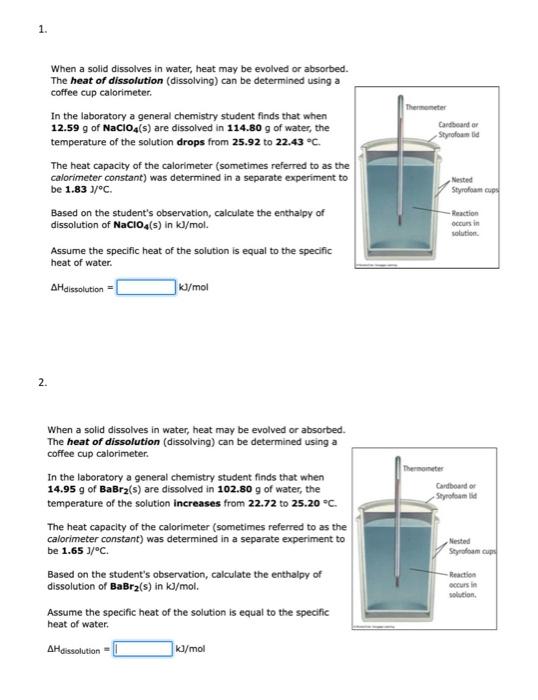
When a solid dissolves in water, heat may be evolved or absorbed. The heat of dissolution (dissolving) can be determined using a coffee cup calorimeter. In the laboratory a general chemistry student finds that when 12.59g of NaClO4(s) are dissolved in 114.80g of water, the temperature of the solution drops from 25.92 to 22.43C. The heat capacity of the calorimeter (sometimes referred to as the calorimeter constant) was determined in a separate experiment to be 1.833/C. Based on the student's observation, calculate the enthalpy of dissolution of NaClO4(s) in kJ/mol. Assume the specific heat of the solution is equal to the specific heat of water. Hdissolution=kJ/mol 2. When a solid dissolves in water, heat may be evolved or absorbed. The heat of dissolution (dissolving) can be determined using a coffee cup calorimeter. In the laboratory a general chemistry student finds that when 14.95 g of BaBr2(s) are dissolved in 102.80g of water, the temperature of the solution increases from 22.72 to 25.20C. The heat capacity of the calorimeter (sometimes referred to as the calorimeter constant) was determined in a separate experiment to be 1.65J/C. Based on the student's observation, calculate the enthalpy of dissolution of BaBr2(s) in kJ/mol. Assume the specific heat of the solution is equal to the specific heat of water. Hdissolution=kJ/mol
Step by Step Solution
There are 3 Steps involved in it

Get step-by-step solutions from verified subject matter experts
 Study Help