



Question: Please answer Case 1 A 1999 Wall Street Journal article (April 7, 1999, page c1) described a now settled U.S. Securities Exchange Commission (SEC) case
Please answer Case 1
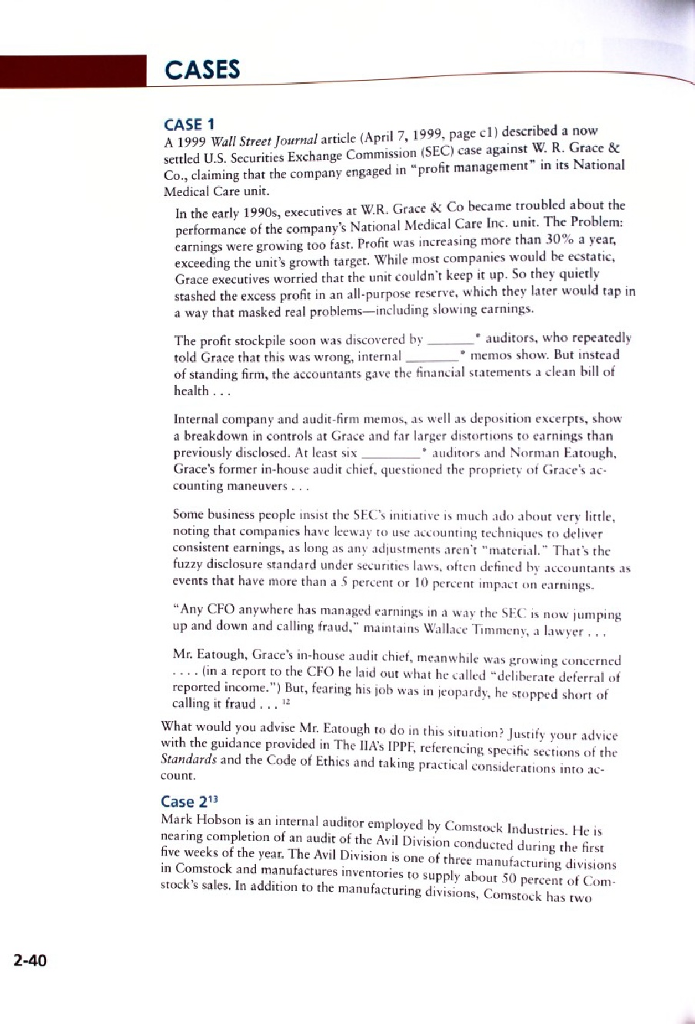
A 1999 Wall Street Journal article (April 7, 1999, page c1) described a now settled U.S. Securities Exchange Commission (SEC) case against W. R. Grace & Co., claiming that the company engaged in "profit management" in its National Medical Care unit. In the early 1990s, executives at WR. Grace & Co became troubled about the performance of the company's National Medical Care Inc. unit. The Problem earnings were growing too fast. Profit was increasing more than 30% a year, exceeding the unit's growth target. While most companies would be ecstatic. Grace executives worried that the unit couldn't keep it up. So they quietly stashed the excess profit in an all purpose reserve, which they later would tap in a way that masked real problems-including slowing earnings. The profit stockpile soon was discovered by _____ * auditors, who repeatedly told Grace that this was wrong, internal _____ * memos show. But instead of standing firm, the accountants gave the financial statements a clean bill of health.... Internal company and audit-firm memos, as well as deposition excerpts, show a breakdown in controls at Grace and far larger distortions to earnings than previous disclosed. At least six _____ * auditors and Norman Eatough, Grace's former in-house audit chief, questioned the propriety of Grace's accounting maneuvers.... Some business people insist the SEC's initiative is much ado about very little noting, that companies have leeway to use accounting techniques to deliver consistent earnings, as long as any adjustments, aren't "material." That's the fuzzy disclosure standard under securities laws, often defined by accountants events that have more than a 5 percent or 10 percent impact on earnings. "Any CFO anywhere has managed earnings in a way the SEC is now jumping up and down and calling fraud, " maintains Wallace Timmeny, a lawyer... Mr. Eatough, Grace's in-house audit chief, meanwhile was growing concerned... (in a report to the CFO he laid out what he called "deliberate deferral of reported income.") But, fearing his job was in jeopardy, he stopped short calling it fraud... What would you advise Mr. Eatough to do in this situation? Justify your advice with the guidance provided in The IPPF, referencing specific sections of the standards and the Code of Ethics and taking practical considerations into account. Mark Hobson is an internal auditor employed by Comstock Industries. He is nearing completion of an audit of the Avil Division conducted during the first weeks of the year. The Avil Division is one of three manufacturing divisions in Comstock and manufactures inventories to supply about 50 percent of Comstock's sales. In addition to the manufacturing divisions, Comstock has two
Step by Step Solution
There are 3 Steps involved in it

Get step-by-step solutions from verified subject matter experts