







Question: Please answer (d) and (e), this was all the information that was given the calculation of opportunity cost (needed for calculating profit). To make things
Please answer (d) and (e), this was all the information that was given
the calculation of opportunity cost (needed for calculating profit). To make things more straightforward, assume that any money from the $1000 that you don't invest in the particular options earns a 5% rate of return (with continuous compounding).
That way part (a) makes sense, and there's one opportunity cost for all the strategies. Otherwise, if you're investing slightly less than $1000 (because you can't *quite* spend the whole $1000 on the security in question) you'll have a different opportunity cost for your money for each of the strategies.
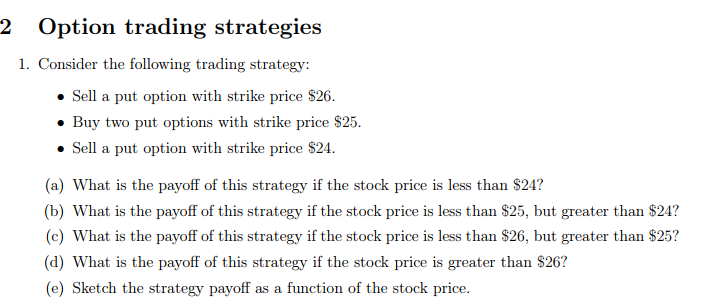
2 Option trading strategies 1. Consider the following trading strategy Sell a put option with strike price $26. Buy two put options with strike price $25. Sell a put option with strike price $24. (a) What is the payoff of this strategy if the stock price is less than $24? (b) What is the payoff of this strategy if the stock price is less than $25, but greater than $24? (c) What is the payoff of this strategy if the stock price is less than $26, but greater than $25? (d) What is the payoff of this strategy if the stock price is greater than $26? (e) Sketch the strategy payoff as a function of the stock price
Step by Step Solution
There are 3 Steps involved in it

Get step-by-step solutions from verified subject matter experts
 Study Help