







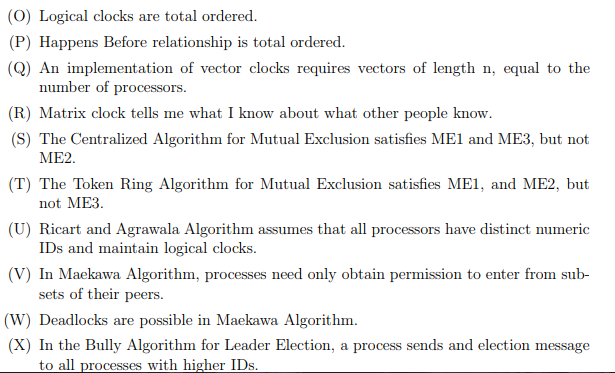
Question: PLEASE ANSWER EACH PART AS TRUE OR FALSE, if false explain why (O) Logical clocks are total ordered (P) Happens Before relationship is total ordered
PLEASE ANSWER EACH PART AS TRUE OR FALSE, if false explain why
(O) Logical clocks are total ordered (P) Happens Before relationship is total ordered (Q) An implementation of vector clocks requires vectors of length n, equal to the number of processors. (R) Matrix clock tells me what I know about what other people knovw (S) The Centralized Algorithm for Mutual Exclusion satisfies MEl and ME3, but not ME2 (T) The Token Ring Algorithm for Mutual Exclusion satisfies ME1, and ME2, but (U) Ricart and Agrawala Algorithm assumes that all processors have distinct numeric (V) In Maekawa Algorithm, processes need only obtain permission to enter from sub- not ME3 IDs and maintain logical clocks. sets of their peers. (W) Deadlocks are possible in Maekawa Algorithm. (X) In the Bully Algorithm for Leader Election, a process sends and election message (O) Logical clocks are total ordered (P) Happens Before relationship is total ordered (Q) An implementation of vector clocks requires vectors of length n, equal to the number of processors. (R) Matrix clock tells me what I know about what other people knovw (S) The Centralized Algorithm for Mutual Exclusion satisfies MEl and ME3, but not ME2 (T) The Token Ring Algorithm for Mutual Exclusion satisfies ME1, and ME2, but (U) Ricart and Agrawala Algorithm assumes that all processors have distinct numeric (V) In Maekawa Algorithm, processes need only obtain permission to enter from sub- not ME3 IDs and maintain logical clocks. sets of their peers. (W) Deadlocks are possible in Maekawa Algorithm. (X) In the Bully Algorithm for Leader Election, a process sends and election message
Step by Step Solution
There are 3 Steps involved in it

Get step-by-step solutions from verified subject matter experts
 Study Help