







Question: Please answer each question and show your work, thank you very much. Decision Making ( Decision Tree ) A manager is trying to decide whether
Please answer each question and show your work, thank you very much. Decision Making Decision Tree
A manager is trying to decide whether to buy one machine or two. If only one is purchased
and demand proves to be excessive, the second machine can be purchased later. Some sales
will be lost, however, because the lead time for producing this type of machine is six months.
In addition, the cost per machine will be lower if both are purchased at the same time. The
probability of low demand is estimated to be The aftertax net present value of the
benefits from purchasing the two machines together is $ if demand is low and $
if demand is high. If one machine is purchased and demand is low, the net present value is
$ If demand is high, the manager has three options. Doing nothing has a net present
value of $; subcontracting, $; and buying the second machine, $
a Draw a decision tree for this problem.
b How many machines should the company buy initially? What is the expected payoff for
this alternative?
Analyzing CostTime Tradeoffs in Managing Projects in Supply Chains
You are in charge of a project at the local community center. The center needs to remodel one
of the rooms in time for the start of a new program. Delays in the project mean that the center
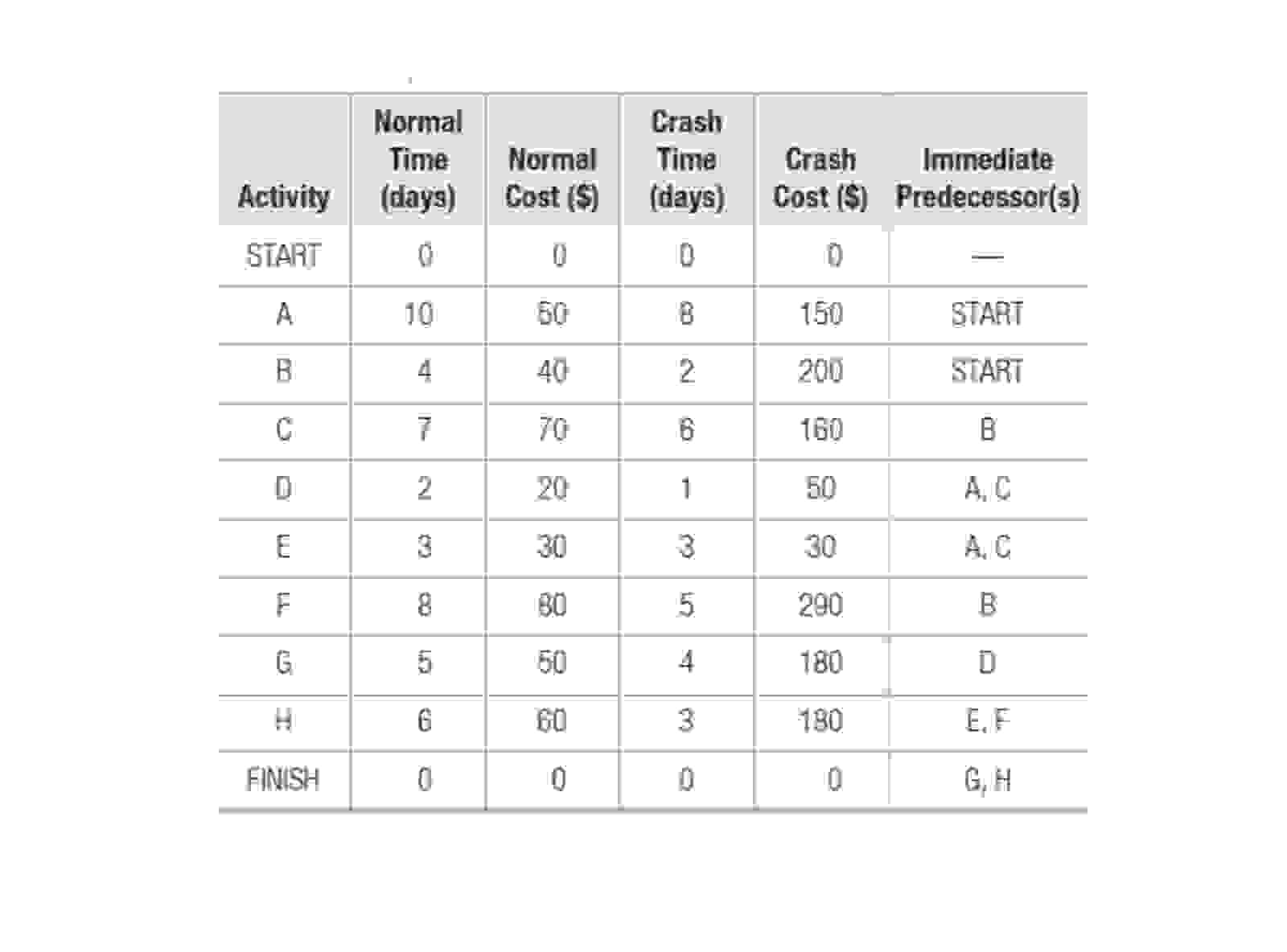
must rent other space at a nearby church at additional cost. Time and cost data for your project
are contained in table below. Your interest is in minimizing the cost of the project to the
community center.
a Using the normal times for each activity, what is the earliest date you can complete
the project?
b Suppose the variable overhead costs are $ per day for your project. Also, suppose that the center must pay $ per day for a temporary room on day or beyond. Find the minimumcost project schedule. tableActivitytableNormalTimedaystableNormalCost $tableCrashTimedaystableCrashCost $tableIminediatePredecessorsSTARTABTARTBSTARTCBDA CEA CFBBGDHEFFINISHG H
Contd on the next page
Step by Step Solution
There are 3 Steps involved in it
1 Expert Approved Answer
Step: 1 Unlock

Question Has Been Solved by an Expert!
Get step-by-step solutions from verified subject matter experts
Step: 2 Unlock
Step: 3 Unlock
 Study Help