







Question: Please answer each questions below based on the case study about Toshiba's Notebook Computer Assembly Line on the attachment 1.What is the daily capacity of
Please answer each questions below based on the case study about "Toshiba's Notebook Computer Assembly Line" on the attachment
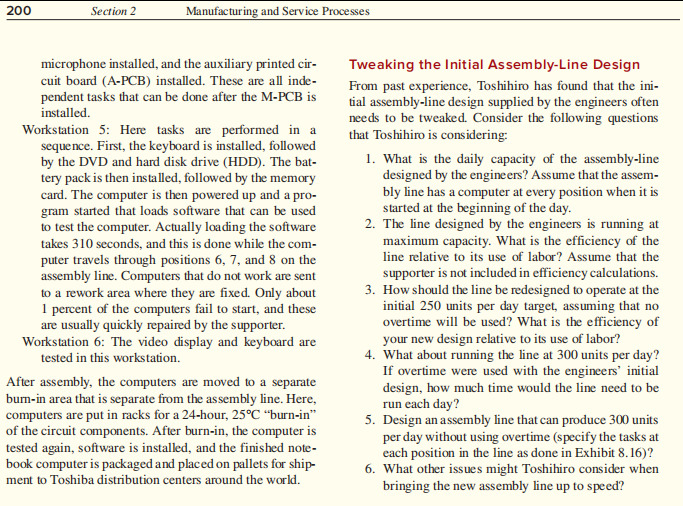
1.What is the daily capacity of the assembly-line designed by the engineers? Assume that the assembly line has a computer at every position when it is started at the beginning of the day.
2.The line designed by the engineers is running at maximum capacity. What is the efficiency of the line relative to its use of labor? Assume that the supporter is not included in efficiency calculations.
3.How should the line be redesigned to operate at the initial 250 units per day target, assuming that no overtime will be used? What is the efficiency of your new design relative to its use of labor?
4.What about running the line at 300 units per day? If overtime were used with the engineers' initial design, how much time would the line need to be run each day? Explain your answer the strategy should be taken to carry out this problem.
5.Design an assembly line that can produce 300 units per day without using overtime (specify the tasks at each position in the line as done in Exhibit 8.16)? How to justify the assembly line meet to produce 300 units per day.
6.What other issues might Toshihiro consider when bringing the new assembly line up to speed? Explain your answer by giving an example and how to make sure these issues are taken for this company.
Thank You
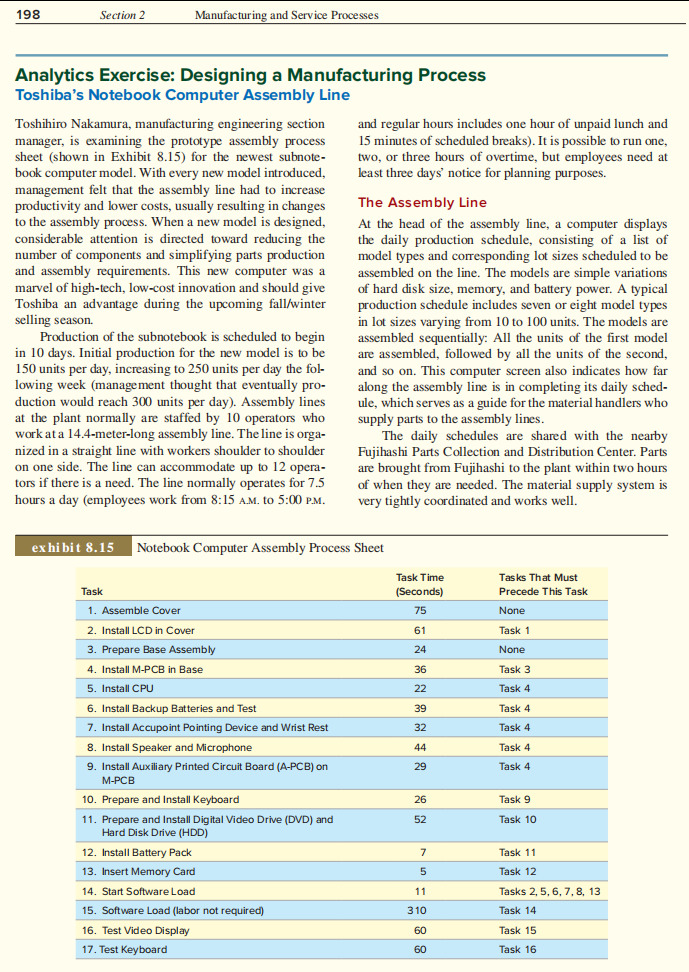
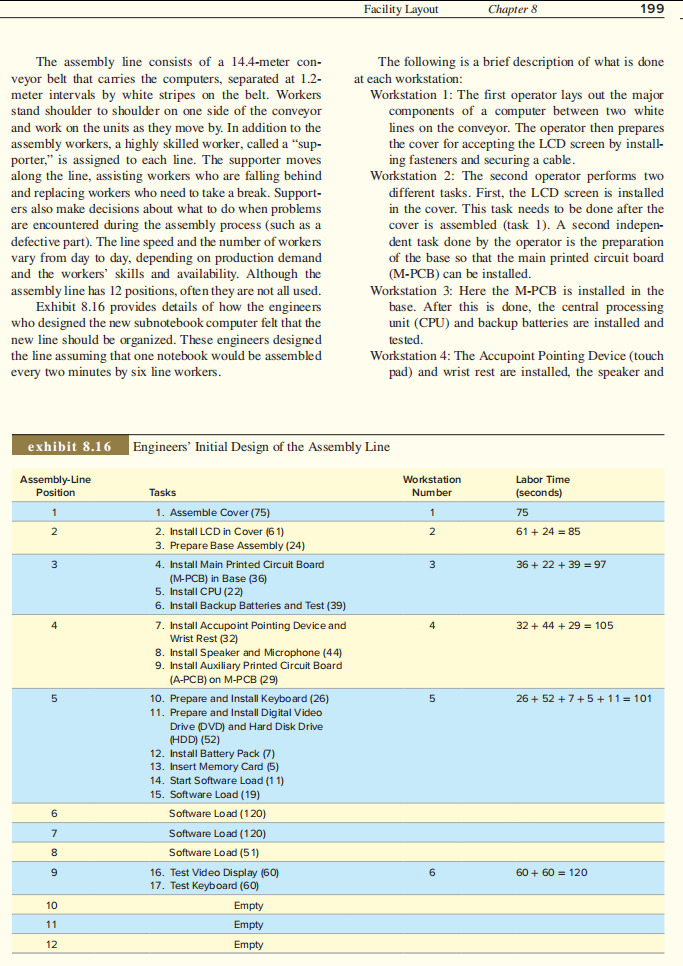
198 Section 2 Manufacturing and Service Processes Analytics Exercise: Designing a Manufacturing Process Toshiba's Notebook Computer Assembly Line Toshihiro Nakamura, manufacturing engineering section and regular hours includes one hour of unpaid lunch and manager, is examining the prototype assembly process 15 minutes of scheduled breaks). It is possible to run one, sheet (shown in Exhibit 8.15) for the newest subnote- two, or three hours of overtime, but employees need at book computer model. With every new model introduced, least three days' notice for planning purposes. management felt that the assembly line had to increase productivity and lower costs, usually resulting in changes The Assembly Line to the assembly process. When a new model is designed, At the head of the assembly line, a computer displays considerable attention is directed toward reducing the the daily production schedule, consisting of a list of number of components and simplifying parts production model types and corresponding lot sizes scheduled to be and assembly requirements. This new computer was a assembled on the line. The models are simple variations marvel of high-tech, low-cost innovation and should give of hard disk size, memory, and battery power. A typical Toshiba an advantage during the upcoming fall/winter production schedule includes seven or eight model types selling season. in lot sizes varying from 10 to 100 units. The models are Production of the subnotebook is scheduled to begin assembled sequentially: All the units of the first model in 10 days. Initial production for the new model is to be are assembled, followed by all the units of the second. 150 units per day, increasing to 250 units per day the fol- and so on. This computer screen also indicates how far lowing week (management thought that eventually pro- along the assembly line is in completing its daily sched- duction would reach 300 units per day). Assembly lines ule, which serves as a guide for the material handlers who at the plant normally are staffed by 10 operators who supply parts to the assembly lines. work at a 14.4-meter-long assembly line. The line is orga- The daily schedules are shared with the nearby nized in a straight line with workers shoulder to shoulder Fujihashi Parts Collection and Distribution Center. Parts on one side. The line can accommodate up to 12 opera- are brought from Fujihashi to the plant within two hours tors if there is a need. The line normally operates for 7.5 of when they are needed. The material supply system is hours a day (employees work from 8:15 A.M. to 5:00 PM. very tightly coordinated and works well. exhibit 8.15 Notebook Computer Assembly Process Sheet Task Time Tasks That Must Task Seconds) Precede This Task 1. Assemble Cover 75 None 2. Install LCD in Cover 61 Task 1 3. Prepare Base Assembly 24 None 4. Install M-PCB in Base 36 Task 3 5. Install CPU 22 Task 4 6. Install Backup Batteries and Test 39 Task 4 7. Install Accupoint Pointing Device and Wrist Rest 32 Task 4 8. Install Speaker and Microphone 44 Task 4 9. Install Auxiliary Printed Circuit Board (A-PCB) on 29 Task 4 M-PCB 10. Prepare and Install Keyboard 26 Task 9 11. Prepare and Install Digital Video Drive (DVD) and 52 Task 10 Hard Disk Drive (HDD) 12. Install Battery Pack 7 Task 11 13. Insert Memory Card 5 Task 12 14. Start Software Load 11 Tasks 2, 5, 6, 7, 8, 13 15. Software Load (labor not required) 310 Task 14 16. Test Video Display 60 Task 15 17. Test Keyboard 60 Task 16Facility Layout Chapter 8 199 The assembly line consists of a 14.4-meter con- The following is a brief description of what is done veyor belt that carries the computers, separated at 1.2- at each workstation: meter intervals by white stripes on the belt. Workers Workstation 1: The first operator lays out the major stand shoulder to shoulder on one side of the conveyor components of a computer between two white and work on the units as they move by. In addition to the lines on the conveyor. The operator then prepares assembly workers, a highly skilled worker, called a "sup- the cover for accepting the LCD screen by install- porter," is assigned to each line. The supporter moves ing fasteners and securing a cable. along the line, assisting workers who are falling behind Workstation 2: The second operator performs two and replacing workers who need to take a break. Support- different tasks. First, the LCD screen is installed ers also make decisions about what to do when problems in the cover. This task needs to be done after the are encountered during the assembly process (such as a cover is assembled (task 1). A second indepen- defective part). The line speed and the number of workers dent task done by the operator is the preparation vary from day to day, depending on production demand of the base so that the main printed circuit board and the workers' skills and availability. Although the (M-PCB) can be installed assembly line has 12 positions, often they are not all used. Workstation 3: Here the M-PCB is installed in the Exhibit 8.16 provides details of how the engineers base. After this is done, the central processing who designed the new subnotebook computer felt that the unit (CPU) and backup batteries are installed and new line should be organized. These engineers designed tested. the line assuming that one notebook would be assembled Workstation 4: The Accupoint Pointing Device (touch every two minutes by six line workers. pad) and wrist rest are installed, the speaker and exhibit 8.16 Engineers' Initial Design of the Assembly Line Assembly-Line Workstation Labor Time Position Tasks Number (seconds) 1. Assemble Cover (75) 75 2. Install LCD in Cover (61) 2 61 + 24 = 85 3. Prepare Base Assembly (24) 3 4. Install Main Printed Circuit Board 3 36 + 22 + 39 =97 (M-PCB) in Base (36) 5. Install CPU (22) 6. Install Backup Batteries and Test (39) 4 7. Install Accupoint Pointing Device and 4 32 + 44 + 29 = 105 Wrist Rest (32) 8. Install Speaker and Microphone (44) 9. Install Auxiliary Printed Circuit Board [A-PCB) on M-PCB (29) 5 10. Prepare and Install Keyboard (26) 5 26 + 52 + 7 + 5 +11 = 101 11. Prepare and Install Digital Video Drive (DVD) and Hard Disk Drive (HDD) (52) 12. Install Battery Pack (7) 13. Insert Memory Card (5) 14. Start Software Load (1 1) 15. Software Load (19) Software Load (120) Software Load (120) CO Software Load (51) LD 16. Test Video Display (60) 6 60 + 60 = 120 17. Test Keyboard (60) 10 Empty 11 Empty 12 Empty200 Section 2 Manufacturing and Service Processes microphone installed, and the auxiliary printed cir- Tweaking the Initial Assembly-Line Design cuit board (A-PCB) installed. These are all inde- From past experience, Toshihiro has found that the ini- pendent tasks that can be done after the M-PCB is tial assembly-line design supplied by the engineers often installed. needs to be tweaked. Consider the following questions Workstation 5: Here tasks are performed in a that Toshihiro is considering: sequence. First, the keyboard is installed, followed by the DVD and hard disk drive (HDD). The bat- 1. What is the daily capacity of the assembly-line tery pack is then installed, followed by the memory designed by the engineers? Assume that the assem- card. The computer is then powered up and a pro- bly line has a computer at every position when it is gram started that loads software that can be used started at the beginning of the day. to test the computer. Actually loading the software 2. The line designed by the engineers is running at takes 310 seconds, and this is done while the com- maximum capacity. What is the efficiency of the puter travels through positions 6, 7, and 8 on the line relative to its use of labor? Assume that the assembly line. Computers that do not work are sent supporter is not included in efficiency calculations. to a rework area where they are fixed. Only about 3. How should the line be redesigned to operate at the 1 percent of the computers fail to start, and these initial 250 units per day target, assuming that no are usually quickly repaired by the supporter. overtime will be used? What is the efficiency of Workstation 6: The video display and keyboard are your new design relative to its use of labor? tested in this workstation. 4. What about running the line at 300 units per day? If overtime were used with the engineers' initial After assembly, the computers are moved to a separate design, how much time would the line need to be burn-in area that is separate from the assembly line. Here, run each day? computers are put in racks for a 24-hour, 25"C "burn-in" 5. Design an assembly line that can produce 300 units of the circuit components. After burn-in, the computer is per day without using overtime (specify the tasks at tested again, software is installed, and the finished note- each position in the line as done in Exhibit 8.16)? book computer is packaged and placed on pallets for ship- 6. What other issues might Toshihiro consider when ment to Toshiba distribution centers around the world. bringing the new assembly line up to speed
Step by Step Solution
There are 3 Steps involved in it

Get step-by-step solutions from verified subject matter experts
 Study Help