







Question: please answer e,f,g,h,i,j and make it simple 13) For each of the following mixtures, do the following: 1) Identify the actual solutes that are present
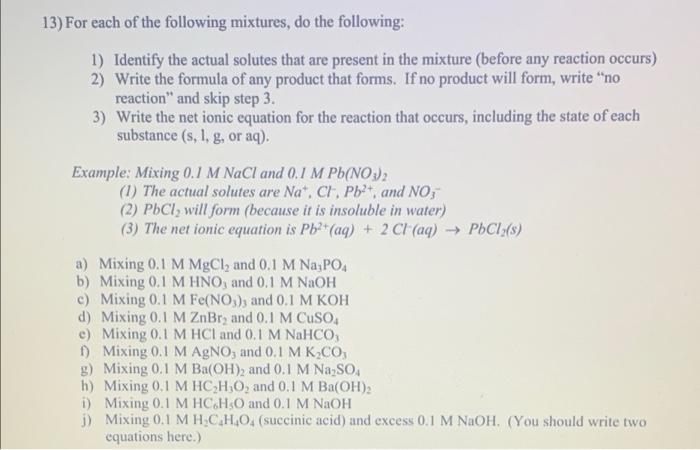
13) For each of the following mixtures, do the following: 1) Identify the actual solutes that are present in the mixture (before any reaction occurs) 2) Write the formula of any product that forms. If no product will form, write no reaction" and skip step 3. 3) Write the net ionic equation for the reaction that occurs, including the state of each substance (s, 1. g, or aq). Example: Mixing 0.1 M NaCl and 0.1 M Pb(NO3)2 (1) The actual solutes are Nat. C, Pb2t, and NO; (2) PbCl, will form (because it is insoluble in water) (3) The net ionic equation is Pb2+ (aq) + 2 CI (aq) PbCl:(8) a) Mixing 0.1 M MgCl2 and 0.1 M Na3PO4 b) Mixing 0.1 M HNO, and 0,1 M NaOH c) Mixing 0.1 M Fe(NO3), and 0.1 M KOH d) Mixing 0,1 M ZnBrand 0.1 M CuSO4 c) Mixing 0.1 M HCl and 0.1 M NaHCO, 1) Mixing 0.1 M AgNO3 and 0.1 M K CO, g) Mixing 0.1 M Ba(OH)2 and 0.1 M Na2SO4 h) Mixing 0,1 M HC,H,O, and 0.1 M Ba(OH)2 i) Mixing 0.1 M HC.HSO and 0.1 M NaOH j) Mixing 0,1 MH.C.H.O. (succinic acid) and excess 0.1 M NaOH. (You should write two equations here.)
Step by Step Solution
There are 3 Steps involved in it

Get step-by-step solutions from verified subject matter experts
 Study Help