



Question: Please answer every item accordingly and i will give you a like! :) Stocks A and B have the following probability distributions of expected future
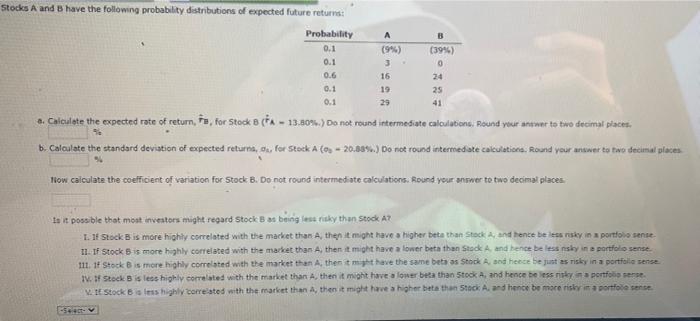
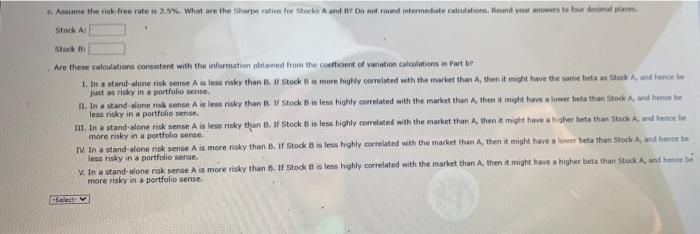
Stocks A and B have the following probability distributions of expected future returns: Probability 0.1 (39%) 0.1 0 0.6 16 24 0.1 19. 25 0.1 29 41 a. Calculate the expected rate of return, FB, for Stock B (FA-13.80%.) Do not round intermediate calculations, Round your answer to two decimal places. % b. Calculate the standard deviation of expected returns, d, for Stock A (-20.88%.) Do not round intermediate calculations. Round your answer to two decimal places A % Now calculate the coefficient of variation for Stock B. Do not round intermediate calculations. Round your answer to two decimal places Is it possible that most investors might regard Stock B as being less risky than Stock A? 1. If Stock B is more highly correlated with the market than A, then it might have a higher beta than Stock A, and hence be less risky in a portfolio sense. 11. If Stock B is more highly correlated with the market than A, then it might have a lower beta than Stock A, and hence be less nsky in a portfolio sense. 111. If Stock B is more highly correlated with the market than A, then it might have the same beta as Stock A, and hence be just as risky in a portfolio sense. If Stock B is less highly correlated with the market than A, then it might have a lower beta than Stock A, and hence be less risky in a portfolio sense. If Stock B is less highly correlated with the market than A, then it might have a higher beta than Stock A, and hence be more risky in a portfolio sense. IV. V. A (9%) 3 Assume the risk-free rate is 2.5%. What are the Sharpe ration for Stocks A and 87 Do not found intermediate calculations. Round your answers to four decimal places Stock Al Stock Br Are these calculations consistent with the information obtained from the coefficient of variation calculations in Parth? 1. In a stand-alone risk sense A is less risky than B. If Stock B is more highly correlated with the market than A, then it might have the same beta as Stock A, and hence be just as risky in a portfolio sense. II. In a stand-alone risk sense A is less risky than B. If Stock B is less highly correlated with the market than A, then it might have a lower beta than Stock A, and hence be less risky in a portfolio senise. III. In a stand-alone risk sense A is less risky than B. If Stock 8 is less highly correlated with the market than A, then it might have a higher beta than Stock A, and hence be more risky in a portfolio sense. IV. In a stand-alone risk sense A is more risky than B. If Stock B is less highly correlated with the market than A, then it might have a lower beta than Stock A, and hence be less risky in a portfolio sense. V. In a stand-alone risk sense A is more risky than B. If Stock B is less highly correlated with the market than A, then it might have a higher beta than Stock A, and hence be more risky in a portfolio sense. Selec
Step by Step Solution
There are 3 Steps involved in it

Get step-by-step solutions from verified subject matter experts