







Question: please answer Example 3.5.]. Maximize 2.11 + 3x2 + 3x3 subject to 3x1 + 2!: S 60 x1 + x2 +4x3 $10 211sz +5.13 S50
please answer
![please answer Example 3.5.]. Maximize 2.11 + 3x2 + 3x3 subject to](https://dsd5zvtm8ll6.cloudfront.net/si.experts.images/questions/2024/10/6709f4f028178_7756709f4efeff7c.jpg)
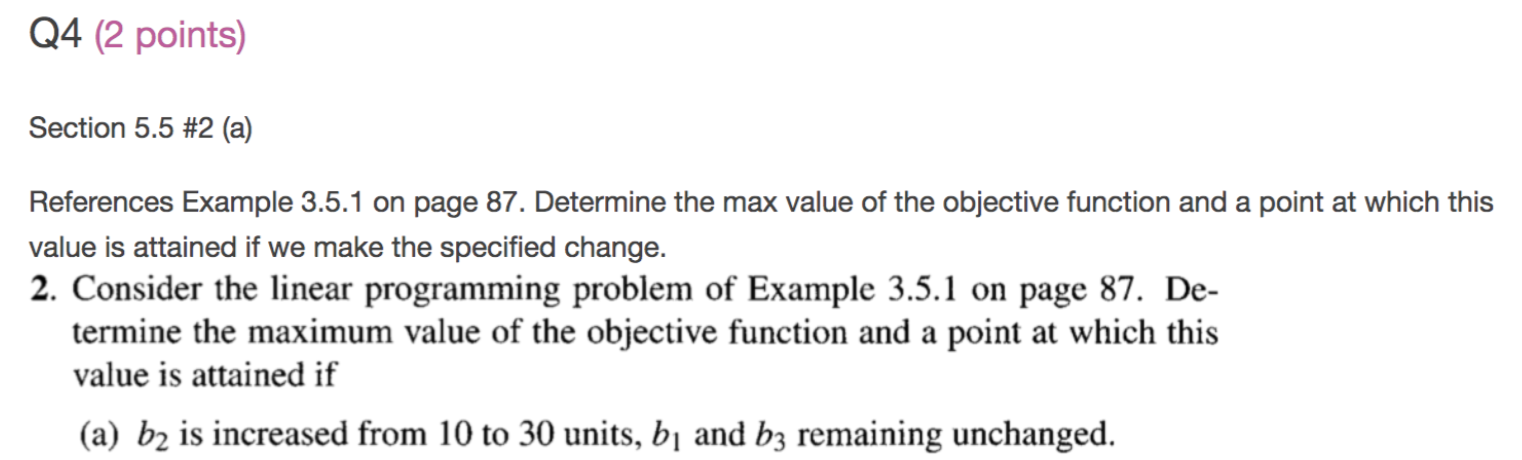
Example 3.5.]. Maximize 2.11 + 3x2 + 3x3 subject to 3x1 + 2!: S 60 x1 + x2 +4x3 $10 211sz +5.13 S50 x1,xz,x320 Introducing three slack variables and putting the problem into standard form gives the following: Minimize 2x1 31:2 3x3 subject to 3x: + 212 + x4 = -x1 + x2 + 4X3 + x5 = [O leZX2-i-SX3 +x5=50 Ilaxz,x3.x4,xsaxa 2 0 The system of constraints for this problem is in canonical form with basic variables x4, x5, and x6, the associated basic solution, (0,0,0,60, 10,50), is feasible. and the objective function is written in terms of the nonbasic variables. Thus the simplex method can be initiated. Table 3.4 gives the resulting tableaux. Note that the rst pivot could have been made in either the rst. second. or third column. From the last tableau we see that, for the problem as stated in standard form, the minimal value of the objective function is 70, and this value is attained at the point (8, l8, 0,0,0, 70). Since the original problem was a maximization problem with no slack variables, the optimal value for the original objective function is 70 and is attained at the point (8,18,0). Q4 (2 points) Section 5.5 #2 (a) References Example 3.5.1 on page 8?. Determine the max value of the objective function and a point at which this value is attained if we make the specied change. 2. Consider the linear programming problem of Example 3.5.1 on page 87. De- termine the maximum value of the objective function and a point at which this value is attained if (a) b; is increased from 10 to 30 units, In and b3 remaining unchanged
Step by Step Solution
There are 3 Steps involved in it

Get step-by-step solutions from verified subject matter experts
 Study Help