







Question: Please answer exercise 8. Use corollary 13.26 if necessary. Please write legibly so I can understand how you solved the problem. Thank you! 13. 26
Please answer exercise 8. Use corollary 13.26 if necessary. Please write legibly so I can understand how you solved the problem. Thank you!
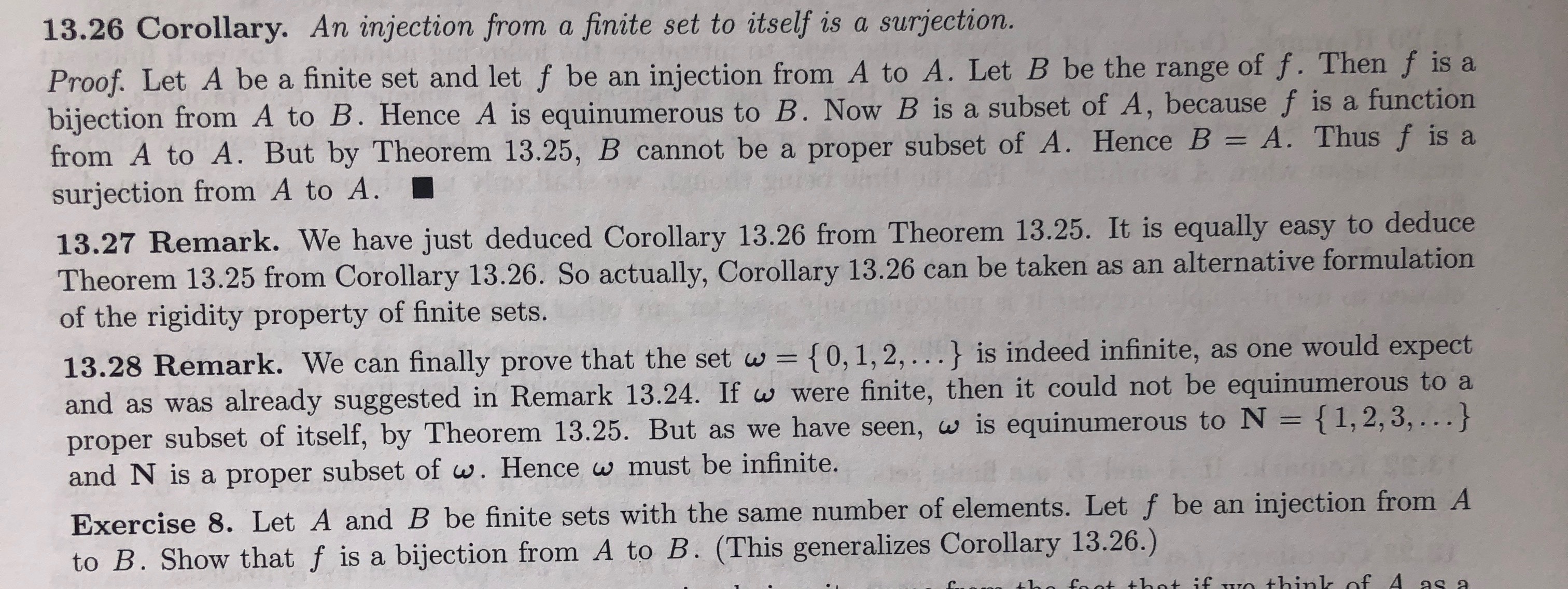
13. 26 Corollary . An injection from a finite set to itself is a surjective. Proof . Let A be a finite set and let f be an injection from A to A. Let B be the range of f . Then I is a bijection from A to B. Hence A is equinumerous to B . Now B is a subset of A, because of is a function from A to A . But by Theorem 13. 25, B cannot be a proper subset of A. Hence B = A. Thus & is a surjective from A to A. 13. 27 Remark . We have just deduced Corollary 13. 26 from Theorem 13. 25 . It is equally easy to deduce Theorem 13. 25 from Corollary 13. 26 . So actually , Corollary 13. 26 can be taken as an alternative formulation of the rigidity property of finite sets . 13. 28 Remark . We can finally prove that the set w = 10 , 1 , 2 . ... I is indeed infinite , as one would expect and as was already suggested in Remark 13. 24 . If w were finite , then it could not be equinumerous to a proper subset of itself , by Theorem 13. 25 . But as we have seen , W is equinumerous to N = [ 1 , 2, 3 . ... ] and I is a proper subset of w. Hence w must be infinite . Exercise 8. Let A and B be finite sets with the same number of elements . Let { be an injection from A to B. Show that I is a bijection from A to B. ( This generalizes Corollary 13. 26. )
Step by Step Solution
There are 3 Steps involved in it

Get step-by-step solutions from verified subject matter experts
 Study Help