







Question: please answer in image form, thank you! Case Study on Design of Compensation Package David Ma is one of the many HR managers who have

please answer in image form, thank you!
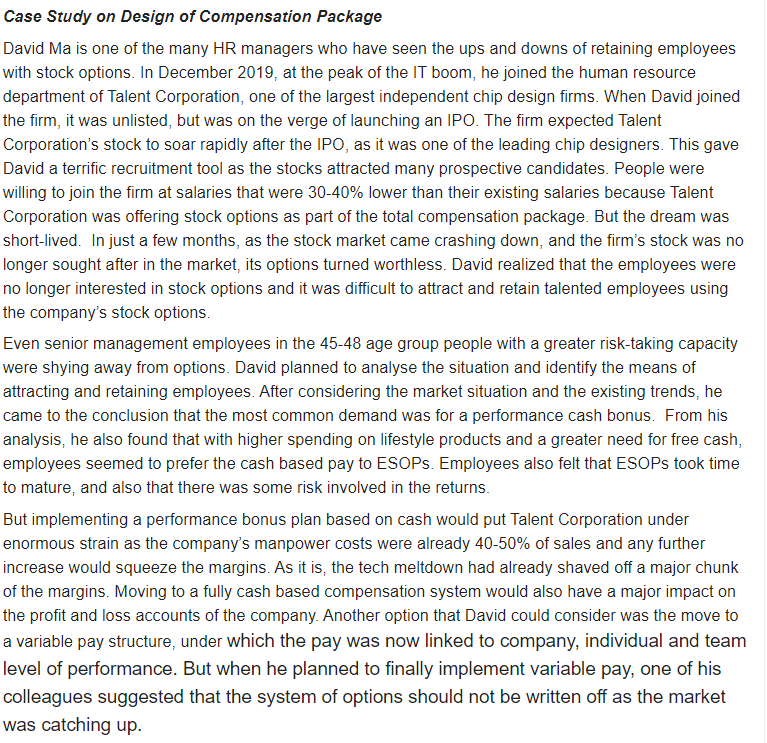
Case Study on Design of Compensation Package David Ma is one of the many HR managers who have seen the ups and downs of retaining employees with stock options. In December 2019, at the peak of the IT boom, he joined the human resource department of Talent Corporation, one of the largest independent chip design firms. When David joined the firm, it was unlisted, but was on the verge of launching an IPO. The firm expected Talent Corporation's stock to soar rapidly after the IPO, as it was one of the leading chip designers. This gave David a terrific recruitment tool as the stocks attracted many prospective candidates. People were willing to join the firm at salaries that were 30-40% lower than their existing salaries because Talent Corporation was offering stock options as part of the total compensation package. But the dream was short-lived. In just a few months, as the stock market came crashing down, and the firm's stock was no longer sought after in the market, its options turned worthless. David realized that the employees were no longer interested in stock options and it was difficult to attract and retain talented employees using the company's stock options. Even senior management employees in the 45-48 age group people with a greater risk-taking capacity were shying away from options. David planned to analyse the situation and identify the means of attracting and retaining employees. After considering the market situation and the existing trends, he came to the conclusion that the most common demand was for a performance cash bonus. From his analysis, he also found that with higher spending on lifestyle products and a greater need for free cash, employees seemed to prefer the cash based pay to ESOPs. Employees also felt that ESOPs took time to mature, and also that there was some risk involved in the returns. But implementing a performance bonus plan based on cash would put Talent Corporation under enormous strain as the company's manpower costs were already 40-50% of sales and any further increase would squeeze the margins. As it is, the tech meltdown had already shaved off a major chunk of the margins. Moving to a fully cash based compensation system would also have a major impact on the profit and loss accounts of the company. Another option that David could consider was the move to a variable pay structure, under which the pay was now linked to company, individual and team level of performance. But when he planned to finally implement variable pay, one of his colleagues suggested that the system of options should not be written off as the market was catching up. C1. What are the reasons for the declining role of stock options in Talent Corporation? (3 Marks) C2. David seems to be in a confused state as to what kind of compensation packages he has to design to retain and attract employees. Can you suggest any guidelines to David for using compensation to attract employees? (7 Marks)
Step by Step Solution
There are 3 Steps involved in it

Get step-by-step solutions from verified subject matter experts
 Study Help