Question: Please answer the questions referring to the CASE STUDY ATTACHED. please answer the questions fully and with elaborations and examples referring to the case study!
Please answer the questions referring to the CASE STUDY ATTACHED.
please answer the questions fully and with elaborations and examples referring to the case study!
thank you! its urgent.
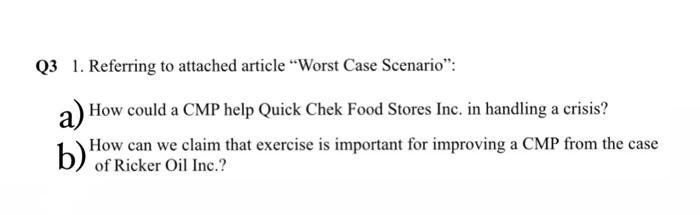
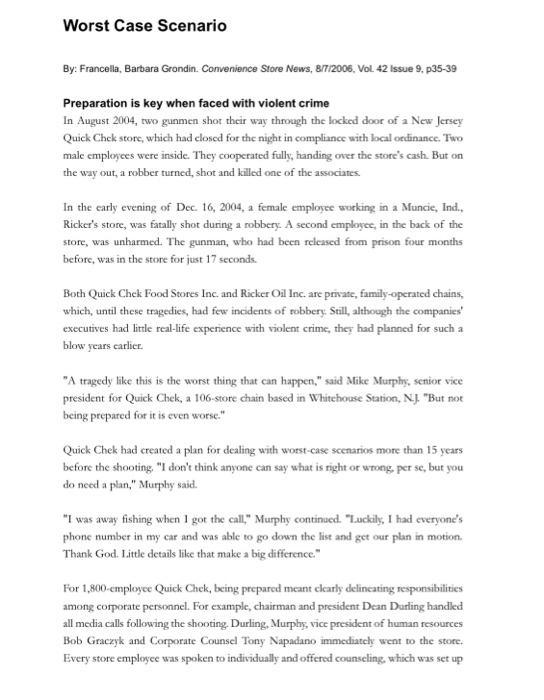
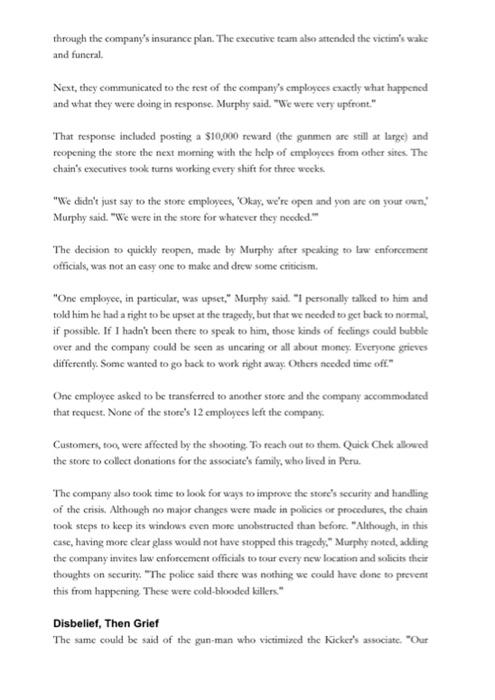
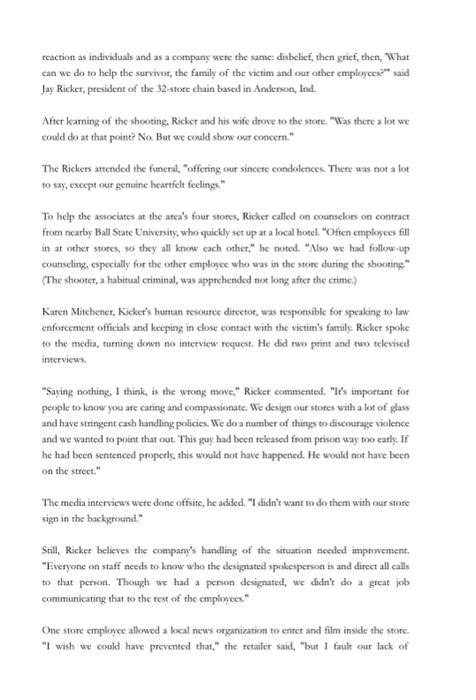
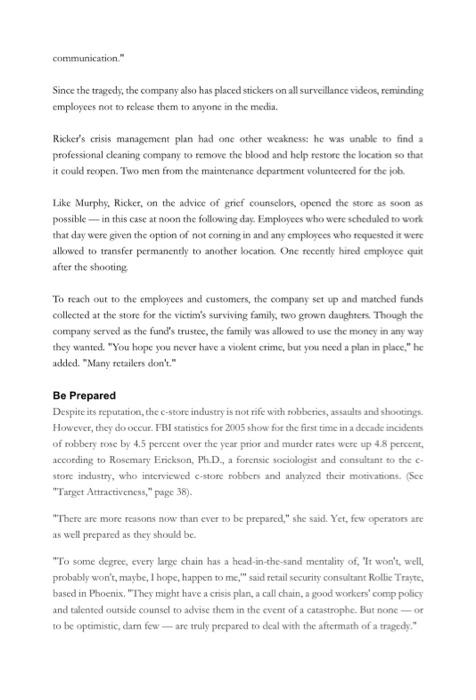
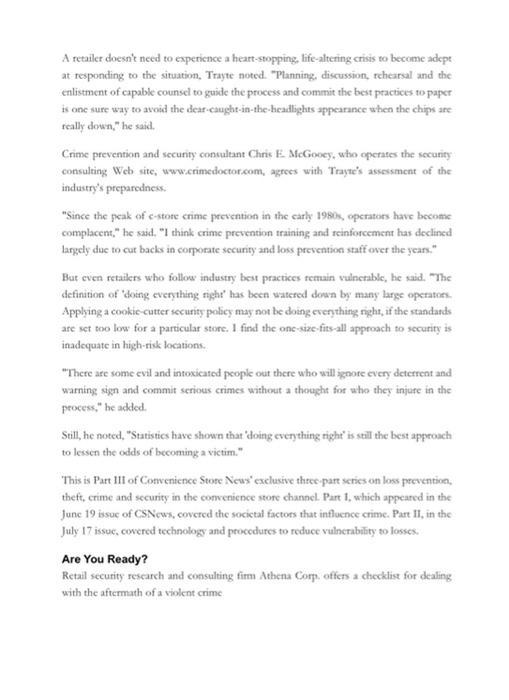
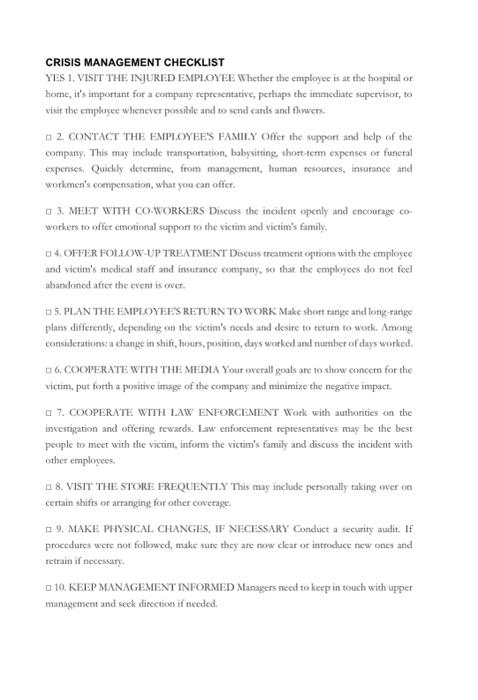
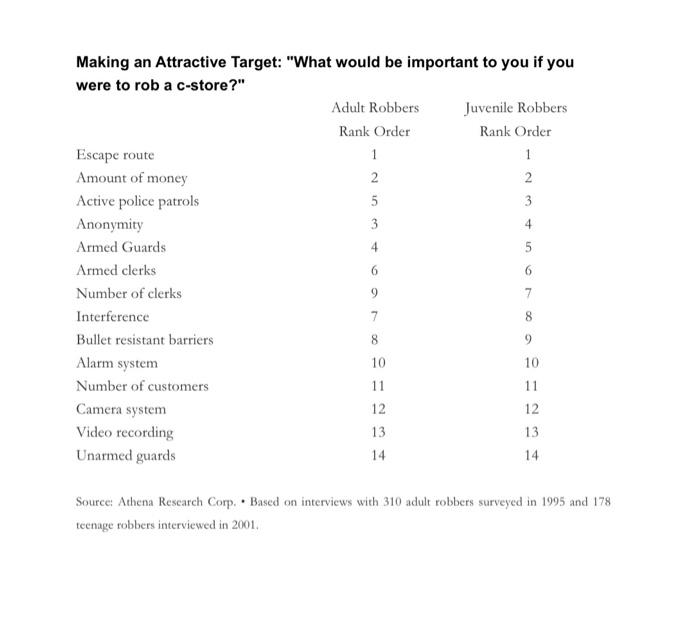
Q3 1. Referring to attached article Worst Case Scenario": a) How could a CMP help Quick Chek Food Stores Inc. in handling a crisis? b) of Ricker Oil Inc.?" How can we claim that exercise is important for improving a CMP from the case Worst Case Scenario By: Francella, Barbara Grondin. Convenience Store News, 8/7/2006, Vol 42 Issue 9, 235-39 , Preparation is key when faced with violent crime In August 2004, two gunmen shot their way through the locked door of a New Jersey Quick Chek store, which had closed for the night in compliance with local ordinance. Two male employees were inside. They cooperated fully, handing over the store's cash But on the way out, a robber turned, shot and killed one of the associates In the early evening of Dec 16, 2004, a female employee working in a Muncie, Ind., Ricker's store, was fatally shot during a robbery. A second employee, in the back of the store, was unharmed. The gunman, who had been reicased from prison four months before, was in the store for just 17 seconds. Both Quick Chek Food Stores Inc. and Ricker Oil Inc. are private, family-operated chains, which, until these tragedies, had few incidents of robbery. Still, although the companies' executives had little real-life experience with violent crime, they had planned for such a blow years carlier "A tragedy like this is the worst thing that can happen," said Mike Murphs, senior vice president for Quick Chek, a 106-store chain based in Whitehouse Station, NJ. "But net being prepared for it is even worse." Quick Chek had created a plan for dealing with worst-case scenarios more than 15 years before the shooting, "I don't think anyone can say what is right or wrong, per se, but you do need a plan," Murphy said. "I was away fishing when I got the call." Murphy continued. "Luckily, I had everyone's phone number in my car and was able to go down the list and get our plan in motion. Thank God. Little details like that make a big difference." For 1,800-employee Quick Chek, being prepared meant clearly delineating responsibilities among corporate personnel. For example, chairman and president Dean Darling handled all media calls following the shooting. Durling, Murphy, vice president of human resources Bob Graczyk and Corporate Counsel Tony Napadano immediately went to the store: Every store employee was spoken to individually and offered counseling, which was set up through the company's insurance plan. The executive tcam also attended the victim's wake and funeral Next, they communicated to the rest of the company's employees exactly what happened and what they were doing in response Murphy said. "We were very upfront." That response included posting a $10,000 reward (the gunmen are still at large) and rcopening the store the next moming with the help of employees from other sites. The chain's executives took turns working every shift for three weeks "We didn't just say to the store employees, 'Okay, we're open and you are on your own Murphy said. "We were in the store for whatever they needed. The decision to quickly reopen, made by Murphy after speaking to law enforcement officials, was not an easy one to make and drew some criticism. "One employee, in particular, was upset," Murphy said. "1 personally talked to him and told him he had a right to be upset at the tragedy, but that we needed to get back to normal if possible. If I hadn't been there to speak to him, those kinds of feelings could bubble over and the company could be seen as uncaring or all about money. Everyone grieves differently. Some wanted to go back to work right away. Others needed time off." One employee asked to be transferred to another store and the company accommodated that request. None of the stote's 12 employees left the company Customers, too, were affected by the shooting To reach out to them. Quick Chek allowed the store to collect donations for the associate's family, who lived in Peru. The company also took time to look for ways to improve the store's security and handling of the crisis. Although no major changes were made in policies or procedures, the chain took steps to keep its windows even more unobstructed than before. Although, in this casc, having more clear glass would not have stopped this tragedy." Murphy noted, adding the company invites law enforcement officials to tout every new location and solicits theit thoughts on security. "The police said there was nothing we could have done to prevent this from happening. These were cold-blooded killers." Disbelief, Then Grief The same could be said of the gun-man who victimized the Kicker's associate. "Our reaction as individuals and as a company were the same: disbelief, then grief, then, What can we do to help the survivor, the family of the victim and our other employees" said Jay Ricker, president of the 32-store chain based in Anderson, Ind. After learning of the shooting. Ricker and his wife drove to the store. "Was there a lot we could do at that point? No But we could show our concern." The Rickers attended the funeral, "offering our sincere condolences. There was not a lot to say, except our genuine heartfelt feelings." To help the associates at the area's four stores, Ricker called on counselors on contract from nearby Ball State University, who quickly set up at a local hotel. "Often employees fill in at other stores, so they all know each other," he noted. "Also we had follow-up counseling, especially for the other employee who was in the store during the shooting (The shooter, a habitual criminal, was apprehended not long after the crime.) Katen Mitchener, Kicker's human resource director, was responsible for speaking to low enforcement officials and keeping in close contact with the victim's furnily: Ricker spoke to the media, turning down no interview request. He did two print and two televised interviews "Saying nothing. I think, is the wrong move." Ricker commented. "W's important for people to know you are caring and compassionate. We design our stores with a best of glass and have stringent cash handling policies. We do a number of things to discourage violence and we wanted to point that out. This guy had been released from prison way too early. If he had been sentenced properly, this would not have happened. He would not have been on the street." The media interviews were done offsite, he added. "I didn't want to do them with our store sign in the background." Still, Ricker believes the company's handling of the situation needed improvement, "Everyone on staff needs to know who the designated spokesperson is and direct all calls to that persen. Though we had a person designated, we didn't do a great job communicating that to the rest of the employees." One store employee allowed a local news organization to enter and film inside the store. "I wish we could have prevented that," the retailer said, "but I fault enar lack of communication" Since the tragedy, the company also has placed stickers on all surveillance videos, reminding employees not to release them to anyone in the media. Ricker's crisis management plan had one other weakness: he was unable to find a professional cleaning company to remove the blood and help restore the location so that it could reopen. Two men from the maintenance department volunteered for the job. Like Murphy, Ricker, on the advice of grief counsclors, opened the store as soon as possible -- in this case at noon the following day. Employees who were scheduled to work that day were given the option of not corning in and any employees who requested it were allowed to transfer permanently to another location. One recently hired employce quit after the shooting To reach out to the employees and customers, the company set up and matched funds collected at the store for the victim's surviving family, two grown daughters Though the company served as the fund's trustee, the family was allowed to use the money in any way they wanted. "You hope you never have a violent etime, but you need a plan in place," he added. "Many retailers don't." Be Prepared Despite its reputation, the c-store industry is not rife with robberies, assaults and shootings However, they do occur. FBI statistics for 2005 show for the first time in a decade incidents of robbery rose by 4.5 percent over the year prior and murder rates were up 48 percent, according to Rosemary Erickson, Ph.D., a forensic sociologist and consultant to the e store industry, who interviewed c-store robbers and analyzed their motivations (Sec "Target Attractiveness, "page 38). "There are more reasons now than ever to be prepared," she said. Yet, few operators are as well prepared as they should be "To some degree, every large chain has a head-in-the-sand mentality of, "It won't well, probably won't, maybe, I hope, happen to me," said retail security consultant Rollie Trayte, based in Phoenix, "They might have a crisis plan, a cull chain, a good workers' comp policy and talented outside counsel to advise them in the event of a catastrophe. But none or to be optimistic, dar few -- are truly prepared to deal with the aftermath of a tragedy." a A retailer doesn't need to experience a heart-stopping, life-altering crisis to become adept at responding to the situation, Trayte noted. "Planning, discussion, rehearsal and the enlistment of capable counsel to guide the process and commit the best practices to paper is one sure way to avoid the dear caught-in-the-headlights appearance when the chips are really down," he said. Crime prevention and security consultant Chris E. McGooey, who operates the security consulting Web site www.crimedoctor.com, grees with Trayte's assessment of the industry's preparedness "Since the peak of c-store crime prevention in the carly 1980, operators have become complacent," he said. "I think crime prevention training and reinforcement has declined largely due to cut backs in corporate security and loss prevention staff over the years." But even retailers who follow industry best practices remain vulnerable, he said. "The definition of "desing everything right" has been watered down by many large operators Applying a cookie-cutter security policy may not be doing everything right, if the standards are set too low for a particular store. I find the one-size-fits-all approach to security is inadequate in high-risk locations "There are some evil and intoxicated people out there who will ignore every deterrent and warning sign and commit serious crimes without a thought for who they injure in the process," he added. Still, he noted, "Statistics have shown that doing everything tight" is still the best approach to lessen the odds of becoming a victim." This is Part 111 of Cowenience Store News'exclusive three pare series on loss prevention theft, crime and security in the convenience store channel. Part 1, which appeared in the June 19 issue of CSNows, covered the societal factors that influence crime. Part II, in the July 17 issuc, cowered technology and procedures to reduce vulnerability to losses Are You Ready? Retail security rescarch and consulting firm Athena Corp, offers a checklist for dealing with the aftermath of a violent crime CRISIS MANAGEMENT CHECKLIST YES 1. VISIT THE INJURED EMPLOYEE Whether the employee is at the hospital or home, it's important for a company reprezentative, perhaps the immediate supervisor, to visit the employee whenever possible and to send cards and flowers 2. CONTACT THE EMPLOYEE'S FAMILY Offer the support and help of the company. This may include transportation, babysitting, short-term expenses or funeral expenses . Quickly determine, from management, human resources, insurance and workmen's compensation, what you can offer. 03. MEET WITH CO-WORKERS Discuss the incident openly and encourage co workers to offer emotional support to the victim and victim's family. 04. OFFER FOLLOW-UP TREATMENT Discuss treatment options with the employee and victim's medical staff and insurance company, so that the employees do not feel abandoned after the event is over. 65. PLAN THE EMPLOYEES RETURN TO WORK Make short range and long-range plans differently, depending on the victim's needs and desire to return to work. Among considerations: a change in shift, hours, position, clays worked and number of days worked 06. COOPERATE WITH THE MEDIA Your overall goals are to show concern for the victim, put forth a positive image of the company and minimize the negative impact 07. COOPERATE WITH LAW ENFORCEMENT Work with authorities on the investigation and offering rewards. L.aw enforcement representatives may be the best people to meet with the victim, inform the victim's family and discuss the incident with other employees 08. VISIT THE STORE FREQUENTLY This may include personally taking over on certain shifts or arranging for other coverage. 9. MAKE PHYSICAL CHANGES, IF NECESSARY Conduct a security audit. If procedures were not followed, make sure they are now dear or introduce new ones and retrain if necessary 10. KEEP MANAGEMENT INFORMED Managers need to keep in touch with upper management and seek direction if needed. 4 4 Making an Attractive Target: "What would be important to you if you were to rob a c-store?" Adult Robbers Juvenile Robbers Rank Order Rank Order Escape route 1 1 Amount of money 2 2 Active police patrols 5 3 Anonymity 3 Armed Guards 5 Armed clerks 6 Number of clerks 9 7 Interference 7 Bullet resistant barriers 9 Alarm system 10 10 Number of customers 11 11 Camera system 12 12 Video recording 13 13 Unarmed guards 14 14 8 8 Source: Athena Research Corp. . Based on interviews with 310 adult robbers surveyed in 1995 and 178 teenage robbers interviewed in 2001









 Study Help