







Question: Please answer in Python Code taking into consideration the example output and default template. Thank you Default Template. # import the necessary libraries # load
Please answer in Python Code taking into consideration the example output and default template. Thank you
Default Template.
# import the necessary libraries
# load nbaallelo_log.csv into a dataframe df = # code to load csv file
# Converts the feature "game_result" to a binary feature and adds as new column "wins" wins = df.game_result == "W" bool_val = np.multiply(wins, 1) wins = pd.DataFrame(bool_val, columns = ["game_result"]) wins_new = wins.rename(columns = {"game_result": "wins"}) df_final = pd.concat([df, wins_new], axis=1)
# split the data df_final into training and test sets with a test size of 0.3 and random_state = 0 train, test = # code to split df_final into training and test sets
# construct a logistic model with wins and the target and elo_i as the predictor, using the training set lm = # code to construct logistic model using the logit function
# print coefficients for the model print(# code to return coefficients)
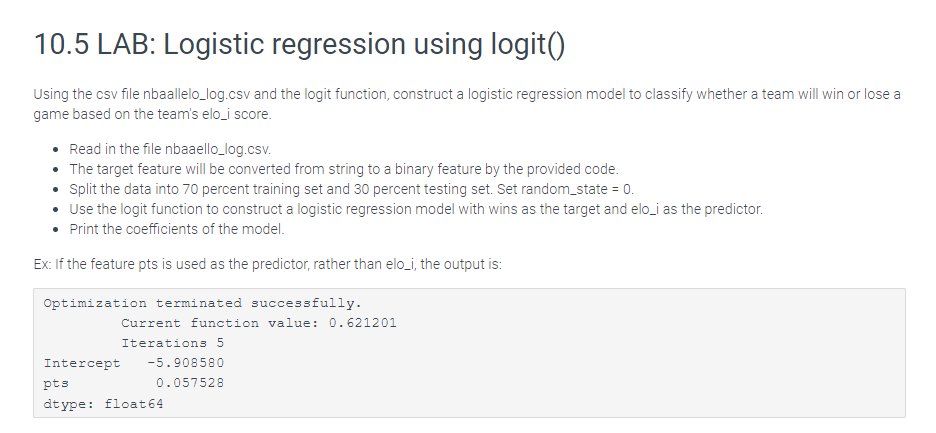
Using the csv file nbaallelo_log.csv and the logit function, construct a logistic regression model to classify whether a team will win or lose a game based on the team's elo_i score. - Read in the file nbaaello_log.csv. - The target feature will be converted from string to a binary feature by the provided code. - Split the data into 70 percent training set and 30 percent testing set. Set random_state =0. - Use the logit function to construct a logistic regression model with wins as the target and elo_i as the predictor. - Print the coefficients of the model. Ex: If the feature pts is used as the predictor, rather than elo_i, the output is: Optimization terminated successfully. Current function value: 0.621201 Iterations 5 Intercept 5.908580 pts 0.057528 dtype: float 64
Step by Step Solution
There are 3 Steps involved in it

Get step-by-step solutions from verified subject matter experts
 Study Help