Question: please answer in your word not copy and paste .. Your Turn Climb the Legal Ladder or Several years ago, Sullivan & Cromwell, a large
 please answer in your word not copy and paste ..
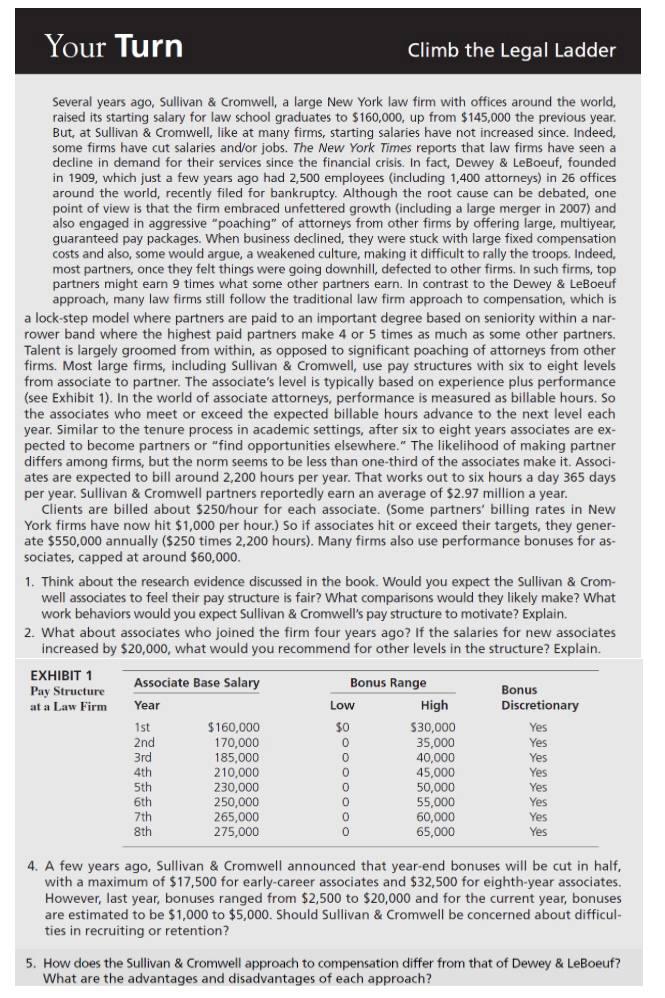
Your Turn Climb the Legal Ladder or Several years ago, Sullivan & Cromwell, a large New York law firm with offices around the world, raised its starting salary for law school graduates to $160,000, up from $145,000 the previous year. But, at Sullivan & Cromwell, like at many firms, starting salaries have not increased since. Indeed, some firms have cut salaries and/or jobs. The New York Times reports that law firms have seen a decline in demand for their services since the financial crisis. In fact, Dewey & LeBoeuf, founded in 1909, which just a few years ago had 2,500 employees (including 1,400 attorneys) in 26 offices around the world, recently filed for bankruptcy. Although the root cause can be debated, one point of view is that the firm embraced unfettered growth (including a large merger in 2007) and also engaged in aggressive "poaching" of attorneys from other firms by offering large, multiyear. guaranteed pay packages. When business declined, they were stuck with large fixed compensation costs and also, some would argue, a weakened culture, making it difficult to rally the troops. Indeed, most partners, once they felt things were going downhill, defected to other firms. In such firms, top partners might earn 9 times what some other partners earn. In contrast to the Dewey & LeBoeuf approach, many law firms still follow the traditional law firm approach to compensation, which a lock-step model where partners are paid to an important degree based on seniority within a nar- rower band where the highest paid partners make 5 times as much as some other partners. Talent t is largely groomed from within, as opposed to significant poaching of attorneys from other firms. Most large firms, including Sullivan & Cromwell, use pay structures with six to eight levels from associate to partner. The associate's level is typically based on experience plus performance (see Exhibit In the world of associate ciate attorneys, performance is measured as billable hours. So the associates who meet exceed the expected billable hours advance to the next level each year. Similar to the tenure process in academic settings, after six to eight years associates are ex- pected to become partners or "find opportunities elsewhere." The likelihood of making partner differs among firms, but the norm ems to be less than one-third of the ates make Associ- ates are expected to bill around 2,200 hours per year. That works out to six hours a day 365 days per year. Sullivan & Cromwell partners reportedly earn an average of $2.97 million a a year. Clients are billed about $250/hour for each associate. (Some partners billing rates in New York firms have now hit $1,000 per hour.) So if associates hit or exceed their targets, they gener- ate $550,000 annually ($250 times 2,200 hours). Many firms also use performance bonuses for as- sociates, capped at around $60,000. 1. Think about the research evidence discussed in the book. Would you expect the Sullivan & Crom- well associates to feel their pay structure is fair? What comparisons would they likely make? What work behaviors would you expect Sullivan & Cromwell's pay structure to motivate? Explain. 2. What about associates who joined the firm four years ago? If the salaries for new associates increased by $20,000, what would you recommend for other levels in the structure? Explain. EXHIBIT 1 Associate Base Salary Pay Structure Bonus Range Bonus at a Law Firm Year Low High Discretionary $160,000 $30,000 2nd 170,000 0 35,000 3rd 185,000 40,000 210,000 0 45,000 230,000 50,000 Yes 250,000 55,000 7th 265,000 60,000 275,000 65,000 1st $0 Yes Yes Yes Yes 0 4th 5th 6th 0 0 0 0 Yes Yes Yes 8th 4. A few years ago, Sullivan & Cromwell announced that year-end bonuses will be cut in half, with a maximum of $17,500 for early-career associates and $32,500 for eighth-year associates. However, last year, bonuses ranged from $2,500 to $20,000 and for the current year, bonuses are estimated to be $1,000 to $5,000. Should Sullivan & Cromwell be concerned about difficul- ties in recruiting or retention? 5. How does the Sullivan & Cromwell approach to compensation differ from that of Dewey & LeBoeuf? What are the advantages and disadvantages of each approach









 Study Help