







Question: Please answer just Question C Question 4 The instantaneous forward rate is: f(t,T)=- lim log P(t,T+AT) log P(t,T) AT-0 AT 8 T log P(t,T), the
Please answer just Question C
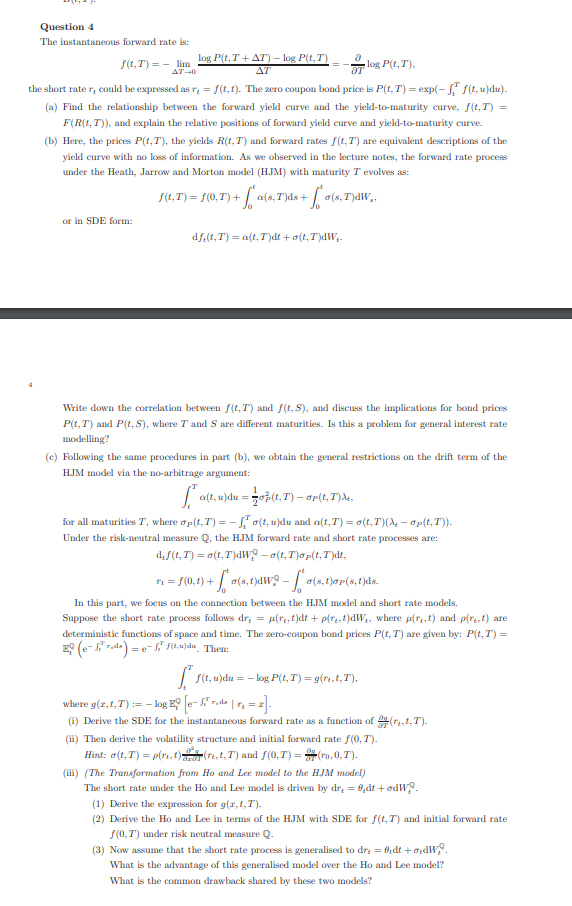
Question 4 The instantaneous forward rate is: f(t,T)=- lim log P(t,T+AT) log P(t,T) AT-0 AT 8 T log P(t,T), the short rate r, could be expressed as r = f(t, t). The zero coupon bond price is P(t, T) = exp(- f(t, u)du). (a) Find the relationship between the forward yield curve and the yield-to-maturity curve, f(t,T) = F(R(t, T)), and explain the relative positions of forward yield curve and yield-to-maturity curve. (b) Here, the prices P(t,T), the yields R(t,T) and forward rates f(t, T) are equivalent descriptions of the yield curve with no loss of information. As we observed in the lecture notes, the forward rate process under the Heath, Jarrow and Morton model (HJM) with maturity T evolves as: f(t.T) = f(0,7) + [a(s,T)ds+ [o(s, T) aw. or in SDE form: df,(t, T)= a(t, T)dt + o(t, T)dW. Write down the correlation between f(t.T) and f(t, S), and discuss the implications for bond prices P(t,T) and P(t, S), where T and S are different maturities. Is this a problem for general interest rate modelling? (c) Following the same procedures in part (b), we obtain the general restrictions on the drift term of the HJM model via the no-arbitrage argument: L'alt a(t, u)du = o(t,T) - op(t, T)M, for all maturities T, where ap(t,T) = -(t, u)du and a(t,T) = o(t,T)( 0p(t,T)). Under the risk-neutral measure Q, the HJM forward rate and short rate processes are: d,f(t,T) = o(t,T)dw-o(t. T)op(t.T)dt, Tt rt = f(0,t) + + [o(s,t)dw? - [a(s, t)or(s, t)ds. In this part, we focus on the connection between the HJM model and short rate models. Suppose the short rate process follows dr = (rt)dt + p(r,t)dW, where (r,,t) and p(r,,t) are deterministic functions of space and time. The zero-coupon bond prices P(t, T) are given by: P(t,T) = E (e-frida)= e-fi f(tu)du. Then: S f(t, u)du = -log P(t, T) = g(re,t,T), where g(x, t,T):=-1 - log E [e-Jrada | r=2]- (i) Derive the SDE for the instantaneous forward rate as a function of (r...T). (ii) Then derive the volatility structure and initial forward rate f(0,7). Hint: o(t.T) = p(ri, t)(r, t,T) and f(0,7)=(ro, 0,7). (iii) (The Transformation from Ho and Lee model to the HJM model) The short rate under the Ho and Lee model is driven by dr, = 0dt +dW?. (1) Derive the expression for g(x,t,T). (2) Derive the Ho and Lee in terms of the HJM with SDE for f(t, T) and initial forward rate f(0,7) under risk neutral measure Q. (3) Now assume that the short rate process is generalised to dr = 0,dt + odw. What is the advantage of this generalised model over the Ho and Lee model? What is the common drawback shared by these two models? Question 4 The instantaneous forward rate is: f(t,T)=- lim log P(t,T+AT) log P(t,T) AT-0 AT 8 T log P(t,T), the short rate r, could be expressed as r = f(t, t). The zero coupon bond price is P(t, T) = exp(- f(t, u)du). (a) Find the relationship between the forward yield curve and the yield-to-maturity curve, f(t,T) = F(R(t, T)), and explain the relative positions of forward yield curve and yield-to-maturity curve. (b) Here, the prices P(t,T), the yields R(t,T) and forward rates f(t, T) are equivalent descriptions of the yield curve with no loss of information. As we observed in the lecture notes, the forward rate process under the Heath, Jarrow and Morton model (HJM) with maturity T evolves as: f(t.T) = f(0,7) + [a(s,T)ds+ [o(s, T) aw. or in SDE form: df,(t, T)= a(t, T)dt + o(t, T)dW. Write down the correlation between f(t.T) and f(t, S), and discuss the implications for bond prices P(t,T) and P(t, S), where T and S are different maturities. Is this a problem for general interest rate modelling? (c) Following the same procedures in part (b), we obtain the general restrictions on the drift term of the HJM model via the no-arbitrage argument: L'alt a(t, u)du = o(t,T) - op(t, T)M, for all maturities T, where ap(t,T) = -(t, u)du and a(t,T) = o(t,T)( 0p(t,T)). Under the risk-neutral measure Q, the HJM forward rate and short rate processes are: d,f(t,T) = o(t,T)dw-o(t. T)op(t.T)dt, Tt rt = f(0,t) + + [o(s,t)dw? - [a(s, t)or(s, t)ds. In this part, we focus on the connection between the HJM model and short rate models. Suppose the short rate process follows dr = (rt)dt + p(r,t)dW, where (r,,t) and p(r,,t) are deterministic functions of space and time. The zero-coupon bond prices P(t, T) are given by: P(t,T) = E (e-frida)= e-fi f(tu)du. Then: S f(t, u)du = -log P(t, T) = g(re,t,T), where g(x, t,T):=-1 - log E [e-Jrada | r=2]- (i) Derive the SDE for the instantaneous forward rate as a function of (r...T). (ii) Then derive the volatility structure and initial forward rate f(0,7). Hint: o(t.T) = p(ri, t)(r, t,T) and f(0,7)=(ro, 0,7). (iii) (The Transformation from Ho and Lee model to the HJM model) The short rate under the Ho and Lee model is driven by dr, = 0dt +dW?. (1) Derive the expression for g(x,t,T). (2) Derive the Ho and Lee in terms of the HJM with SDE for f(t, T) and initial forward rate f(0,7) under risk neutral measure Q. (3) Now assume that the short rate process is generalised to dr = 0,dt + odw. What is the advantage of this generalised model over the Ho and Lee model? What is the common drawback shared by these two models
Step by Step Solution
There are 3 Steps involved in it

Get step-by-step solutions from verified subject matter experts
 Study Help