Question: Please answer me. In this question, we extend the model with search friction discussed in class by adding non-pecuniary preferences over jobs. There are two
Please answer me.
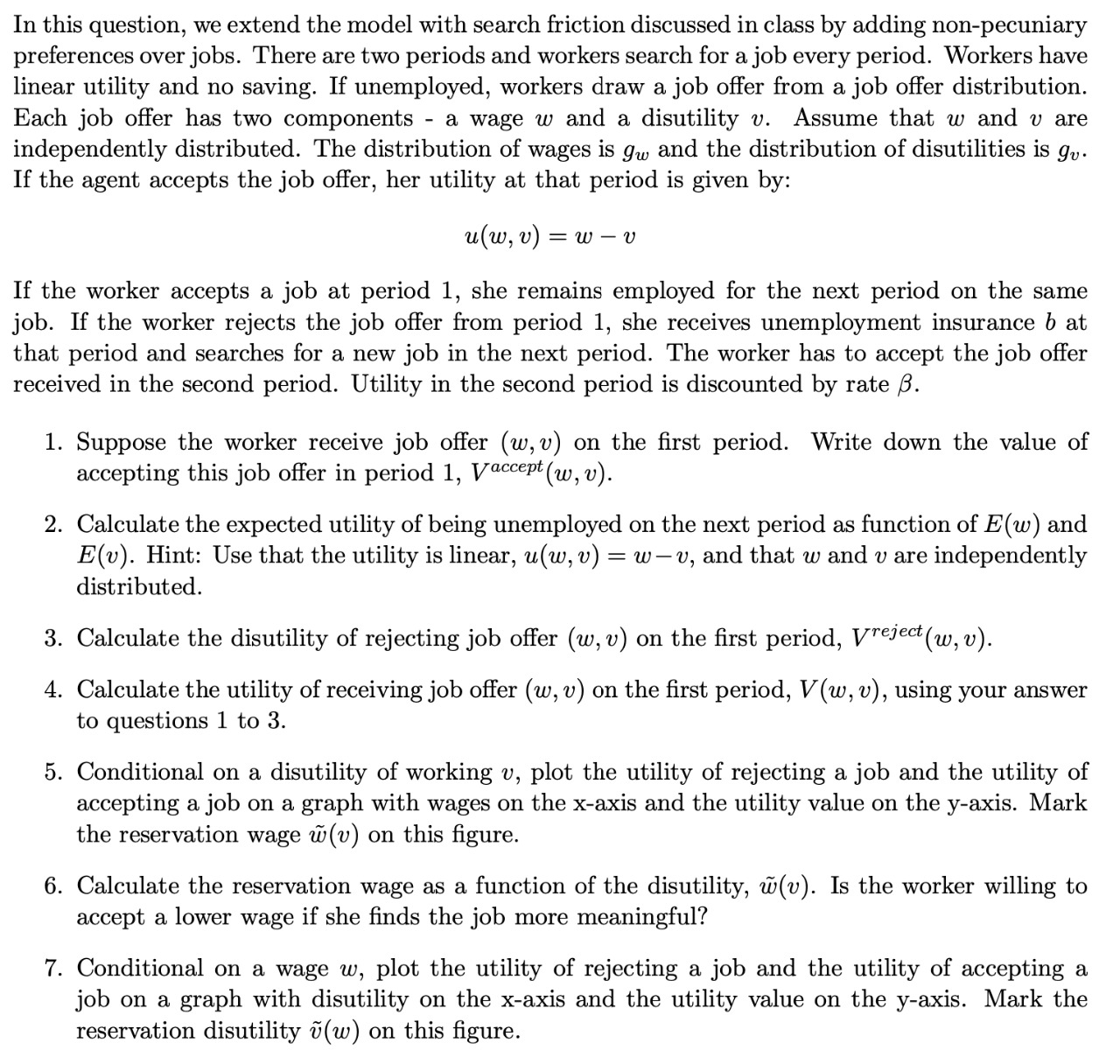
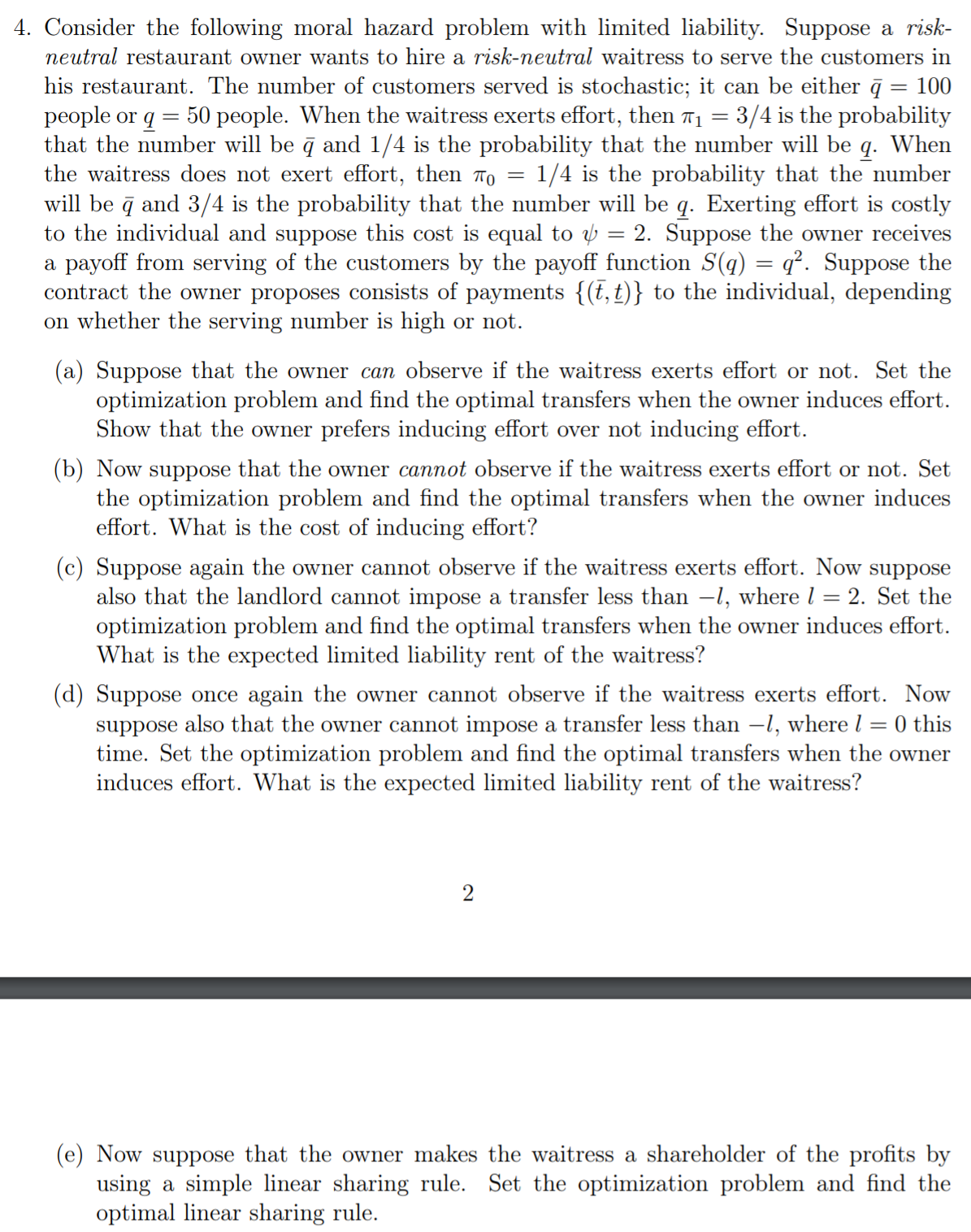
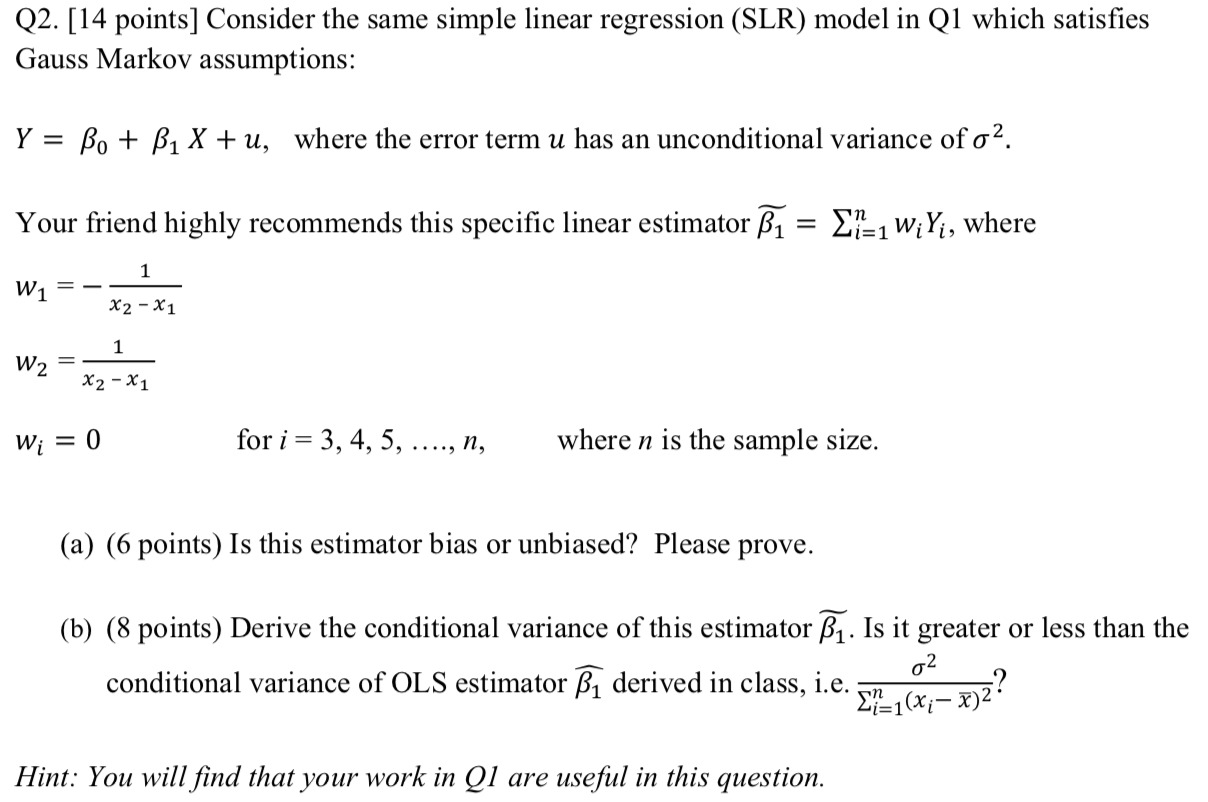
In this question, we extend the model with search friction discussed in class by adding non-pecuniary preferences over jobs. There are two periods and workers search for a job every period. Workers have linear utility and no saving. If unemployed, workers draw a job offer from a job offer distribution. Each job offer has two components - a wage to and a disutility 1). Assume that w and 'v are independently distributed. The distribution of wages is gm and the distribution of disutilities is g\". If the agent accepts the job offer, her utility at that period is given by: u(w,v)=w'u If the worker accepts a job at period 1, she remains employed for the next period on the same job. If the worker rejects the job offer from period 1, she receives unemployment insurance b at that period and searches for a new job in the next period. The worker has to accept the job offer received in the second period. Utility in the second period is discounted by rate ,8. 1. Suppose the worker receive job offer (110,11) on the rst period. Write down the value of accepting this job offer in period 1, V\"\"\"Pt(w, 'v). . Calculate the expected utility of being unemployed on the next period as function of E(w) and 13(1)). Hint: Use that the utility is linear, u('w, v) = 'w 'v, and that w and v are independently distributed. . Calculate the disutility of rejecting job offer (10,0) on the rst period, Vrew, c). . Calculate the utility of receiving job offer (11:, v) on the rst period, V(w, '0), using your answer to questions 1 to 3. . Cenditional on a disutility of working or, plot the utility of rejecting a job and the utility of accepting a job on a graph with wages on the xaxis and the utility value on the yaxis. Mark the reservation wage 213(1)) on this gure. . Calculate the reservation wage as a function of the disutility, 25(1)). Is the worker willing to accept a lower wage if she nds the job more meaningful? Conditional on a wage w, plot the utility of rejecting a job and the utility of accepting a job on a graph with disutility on the x-axis and the utility value on the y-axis. Mark the reservation disutility 6(a)) on this gure. 4. Consider the following moral hazard problem with limited liability. Suppose a risk- nentml restaurant owner wants to hire a risk-neutral waitress to serve the customers in his restaurant. The number of customers served is stochastic; it can be either (j = 100 people or q = 50 people. When the waitress exerts effort, then 1T1 = 3/4 is the probability that the number will be it} and 1/4 is the probability that the number will be q. When the waitress does not exert effort, then no : 1/4 is the probability that thenumber will be (j and 3/4 is the probability that the number will be q. Exerting effort is costly to the individual and suppose this cost is equal to 1/) = 2. Sppose the owner receives a payoff from serving of the customers by the payoff function 3(q) = 43?. Suppose the contract the owner proposes consists of payments {(5.1)} to the individual1 depending on whether the serving number is high or not. (a) (b) Suppose that the owner can observe if the waitress exerts effort or not. Set the optimization problem and nd the optimal transfers when the owner induces effort. Show that the owner prefers inducing effort over not. inducing effort. Now suppose that the owner cannot observe if the waitress exerts effort or not. Set the optimization problem and nd the optimal transfers when the owner induces effort. What is the cost. of inducing effort? Suppose again the owner cannot observe if the waitress exerts effort. Now suppose also that the landlord cannot impose a transfer less than l, where l = 2. Set the optimization problem and nd the optimal transfers when the owner induces effort. What is the expected limited liability rent. of the waitress? Suppose once again the owner cannot observe if the waitress exerts effort. Now suppose also that the owner cannot impose a transfer less than l, where l = 0 this time. Set the optimization problem and nd the optimal transfers when the owner induces effort. What is the expected limited liability rent of the waitress? (0) Now suppose that the owner makes the waitress a shareholder of the prots by using a simple linear sharing rule. Set the optimization problem and nd the optimal linear sharing rule. Q2. [14 points] Consider the same simple linear regression (SLR) model in Q1 which satises Gauss Markov assumptions: Y = ,80 + ,81 X + u, where the error term u has an unconditional variance of oz. Your friend highly recommends this specic linear estimator Z3: = 2:21 wil'i, where 1 W = _ 1 x2-x1 w _ 1 2 552351 w; = 0 for i = 3,4,5, ...., n, where n is the sample size. (a) (6 points) Is this estimator bias or unbiased? Please prove. (b) (8 points) Derive the conditional variance of this estimator B: Is it greater or less than the .._. 2 conditional variance of OLS estimator )31 derived in class, i.e. m1? i=1 I: Hint.' You willnd that your work in Q1 are usecl in this









 Study Help