







Question: PLEASE ANSWER MY ASSIGNMENT READ THE CASE STUDY AND ANSWER THE FOLLOWING CASE QUESTIONS CASE STUDY CASE QUESTIONS Read the case that follows then answer
PLEASE ANSWER MY ASSIGNMENT 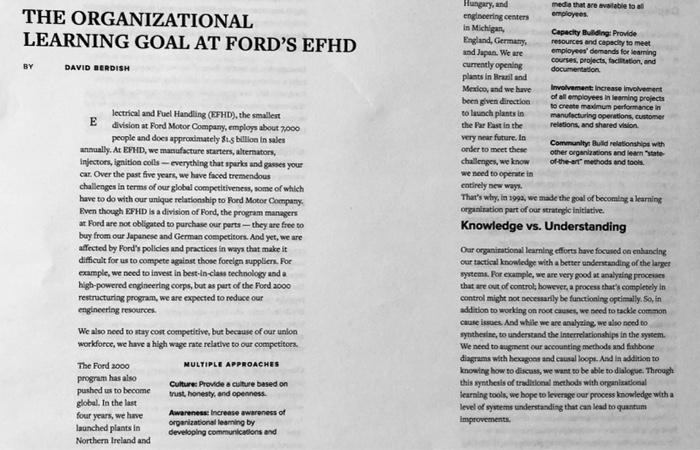
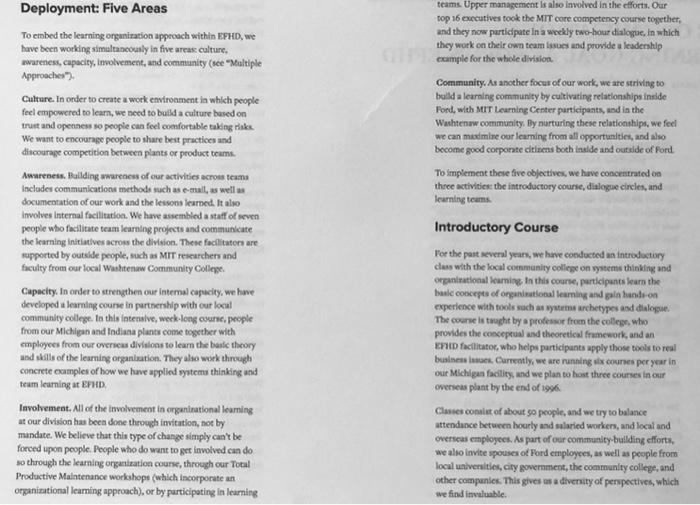
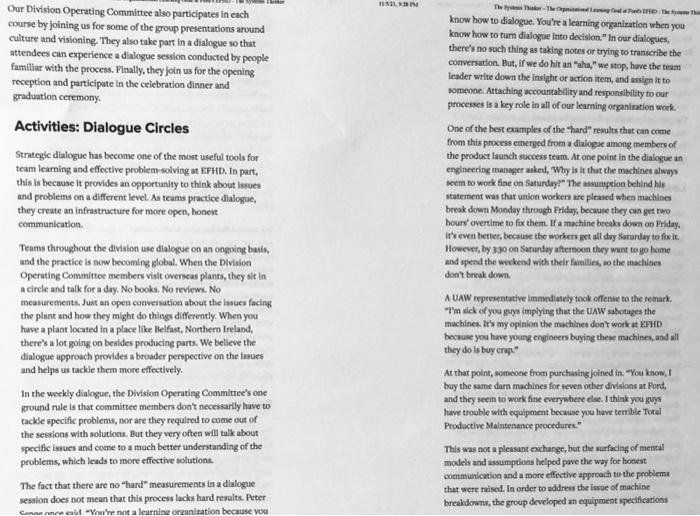
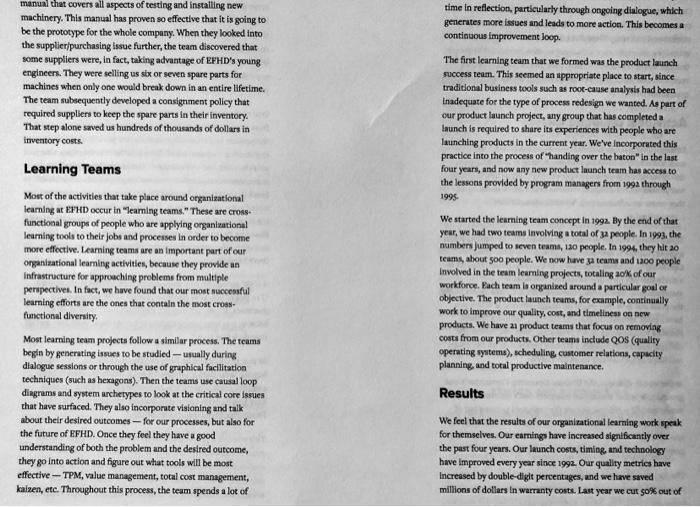
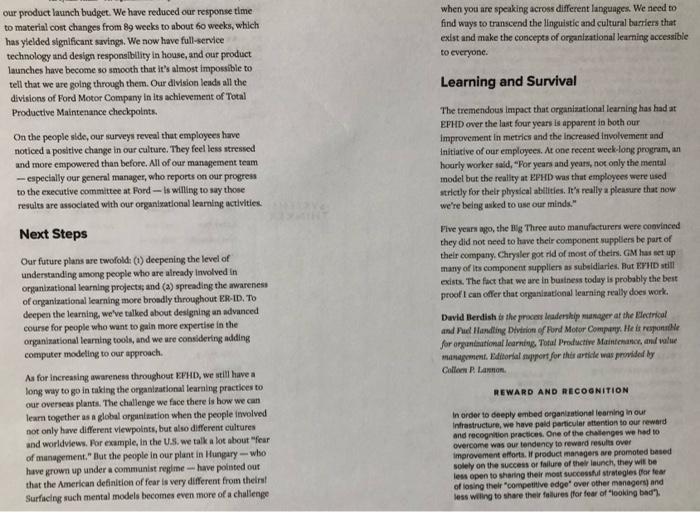
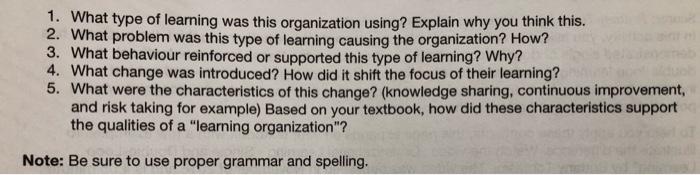
Read the case that follows then answer the questions below: The Case: Organizational Learning at Ford's EFHD In order to deeply embed organizational learning in our infrastructure, we have paid particular attention to our reward and recognition practices. One of the challenges we had to overcome was our tendency to reward results over improvement efforts. If product managers are promoted based solely on the success or failure of their launch, they will be less open to sharing their most successful strategies (for fear of losing their "competitive edge" over other managers) and less willing to share their failures (for fear of "looking bad"), both of which decrease the learning opportunities for the division as a whole. To overcome this tendency, we have tried hard to reward commitment to organizational learning. In the last three years, the program managers that have been the most honest and most open with their learning - both in terms of things gone right and things gone wrong - have been promoted. In one of those cases, the launch was less successful in terms of the hard metrics, but the manager did a wonderful job of making sure that all current and future managers knew what went well and what didn't. When these promotions were announced, the message was clear these people were recognized not only for launching their products successfully, but also for supporting organizational learning throughout EFHD. Learning is now seen as a critical metric for whether people exhibit the leadership styles necessary to be part of top management at EFHD. Source: The Organizational Learning Goal at Ford's EFHD by David Berdish for Systems Thinker THE ORGANIZATIONAL LEARNING GOAL AT FORD'S EFHD BY DAVID BERDISH Hungary, and media that are able to a engineering centers employees in Michigan Capacity Building provide England, Germany resources and capacity to meet and Japan. We are employees' demands for learning courses, projects, facilitation, and currently opening documentation plants in Brailand Mexico, and we have Involvement increase involvement of all employees in learning projects been given direction to create maximum performance in to launch plants in manufacturing operations, customer the Par Fast in the relations, and shared vision very near future. In Community Build relationships with onder to meet the other organizations and ante challenges, we know of-the-art methods and tools we need to operate in entirely new ways That's why. In 1993, we made the goal of becoming a learning organization part of our strategic initiative. Knowledge vs. Understanding lectrical and Puel Handling (PHD), the smallest E division at Ford Motor Company, employs about 7000 people and does approximately s billion in sales annually. At EFHD, we manufacture starters, alternators, Injectors, ignition colls - everything that sparks and gases your car. Over the past five years, we have faced tremendous challenges in terms of our global competitiveness, some of which have to do with our unique relationship to Ford Motor Company Even though EFHD is a division of Ford, the program managers at Ford are not obligated to purchase our parts--they are free to buy from our Japanese and German competitors. And yet, we are affected by Ford's policies and practices in ways that make it difficult for us to compete against those foreign suppliers. For example, we need to invest in best-in-class technology and a high-powered engineering corps, but as part of the Ford 2000 restructuring program, we are expected to reduce our engineering resources We also need to stay cost competitive, but because of our union workforce, we have a high wage rate relative to our competitors The Ford 2000 MULTIPLE APPROACHES program has also Culture Provide a culture based on pushed us to become trust, honesty, and openness global. In the last four years, we have Awareness Increase awareness of organizational learning by launched plants in developing communications and Northern Ireland and Our organisational learning efforts have focused on enhancing our tactical knowledge with a better understanding of the larger systems. Por example, we are very good at analysing proces that are out of control; however, a process that's completely in control might not necessarily be functioning optimally. So, in addition to working on root causes, we need to tackle common Chase issues. And while we are analyzing, we also need to synthesie, to understand the interrelationships in the system. We need to augment our accounting methods and fishbone diagrams with heges and causal loops. And in addition to knowing how to discuss, we want to be able to dialogue. Through this synthesis of traditional methods with organizational learning tools, we hope to leverage our process knowledge with a level of systems understanding that can lead to quantum Improvements teams. Upper management is also involved in the efforts. Our top 16 executives took the MIT core competency course together, and they now participate in a weekly two-hour dialogue, in which they work on their own team issues and provide a leadership cumple for the whole division Community. As another focus of our work, we are striving to build a learning community by cultivating relationshipa inside Ford, with MIT Learning Center participants, and in the Washtenaw.community. By nurturing these relationships, we feel we can medmine our learning from all opportunities, and also become good corporate cleinens both inside and outside of Ford To implement these five objectives, we have concesstrated on three activities the introductory course, dialogue circles, and learning teams Deployment: Five Areas To embed the learning organisation approach within EFHD, we have been working simultaneously in five areas culture, wwareness, capacity, Involvement, and community (see "Multiple Approaches") Culture. In order to create a work environment in which people feel empowered to learn, we need to build a culture based on trust and openness so people can feel comfortable taking rake We want to encourage people to share best practices and discourage competition between plants or product teams. Awareness. Building wareness of our activities across tema Includes communication methods such as e-mail, as well as documentation of our work and the lessons learned. It also involves Internal facilitation. We have assembled a staff of seven people who facilitate team learning projects and communicate the learning indelatives across the division. These facilitators are supported by outside people, such as MIT researchers and faculty from our local Wushtenew Community College Capacity. In order to strengthen our Internal capacity, we have developed a learning course in partnership with our local community college to this intensive, week-long course, people from our Michigan and Indiana plants come together with employees from our overies divisions to learn the basic theory und skills of the learning organisation. They also work through concrete cumples of how we have applied systems thinking and team learning at EPHD Involvement. All of the involvement in organinational loaming at our division has been done through invitation, not by mandate. We believe that this type of change simply can't be forced upon people. People who do want to get involved can do so through the learning organization course, through our Total Productive Maintenance workshops (which incorporate an organisational learning approach), or by participating in learning Introductory Course For the past several years, we have conducted an introductory class with the local community college on systems thinking and organizational learning in this course, participants learn the bune concepts of organisational leaming and gala bunde-on experience with tools such as systems archetypes and dialogue The course is taught by a professor from the college, who provides the conceptual and theoretical framework, and an EFHD facilitator, who helps participants apply those tools to real business in Currently, we are running courses per year in out Michigan facility, and we plan to host three courses in our overseas plant by the end of 1996 Classes con of about 30 people, and we try to balance attendance between hourly and salaried workers, and local and overseas employees. As part of our community-building efforts we also invite spouses of Ford employees, as well as people from local universities, city government, the community college, and other companies. This gives us a diversity of perspectives, which we find invaluable TISTI, Our Division Operating Committee also participates in each course by joining us for some of the group presentations around culture and visioning. They also take part in a dialogue so that attendees can experience a dialogue session conducted by people familiar with the process. Finally, they join us for the opening reception and participate in the celebration dinner and graduation ceremony. Activities: Dialogue Circles Strategic dialogue has become one of the most useful tools for team learning and effective problem-solving at EPHD. In part, this is because it provides an opportunity to think about issues and problems on a different level. As teams practice dialogue, they create an infrastructure for more open, honest communication Teams throughout the division use dialogue on an ongoing balls, und the practice is now becoming global. When the Division Operating Committee members visit overseas plants, they sit in a circle and talk for a day. No books. No reviews. No measurements. Just an open conversation about the laues facing the plant and how they might do things differently. When you have a plant located in a place like Belfast, Northern Ireland, there's a lot going on bexides producing parts. We believe the dialogue approach provides a broader perspective on the issues and helps us tackle them more effectively In the weekly dialogue, the Division Operating Committee's one ground rule is that committee members don't necessarily have to tackle specific problems, nor are they required to come out of the sessions with solutions. But they very often will talk about specific issues and come to a much better understanding of the problems, which leads to more effective solutions. The fact that there are no "hard" measurements in a dialogue session does not mean that this process lacks hard results. Peter Canan men all ure not a learning organization because you Mariate -11 nalamar know how to dialogue. You're a learning organisation when you know how to turn dialogue into decision." In our dialogues, there's no such thing as taking notes or trying to transcribe the conversation. But, if we do hit an "aha" we stop, have the team leader write down the insight or action item, and assign it to someone. Attaching accountability and responsibility to our processes is a key role in all of our learning organization work One of the best examples of the "hard" results that can come from this process emerged from a dialogue among members of the product launch success team. At one point in the dialogue an engineering manager asked, "Why is it that the machines always seem to work fine on Saturday?" The assumption behind his statement was that union workers are pleased when machines break down Monday through Priday, because they can get two hours' overtime to fix them. If a machine breaks down on Priday, it's even better, because the workers get all day Saturday to fix it. However, by 3:30 on Saturday afternoon they want to go home and spend the weekend with their families, so the machines don't break down. A UAW representative immediutely took offense to the remark "I'm sick of you guys implying that the UAW sabotuges the machines. It's my opinion the machines don't work at EFHD because you have young engineers buying these machines, and all they do las buy crup." At that point, someone from purchasing joined in. "You know, I buy the same darn machines for seven other divisions at Ford, and they seem to work fine everywhere else. I think you guya have trouble with equipment because you have terrible Total Productive Maintenance procedures." This was not a pleasant exchange, but the surfacing of mental models and assumptions helped pave the way for honest communication and a more effective approach to the problems that were raised. In order to address the issue of machine breakdowns, the group developed an equipment specifications 3 time in reflection, particularly through ongoing dialogue, which generates more issues and leads to more action. This becomes a continuous Improvement loop. manual that covers all aspects of testing and installing new machinery. This manual has proven so effective that it is going to be the prototype for the whole company. When they looked into the supplier/purchasing issue further, the team discovered that some suppliers were, in fact, taking advantage of EFHD's young engineers. They were selling us six or seven spare parts for machines when only one would break down in an entire lifetime. The team subsequently developed a consignment policy that required suppliers to keep the spare parts in their inventory That step alone saved us hundreds of thousands of dollars in inventory costs The first learning team that we formed was the product launch success team. This seemed an appropriate place to start, since traditional business tools such as root-cause analysis had been inadequate for the type of process redesign we wanted. As part of our product launch project, any group that has completed a launch is required to share its experiences with people who are launching products in the current year. We've incorporated this practice into the process of handing over the baton" in the last four years, and now any new product launch team has access to the lessons provided by program managers from 1992 through 1995 Learning Teams Most of the activities that take place around organizational learning at EPHD occur in learning teams." These are cross- functional groups of people who are applying organizational learning tools to their jobs and processes in order to become more effective. Learning teams are an important part of our organisational learning activities, because they provide an Infrastructure for approaching problems from multiple perspectives. In fact, we have found that our most successful learning efforts are the ones that contain the most cross- functional diversity Most learning team projects follow a similar process. The teams begin by generating issues to be studied -urally during dialogue sessions or through the use of graphical facilitation techniques (such as hexagons). Then the teams use causal loop diagrams and system archetypes to look at the critical core Issues that have surfaced. They also incorporate visioning and talk about their desired outcomes - for our processes, but also for the future of EFHD. Once they feel they have a good understanding of both the problem and the desired outcome, they go into action and figure out what tools will be most effective - TPM, value management, total cost management, kaizen, etc. Throughout this process, the team spends a lot of We started the learning team concept in 1992. By the end of that year, we had two teams involving a total of a people. In 1993, the numbers Jumped to seven teams, 130 people. In 1994, they hit 20 teams, about 500 people. We now have a teams and taco people Involved in the team learning projects, totaling o'k of our workforce. Each team la organized around a particular goal or objective. The product launch teams, for example, continually work to improve our quality, cost, and timeliness on new products. We have a product teams that focus on removing costs from our products. Other teams include QoS (quality operating systems), scheduling customer relations, capacity planning, and total productive maintenance Results We feel that the results of our organizational learning work speak for themselves. Our earnings have increased significantly over the past four years. Our launch costs, timing, and technology have improved every year since 1992. Our quality metries have Increased by double-digit percentages, and we have saved millions of dollars in warranty costs. Last year we cut 50% out of when you are speaking across different languages. We need to find ways to transcend the linguistic and cultural barriers that exist and make the concepts of organizational learning accessible to everyone. Learning and Survival our product launch budget. We have reduced our response time to material cost changes from 89 weeks to about 60 weeks, which has ylelded significant savings. We now have full-service technology and design responsibility in house, and our product launches have become so smooth that it's almost impossible to tell that we are going through them. Our division leads all the divisions of Ford Motor Company in its achievement of Total Productive Maintenance checkpoints. On the people side, our surveys reveal that employees have noticed a positive change in our culture. They feel less stressed and more empowered than before. All of our management team -- especially our general manager, who reports on our progress to the executive committee at Ford is willing to say those results are associated with our organisational learning activities. Next Steps The tremendous impact that organizational learning has had at EFHD over the last four years is apparent in both our improvement in metrics and the increased involvement and Initiative of our employees. At one recent week-long program, an hourly worker said, "For years and years, not only the mental model but the really at EPHD was that employees were used strictly for their physical abilities. It's really a pleasure that now we're being asked to use our minds." Five years ago, the Big Three auto manufacturers were convinced they did not need to have their component suppliers be part of their company. Chrysler got rid of most of theirs. GM has set up many of its component suppliers as subsidiaries. But EPHD still exists. The fact that we are in business today is probably the best proof I can offer that organizational learning really does work, Duvid Berdish is the processing at the Electrical and Pudl Handling Divinion of Ford Motor Company. He is responde for organisational learning. Total Productive Maintenance and value management. Editorial port for this artide was provided by Collon P. Lamon. Our future plans are twofold: (1) deepening the level of understanding among people who are already involved in organizational learning projects, and (a) spreading the awareness of organizational learning more broadly throughout ER-ID. To deepen the learning, we've talked about designing an advanced course for people who want to gain more expertise in the organisational learning tools, and we are considering adding computer modeling to our approach As for increasing awareness throughout EPHD, we still have a long way to go in taking the organisational learning practices to our overseas plants. The challenge we face there is how we can learn together as a global organisation when the people involved not only have different viewpoints, but also different cultures and worldviews. For example, in the U.S. we talk a lot about fear of management. But the people in our plant in Hungary-who have grown up under a communist regime have pointed out that the American definition of fear is very different from their Surfacing such mental models becomes even more of a challenge REWARD AND RECOGNITION In order to deeply embed organizational learning in our Infrastructure, we have paid particular attention to our reward and recognition practices. One of the challenges we had to overcome was our tendency to reward results over Improvement efforts. If product managers are promoted based solely on the success or failure of the launch, they will be lems open to sharing their most successful strategies for fear of losing their competitive edge over other managers and less willing to share their folures for fear of looking bad') 1. What type of learning was this organization using? Explain why you think this. 2. What problem was this type of learning causing the organization? How? 3. What behaviour reinforced or supported this type of learning? Why? 4. What change was introduced? How did it shift the focus of their learning? 5. What were the characteristics of this change? (knowledge sharing, continuous improvement, and risk taking for example) Based on your textbook, how did these characteristics support the qualities of a "learning organization"? Note: Be sure to use proper grammar and spelling READ THE CASE STUDY AND ANSWER THE FOLLOWING CASE QUESTIONS
CASE STUDY 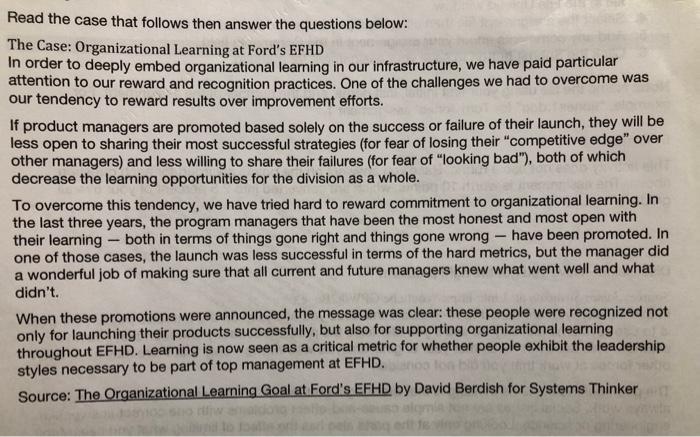
CASE QUESTIONS
Step by Step Solution
There are 3 Steps involved in it
1 Expert Approved Answer
Step: 1 Unlock

Question Has Been Solved by an Expert!
Get step-by-step solutions from verified subject matter experts
Step: 2 Unlock
Step: 3 Unlock
 Study Help