







Question: Please answer my doubts and derive the equation for b and d only (b) Derive the axisymmetric stress equilibrium equation in polar coordinates, and show
Please answer my doubts and derive the equation for b and d only 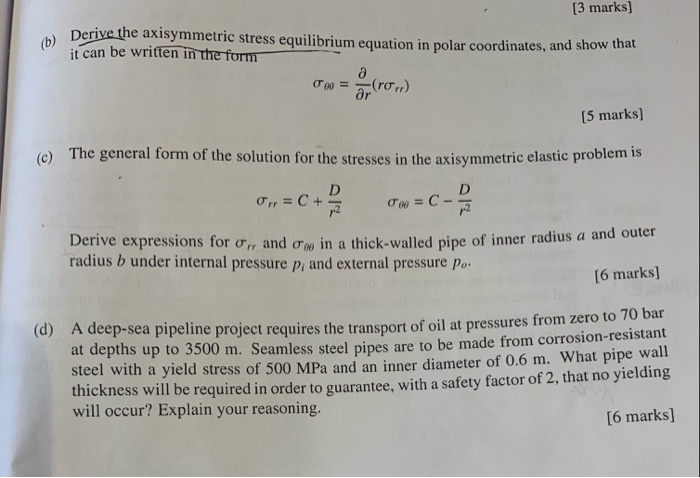
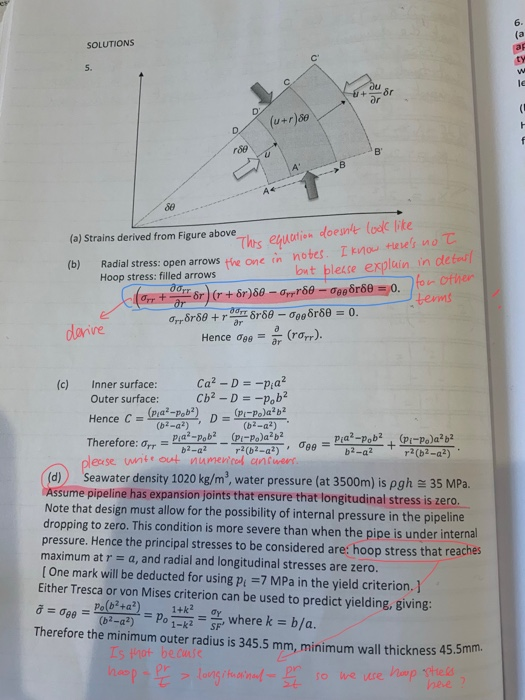
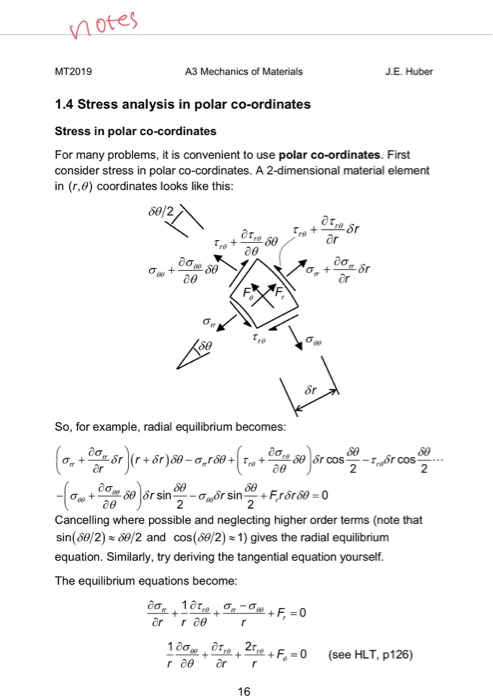
(b) Derive the axisymmetric stress equilibrium equation in polar coordinates, and show that [3 marks) it can be written in the form a 0 = [5 marks) (c) The general form of the solution for the stresses in the axisymmetric elastic problem is D 72 Derive expressions for o, and or in a thick-walled pipe of inner radius a and outer radius b under internal pressure p, and external pressure po. D 0r = C + r2 og = C [6 marks] (d) A deep-sea pipeline project requires the transport of oil at pressures from zero to 70 bar at depths up to 3500 m. Seamless steel pipes are to be made from corrosion-resistant steel with a yield stress of 500 MPa and an inner diameter of 0.6 m. What pipe wall thickness will be required in order to guarantee, with a safety factor of 2, that no yielding will occur? Explain your reasoning. [6 marks] 6 (a ar SOLUTIONS c 5. ty w le du 8r ar O (u+r) D rde " 80 (a) Strains derived from Figure above (b) This equation doesn't look like Radial stress: open arrows the one in nobes. I know Here's not but please explain in de tout 6r) (r +8r)88 - Ore - pre = 0. for other derive 08r89 +r terms Hoop stress: filled arrows dor (Oppt ar SOFT &r88 - 000880 = 0. a Hence des ar . (c) Inner surface: Ca? - D = -pa? Outer surface: Cb2-D = -poba Hence C = (pa-Pob?) DE (P-Pela2 (b2-a) (12-2) Therefore: Or pa-Pob? (1-P)a2b2 Pia2-pob2(Pi-Pa)a2 b2-a2 + 72(b2-) Joo = b2-42 r2(b2-22) please writtout numerou antwer (d) Seawater density 1020 kg/m, water pressure (at 3500m) is pgh 35 MPa. Assume pipeline has expansion joints that ensure that longitudinal stress is zero. Note that design must allow for the possibility of internal pressure in the pipeline dropping to zero. This condition is more severe than when the pipe is under internal pressure. Hence the principal stresses to be considered are: hoop stress that reaches maximum at r = a, and radial and longitudinal stresses are zero. [One mark will be deducted for using pc =7 MPa in the yield criterion.] Either Tresca or von Mises criterion can be used to predict yielding, giving: Polb2+a) 1+2 (02-42) Po 1-k2 as where k = b/a. Therefore the minimum outer radius is 345.5 mm, minimum wall thickness 45.5mm. Is that because hoop - PE longitudinal for so we use houp stress o = der = notes MT2019 A3 Mechanics of Materials J.E. Huber 1.4 Stress analysis in polar co-ordinates Stress in polar co-cordinates For many problems, it is convenient to use polar co-ordinates. First consider stress in polar co-cordinates. A 2-dimensional material element in (5,0) coordinates looks like this: 80/2 Ofer Tre ar 80 ae 0051 + 80 ao ar to Too r 2015r)(r+8r)30 -0,580 +(** So, for example, radial equilibrium becomes: co 80 80 . 80 Srcos Forcos ar ae 88 0 + r 2 + Frr 80 = 0 Cancelling where possible and neglecting higher order terms (note that sin(80/2) = 50/2 and cos(50/2) = 1) gives the radial equilibrium equation. Similarly, try deriving the tangential equation yourself. The equilibrium equations become: 20, 105,0 -0+F, = 0 ar re r 100% Orre 25 +F, = 0 (see HLT, p126) rae ar 16 (b) Derive the axisymmetric stress equilibrium equation in polar coordinates, and show that [3 marks) it can be written in the form a 0 = [5 marks) (c) The general form of the solution for the stresses in the axisymmetric elastic problem is D 72 Derive expressions for o, and or in a thick-walled pipe of inner radius a and outer radius b under internal pressure p, and external pressure po. D 0r = C + r2 og = C [6 marks] (d) A deep-sea pipeline project requires the transport of oil at pressures from zero to 70 bar at depths up to 3500 m. Seamless steel pipes are to be made from corrosion-resistant steel with a yield stress of 500 MPa and an inner diameter of 0.6 m. What pipe wall thickness will be required in order to guarantee, with a safety factor of 2, that no yielding will occur? Explain your reasoning. [6 marks] 6 (a ar SOLUTIONS c 5. ty w le du 8r ar O (u+r) D rde " 80 (a) Strains derived from Figure above (b) This equation doesn't look like Radial stress: open arrows the one in nobes. I know Here's not but please explain in de tout 6r) (r +8r)88 - Ore - pre = 0. for other derive 08r89 +r terms Hoop stress: filled arrows dor (Oppt ar SOFT &r88 - 000880 = 0. a Hence des ar . (c) Inner surface: Ca? - D = -pa? Outer surface: Cb2-D = -poba Hence C = (pa-Pob?) DE (P-Pela2 (b2-a) (12-2) Therefore: Or pa-Pob? (1-P)a2b2 Pia2-pob2(Pi-Pa)a2 b2-a2 + 72(b2-) Joo = b2-42 r2(b2-22) please writtout numerou antwer (d) Seawater density 1020 kg/m, water pressure (at 3500m) is pgh 35 MPa. Assume pipeline has expansion joints that ensure that longitudinal stress is zero. Note that design must allow for the possibility of internal pressure in the pipeline dropping to zero. This condition is more severe than when the pipe is under internal pressure. Hence the principal stresses to be considered are: hoop stress that reaches maximum at r = a, and radial and longitudinal stresses are zero. [One mark will be deducted for using pc =7 MPa in the yield criterion.] Either Tresca or von Mises criterion can be used to predict yielding, giving: Polb2+a) 1+2 (02-42) Po 1-k2 as where k = b/a. Therefore the minimum outer radius is 345.5 mm, minimum wall thickness 45.5mm. Is that because hoop - PE longitudinal for so we use houp stress o = der = notes MT2019 A3 Mechanics of Materials J.E. Huber 1.4 Stress analysis in polar co-ordinates Stress in polar co-cordinates For many problems, it is convenient to use polar co-ordinates. First consider stress in polar co-cordinates. A 2-dimensional material element in (5,0) coordinates looks like this: 80/2 Ofer Tre ar 80 ae 0051 + 80 ao ar to Too r 2015r)(r+8r)30 -0,580 +(** So, for example, radial equilibrium becomes: co 80 80 . 80 Srcos Forcos ar ae 88 0 + r 2 + Frr 80 = 0 Cancelling where possible and neglecting higher order terms (note that sin(80/2) = 50/2 and cos(50/2) = 1) gives the radial equilibrium equation. Similarly, try deriving the tangential equation yourself. The equilibrium equations become: 20, 105,0 -0+F, = 0 ar re r 100% Orre 25 +F, = 0 (see HLT, p126) rae ar 16 Step by Step Solution
There are 3 Steps involved in it
1 Expert Approved Answer
Step: 1 Unlock

Question Has Been Solved by an Expert!
Get step-by-step solutions from verified subject matter experts
Step: 2 Unlock
Step: 3 Unlock
 Study Help