







Question: Process Modelling 1. This module aims to teach you to break down many engineering or every day life processes into smaller problems. Models can then
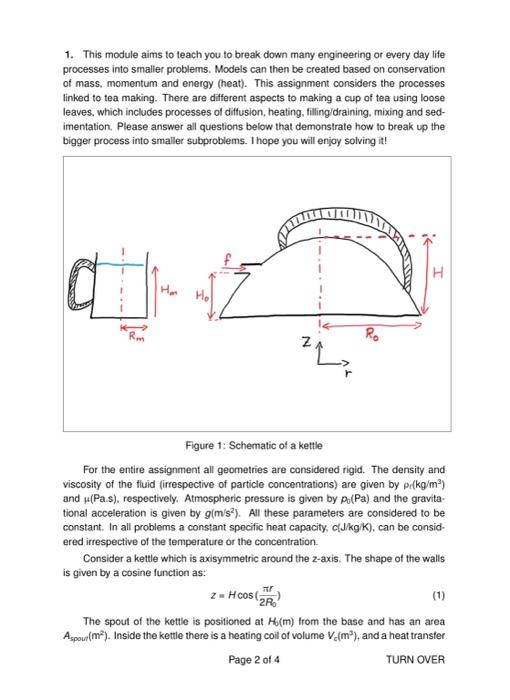
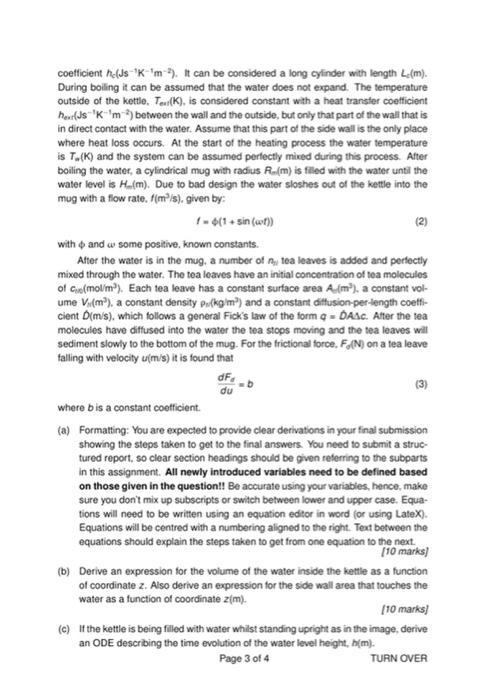
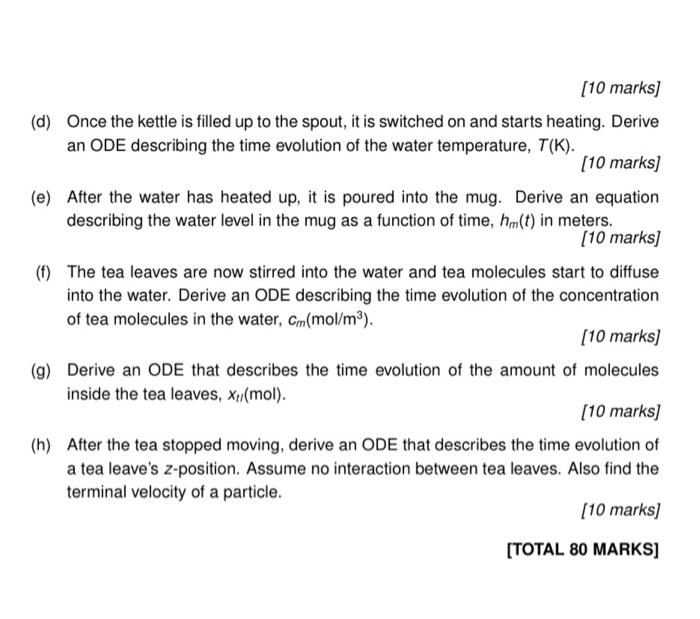
1. This module aims to teach you to break down many engineering or every day life processes into smaller problems. Models can then be created based on conservation of mass, momentum and energy (heat). This assignment considers the processes linked to tea making. There are different aspects to making a cup of tea using loose leaves, which includes processes of diffusion, heating, filling draining, mixing and sed- imentation. Please answer all questions below that demonstrate how to break up the bigger process into smaller subproblems. I hope you will enjoy solving it! H a 6 N Figure 1: Schematic of a kettle For the entire assignment all geometries are considered rigid. The density and viscosity of the fluid (irrespective of particle concentrations) are given by pi(kg/m?) and (Pa.s), respectively. Atmospheric pressure is given by po(Pa) and the gravita tional acceleration is given by g(m's?). All these parameters are considered to be constant. In all problems a constant specific heat capacity, clJ/kg/K), can be consid- ered irrespective of the temperature or the concentration Consider a kettle which is axisymmetric around the z-axis. The shape of the walls is given by a cosine function as: 2 - Host 2R The spout of the kettle is positioned at Hy(m) from the base and has an area Aspour(m2). Inside the kettle there is a heating coil of volume Ve{m), and a heat transfer Page 2 of 4 TURN OVER coefficient helds-K-m . It can be considered a long cylinder with length L.(m). During boiling it can be assumed that the water does not expand. The temperature outside of the kettle. T(K), is considered constant with a heat transfer coefficient heur(js"'K 'm) between the wail and the outside, but only that part of the wall that is in direct contact with the water. Assume that this part of the side wail is the only place where heat loss occurs. At the start of the heating process the water temperature is T.(K) and the system can be assumed perfectly mixed during this process. After boiling the water, a cylindrical mug with radius R.(m) is filled with the water until the water level is H.(m). Due to bad design the water sloshes out of the kettle into the mug with a flow rate. f(m/s). given by: 1 - 6(1 + sin(wr)) (2) with and w some positive, known constants. After the water is in the mug, a number of tea leaves is added and perfectly mixed through the water. The tea leaves have an initial concentration of tea molecules of co(moum). Each tea leave has a constant surface area A (m), a constant vol- ume (m), a constant density pu(km) and a constant diffusion per-length coeffi- cient Dimus), which follows a general Fick's law of the form a- DAAC. After the tea molecules have diffused into the water the tea stops moving and the tea leaves will sediment slowly to the bottom of the mug. For the frictional force. F.(N) on a tea leave falling with velocity u(m/s) it is found that (3) where is a constant coefficient (a) Formatting: You are expected to provide clear derivations in your final submission showing the steps taken to get to the final answers. You need to submit a struc tured report, so clear section Headings should be given referring to the subparts In this assignment. All newly introduced variables need to be defined based on those given in the question!! Be accurate using your variables, hence, make sure you don't mix up subscripts or switch between lower and upper case. Equa- tions will need to be written using an equation editor in word for using Latex). Equations will be centred with a numbering aligned to the right. Text between the equations should explain the steps taken to get from one equation to the next [10 marks) (b) Derive an expression for the volume of the water inside the kettle as a function of coordinate z. Also derive an expression for the side wall area that touches the water as a function of coordinate z(m). [10 marks) (C) If the kettle is being filled with water whilst standing upright as in the image, derive an ODE describing the time evolution of the water level height, hm). Page 3 of 4 TURN OVER dF. du (10 marks) (d) Once the kettle is filled up to the spout, it is switched on and starts heating. Derive an ODE describing the time evolution of the water temperature, T(K). [10 marks] (e) After the water has heated up, it is poured into the mug. Derive an equation describing the water level in the mug as a function of time, hm(t) in meters. (10 marks) (1) The tea leaves are now stirred into the water and tea molecules start to diffuse into the water. Derive an ODE describing the time evolution of the concentration of tea molecules in the water, cm(mol/m). (10 marks) (9) Derive an ODE that describes the time evolution of the amount of molecules inside the tea leaves, X/(mol). (10 marks) (h) After the tea stopped moving, derive an ODE that describes the time evolution of a tea leave's z-position. Assume no interaction between tea leaves. Also find the terminal velocity of a particle. [10 marks) [TOTAL 80 MARKS] 1. This module aims to teach you to break down many engineering or every day life processes into smaller problems. Models can then be created based on conservation of mass, momentum and energy (heat). This assignment considers the processes linked to tea making. There are different aspects to making a cup of tea using loose leaves, which includes processes of diffusion, heating, filling draining, mixing and sed- imentation. Please answer all questions below that demonstrate how to break up the bigger process into smaller subproblems. I hope you will enjoy solving it! H a 6 N Figure 1: Schematic of a kettle For the entire assignment all geometries are considered rigid. The density and viscosity of the fluid (irrespective of particle concentrations) are given by pi(kg/m?) and (Pa.s), respectively. Atmospheric pressure is given by po(Pa) and the gravita tional acceleration is given by g(m's?). All these parameters are considered to be constant. In all problems a constant specific heat capacity, clJ/kg/K), can be consid- ered irrespective of the temperature or the concentration Consider a kettle which is axisymmetric around the z-axis. The shape of the walls is given by a cosine function as: 2 - Host 2R The spout of the kettle is positioned at Hy(m) from the base and has an area Aspour(m2). Inside the kettle there is a heating coil of volume Ve{m), and a heat transfer Page 2 of 4 TURN OVER coefficient helds-K-m . It can be considered a long cylinder with length L.(m). During boiling it can be assumed that the water does not expand. The temperature outside of the kettle. T(K), is considered constant with a heat transfer coefficient heur(js"'K 'm) between the wail and the outside, but only that part of the wall that is in direct contact with the water. Assume that this part of the side wail is the only place where heat loss occurs. At the start of the heating process the water temperature is T.(K) and the system can be assumed perfectly mixed during this process. After boiling the water, a cylindrical mug with radius R.(m) is filled with the water until the water level is H.(m). Due to bad design the water sloshes out of the kettle into the mug with a flow rate. f(m/s). given by: 1 - 6(1 + sin(wr)) (2) with and w some positive, known constants. After the water is in the mug, a number of tea leaves is added and perfectly mixed through the water. The tea leaves have an initial concentration of tea molecules of co(moum). Each tea leave has a constant surface area A (m), a constant vol- ume (m), a constant density pu(km) and a constant diffusion per-length coeffi- cient Dimus), which follows a general Fick's law of the form a- DAAC. After the tea molecules have diffused into the water the tea stops moving and the tea leaves will sediment slowly to the bottom of the mug. For the frictional force. F.(N) on a tea leave falling with velocity u(m/s) it is found that (3) where is a constant coefficient (a) Formatting: You are expected to provide clear derivations in your final submission showing the steps taken to get to the final answers. You need to submit a struc tured report, so clear section Headings should be given referring to the subparts In this assignment. All newly introduced variables need to be defined based on those given in the question!! Be accurate using your variables, hence, make sure you don't mix up subscripts or switch between lower and upper case. Equa- tions will need to be written using an equation editor in word for using Latex). Equations will be centred with a numbering aligned to the right. Text between the equations should explain the steps taken to get from one equation to the next [10 marks) (b) Derive an expression for the volume of the water inside the kettle as a function of coordinate z. Also derive an expression for the side wall area that touches the water as a function of coordinate z(m). [10 marks) (C) If the kettle is being filled with water whilst standing upright as in the image, derive an ODE describing the time evolution of the water level height, hm). Page 3 of 4 TURN OVER dF. du (10 marks) (d) Once the kettle is filled up to the spout, it is switched on and starts heating. Derive an ODE describing the time evolution of the water temperature, T(K). [10 marks] (e) After the water has heated up, it is poured into the mug. Derive an equation describing the water level in the mug as a function of time, hm(t) in meters. (10 marks) (1) The tea leaves are now stirred into the water and tea molecules start to diffuse into the water. Derive an ODE describing the time evolution of the concentration of tea molecules in the water, cm(mol/m). (10 marks) (9) Derive an ODE that describes the time evolution of the amount of molecules inside the tea leaves, X/(mol). (10 marks) (h) After the tea stopped moving, derive an ODE that describes the time evolution of a tea leave's z-position. Assume no interaction between tea leaves. Also find the terminal velocity of a particle. [10 marks) [TOTAL 80 MARKS]
Step by Step Solution
There are 3 Steps involved in it

Get step-by-step solutions from verified subject matter experts
 Study Help